
[Paper Review] Exact power spectrum in a minimal hybrid model of stochastic gene expression oscillations
This paper presents an exact analytical solution for the power spectrum of stochastic gene expression oscillations in a minimal hybrid model combining discrete gene switching with continuous protein dynamics. By solving the Fokker-Planck equation for the protein concentration, the authors derive exact expressions for the autocorrelation function and power spectrum, revealing a triphasic stochastic bifurcation in negative feedback loops that explains the emergence of sustained noise-induced oscillations.
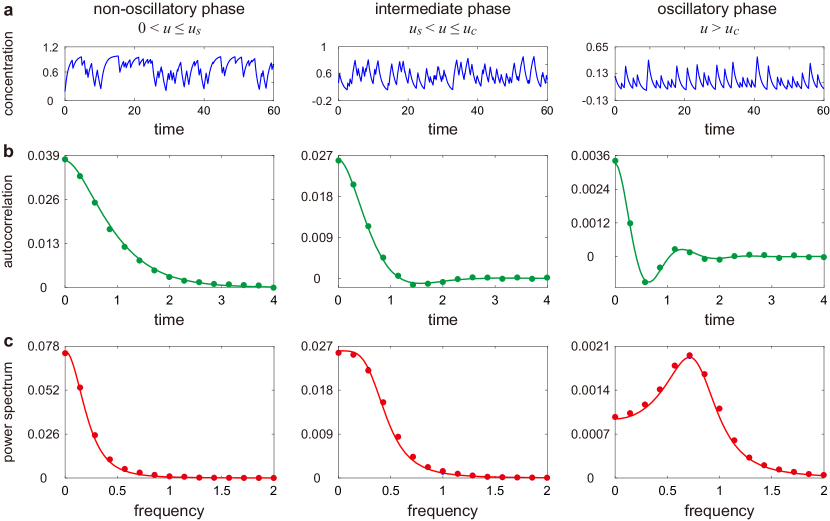
Stochastic oscillations in individual cells are usually characterized by a non-monotonic power spectrum with an oscillatory autocorrelation function. Here we develop an analytical approach of stochastic oscillations in a minimal hybrid model of stochastic gene expression including promoter state switching, protein synthesis and degradation, as well as a genetic feedback loop. The oscillations observed in our model are noise-induced since the deterministic theory predicts stable fixed points. The autocorrelated function, power spectrum, and steady-state distribution of protein concentration fluctuations are computed in closed form without making any approximations. Using the exactly solvable model, we illustrate sustained oscillations as a circular motion along a stochastic hysteresis loop induced by gene state switching. A triphasic stochastic bifurcation upon the increasing strength of negative feedback is observed, which reveals how stochastic bursts evolve into stochastic oscillations. In our model, oscillations tend to occur when the protein is relatively stable and when gene switching is relatively slow. Translational bursting is found to enhance the robustness and broaden the region of stochastic oscillations. These results provide deeper insights into R. Thomas' two conjectures for single-cell gene expression kinetics.
Motivation & Objective
- To develop an exact analytical framework for stochastic oscillations in gene expression, overcoming limitations of approximate methods like the linear noise approximation.
- To resolve the long-standing gap in exact theory for single-cell stochastic oscillations, particularly in the presence of feedback loops.
- To provide a mechanistic explanation for René Thomas’s conjectures on feedback and oscillations using a minimal hybrid model.
- To quantify how noise induces sustained oscillations through a stochastic hysteresis loop driven by gene state switching.
- To extend the analysis to include translational bursting, capturing biologically relevant features of gene expression.
Proposed method
- Formulates a hybrid stochastic model where gene state switches are discrete, while protein concentration evolves continuously via a stochastic differential equation.
- Derives the Fokker-Planck equation for the joint probability density of protein concentration and gene state, enabling exact computation of moments.
- Computes the autocorrelation function and power spectrum by solving a system of linear ODEs for the first and second moments of protein concentration.
- Uses matrix exponential methods and eigenvalue decomposition to derive closed-form expressions for the autocorrelation function as a sum of exponentials.
- Applies Fourier transform to the autocorrelation function to obtain the exact analytical power spectrum in the frequency domain.
- Extends the framework to include translational bursting by incorporating a general jump measure for burst size and frequency in the moment equations.

Experimental results
Research questions
- RQ1Can an exact analytical power spectrum be derived for stochastic gene expression oscillations in a minimal hybrid model with feedback?
- RQ2How does the strength of negative feedback influence the emergence of sustained oscillations in the presence of intrinsic noise?
- RQ3What is the role of gene state switching in generating a stochastic hysteresis loop that supports oscillations?
- RQ4How does translational bursting affect the autocorrelation and power spectrum of protein concentration fluctuations?
- RQ5Can the exact solution explain the mechanistic basis of Thomas’s two conjectures on feedback and oscillations?
Key findings
- The exact power spectrum is derived as a sum of two Lorentzian peaks, corresponding to the two eigenvalues of the moment dynamics matrix, enabling precise characterization of oscillatory behavior.
- In the absence of feedback or with positive feedback, sustained oscillations do not emerge, confirming that negative feedback is necessary for noise-induced oscillations.
- For negative feedback, a triphasic stochastic bifurcation is revealed: increasing feedback strength first suppresses noise, then induces oscillations, and finally damps them, with a peak in power spectrum at intermediate strengths.
- The autocorrelation function is monotonically decreasing at t=0, indicating that fluctuations are anti-correlated at short times, a signature of oscillatory dynamics.
- The steady-state protein concentration variance is given by a closed-form expression involving feedback strength, degradation rate, and burst parameters, with exact dependence on system size and noise intensity.
- The inclusion of translational bursting modifies the moment equations by introducing a second moment of burst size, leading to a modified power spectrum with enhanced low-frequency components.
Better researchstarts right now
From reading papers to final review, dramatically reduce your research time.
No credit card · Free plan available
This review was created by AI and reviewed by human editors.