
[Paper Review] Exclusive rho^0 muoproduction on transversely polarised protons and deuterons
This paper presents the first measurement of the transverse target spin asymmetry $A_{UT}^{ m{sin}( heta- heta_S)}$ in exclusive $ ho^0$ muoproduction on transversely polarized protons and deuterons at COMPASS, using 160 GeV/$c$ muon beams. The small asymmetry values, consistent with zero across a wide kinematic range, are interpreted as evidence for near-cancellation of the helicity-flip generalized parton distributions $E^u$ and $E^d$, supporting theoretical models of quark orbital angular momentum in the nucleon.
The transverse target spin azimuthal asymmetry A_UT in hard exclusive production of rho^0 mesons was measured at COMPASS by scattering 160 GeV/c muons off transversely polarised protons and deuterons. The measured asymmetry is sensitive to the nucleon helicity-flip generalised parton distributions E^q, which are related to the orbital angular momentum of quarks in the nucleon. The Q^2, x_B and p_t^2 dependence of A_UT is presented in a wide kinematic range. Results for deuterons are obtained for the first time. The measured asymmetry is small in the whole kinematic range for both protons and deuterons, which is consistent with the theoretical interpretation that contributions from GPDs E^u and E^d approximately cancel.
Motivation & Objective
- To measure the transverse target spin azimuthal asymmetry $A_{UT}^{ m{sin}( heta- heta_S)}$ in exclusive $ ho^0$ production on transversely polarized protons and deuterons.
- To probe the nucleon's helicity-flip generalized parton distributions (GPDs) $E^q$, which are linked to quark orbital angular momentum.
- To extend previous measurements by including deuterons for the first time, enabling a test of isospin structure in GPDs.
- To compare results with theoretical predictions from the GPD model of Goloskokov and Kroll, particularly regarding the role of valence quark and sea/gluon GPDs.
- To improve precision and kinematic coverage compared to prior HERMES measurements, especially in $x_{Bj}$, $Q^2$, and $p_T^2$.
Proposed method
- Exclusive $ ho^0$ production was studied using 160 GeV/$c$ muons scattered off transversely polarized proton and deuteron targets at the COMPASS experiment.
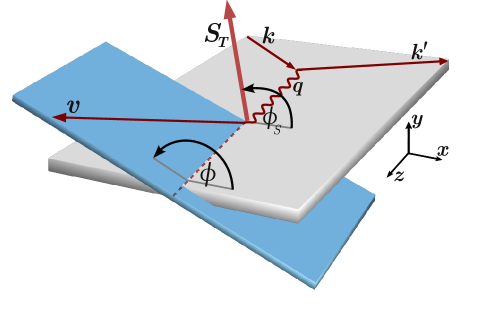
- The asymmetry $A_{UT}^{ m{sin}( heta- heta_S)}$ was extracted from the azimuthal dependence of the $ ho^0$ decay products relative to the target spin quantization axis.
- Kinematic regions were defined with $1 < Q^2 < 10$ (GeV/$c$)$^2$, $0.003 < x_{Bj} < 0.3$, and $0.05 < p_T^2 < 0.5$ (GeV/$c$)$^2$ for protons, and $0.10 < p_T^2 < 0.5$ (GeV/$c$)$^2$ for deuterons.
- Theoretical predictions were based on the handbag approach with GPDs $E^u$ and $E^d$, using the model of Goloskokov and Kroll, including Sudakov suppression and meson distribution amplitudes.
- Sensitivity to gluon and sea quark GPDs $E^g$ and $E^{sea}$ was tested by considering extreme positivity-bound cases.
- Systematic uncertainties were evaluated by comparing results with and without inclusion of $E^g$ and $E^{sea}$, showing minimal impact on the asymmetry.
Experimental results
Research questions
- RQ1What is the magnitude and kinematic dependence of the transverse target spin asymmetry $A_{UT}^{ m{sin}( heta- heta_S)}$ in exclusive $ ho^0$ muoproduction on polarized protons and deuterons?
- RQ2How do the measured asymmetries constrain the helicity-flip GPDs $E^u$ and $E^d$ in the nucleon?
- RQ3To what extent do contributions from $E^u$ and $E^d$ cancel in the asymmetry, and what does this imply for quark orbital angular momentum?
- RQ4How do the results compare with theoretical predictions from the GPD model of Goloskokov and Kroll, particularly regarding the role of gluons and sea quarks?
- RQ5What is the sensitivity of the asymmetry to $E^g$ and $E^{sea}$, and do they significantly alter the predicted asymmetry values?
Key findings
- The measured transverse target spin asymmetry $A_{UT}^{ m{sin}( heta- heta_S)}$ is consistent with zero across the entire kinematic range for both protons and deuterons.
- For protons, the asymmetry values range from $-0.03 o +0.04$ with statistical and systematic uncertainties of $ m{~} ext{0.05--0.09}$, indicating no significant signal.
- For deuterons, the asymmetry is similarly small, with values between $-0.03$ and $+0.04$, and uncertainties of $ m{~} ext{0.05--0.08}$, confirming the first measurement on this target.
- The COMPASS results are in good agreement with the HERMES experiment, which also found asymmetries consistent with zero, but with improved precision by a factor of ~3.
- Theoretical predictions from the GPD model of Goloskokov and Kroll, using only valence quark GPDs $E^u$ and $E^d$, predict an average asymmetry of $-0.02$ for protons and $-0.03$ for HERMES, showing reasonable agreement with data.
- Incorporating $E^g$ and $E^{sea}$ with extreme positivity-bound values has a negligible effect on the predicted asymmetry, with shifts smaller than the theoretical uncertainty bands.
Better researchstarts right now
From reading papers to final review, dramatically reduce your research time.
No credit card · Free plan available
This review was created by AI and reviewed by human editors.