
[Paper Review] Exploring chemical enrichment of the intracluster medium with the Line Emission Mapper
The Line Emission Mapper (LEM) probe mission will enable high-resolution, spatially resolved X-ray spectroscopy of the soft X-ray band to map the chemical enrichment of the intracluster medium (ICM) across Mpc scales. By observing nearby relaxed clusters and serendipitously discovered high-redshift protoclusters, LEM will measure abundances of ten key elements, providing unprecedented constraints on the timing, sources, and universality of cosmic metal enrichment.
Synthesized in the cores of stars and supernovae, most metals disperse over cosmic scales and are ultimately deposited well outside the gravitational potential of their host galaxies. Since their presence is well visible through their X-ray emission lines in the hot gas pervading galaxy clusters, measuring metal abundances in the intracluster medium (ICM) offers us a unique view of chemical enrichment of the Universe as a whole. Despite extraordinary progress in the field thanks to four decades of X-ray spectroscopy using CCD (and gratings) instruments, understanding the precise stellar origins of the bulk of metals, and when the latter were mixed on Mpc scales, requires an X-ray mission capable of spatial, non-dispersive high resolution spectroscopy covering at least the soft X-ray band over a large field of view. In this White Paper, we demonstrate how the Line Emission Mapper (LEM) probe mission concept will revolutionize our current picture of the ICM enrichment. Specifically, we show that LEM will be able to (i) spatially map the distribution of ten key chemical elements out to the virial radius of a nearby relaxed cluster and (ii) measure metal abundances in serendipitously discovered high-redshift protoclusters. Altogether, these key observables will allow us to constrain the chemical history of the largest gravitationally bound structures of the Universe. They will also solve key questions such as the universality of the initial mass function (IMF) and the initial metallicity of the stellar populations producing these metals, as well as the relative contribution of asymptotic giant branch (AGB) stars, core-collapse, and Type Ia supernovae to enrich the cosmic web over Mpc scales. Concrete observing strategies are also briefly discussed.
Motivation & Objective
- To address the unresolved question of when and how the bulk of cosmic metals were dispersed into the large-scale structure of the universe.
- To determine the relative contributions of different stellar populations—AGB stars, core-collapse, and Type Ia supernovae—to the chemical enrichment of the cosmic web.
- To test the universality of the initial mass function (IMF) and the initial metallicity of stellar populations via spatially resolved metal abundance measurements in clusters and groups.
- To investigate the chemical history of galaxy clusters by combining deep observations of nearby relaxed clusters with serendipitous detections of high-redshift protoclusters.
- To enable a comprehensive, multi-scale view of metal distribution and mixing in the ICM, including effects from AGN feedback, mergers, and gas sloshing.
Proposed method
- Conduct a 2 Ms deep observation of a relaxed cluster at redshift z ≈ 0.07–0.08 to map spatially resolved abundances of ten key elements (e.g., Fe, O, Ne, Mg, Si, S, Ar, Ca, Sc, Ti) in the soft X-ray band.
- Leverage the large field of view and high energy resolution of LEM to detect and analyze X-ray emission lines from highly ionized ions in the hot ICM, enabling precise abundance measurements.
- Use synergy between deep cluster observations and serendipitous detections of high-redshift protoclusters to trace metal enrichment at early cosmic times.
- Perform comparative analysis between massive clusters and lower-mass galaxy groups to assess the universality of metal enrichment across different mass scales.
- Apply advanced spectral modeling and atomic data to interpret line emissivity and abundance profiles, accounting for temperature and density variations in the ICM.
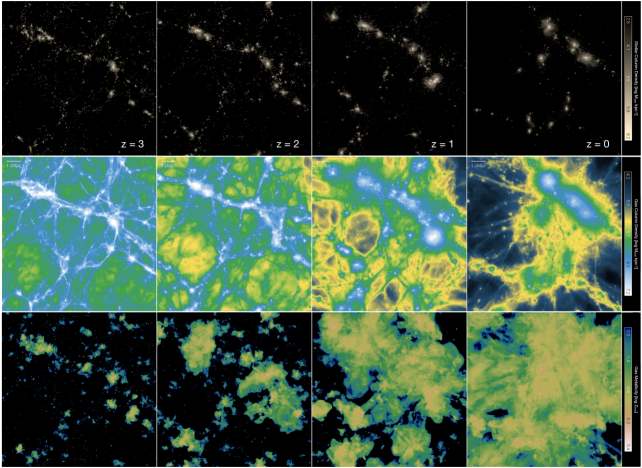
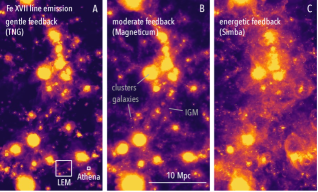
- Use simulations (e.g., TNG100-1, Magneticum, Simba) to interpret expected LEM observations and validate the sensitivity and dynamic range of the mission concept.
Experimental results
Research questions
- RQ1When did galaxies enrich the intracluster medium, and what are the signatures of this enrichment in the outskirts of nearby clusters and in high-redshift protoclusters?
- RQ2What are the relative contributions of asymptotic giant branch (AGB) stars, core-collapse supernovae, and Type Ia supernovae to the metal enrichment of the cosmic web on Mpc scales?
- RQ3Is the initial mass function (IMF) universal across different mass scales and cosmic epochs, as inferred from metal abundance profiles in clusters and groups?
- RQ4How universal is the iron enrichment history of the ICM, and what does the O/Fe ratio reveal about the timing and nature of early enrichment processes?
- RQ5How do feedback mechanisms such as AGN jets, X-ray cavities, and gas sloshing influence the spatial distribution and mixing of metals in the ICM?
Key findings
- LEM will enable spatial mapping of ten key chemical elements (Fe, O, Ne, Mg, Si, S, Ar, Ca, Sc, Ti) in the ICM out to the virial radius of a nearby relaxed cluster, providing the first comprehensive view of large-scale metal distribution.
- A deep 2 Ms observation of a z ≈ 0.07–0.08 cluster will allow precise measurement of metal abundances and their radial profiles, with sensitivity to variations in Fe, O, and O/Fe ratios.
- LEM will detect and characterize metal abundances in serendipitously discovered high-redshift protoclusters, offering direct constraints on the epoch of early enrichment.
- The combination of cluster and group observations (including two additional Ms dedicated to four systems: two groups and two massive clusters) will allow a comparative study of metal abundance distributions across mass scales.
- The higher line emissivity in cooler, lower-mass groups compensates for their lower X-ray brightness, making them viable targets for high-resolution abundance mapping with LEM.
- LEM’s capabilities will complement XRISM (core spectroscopy) and NewAthena (deep, high-energy band sensitivity), enabling a full-spectrum, multi-scale understanding of cosmic metal enrichment.
Better researchstarts right now
From reading papers to final review, dramatically reduce your research time.
No credit card · Free plan available
This review was created by AI and reviewed by human editors.