
[Paper Review] Exploring Lead Free Mixed Halide Double Perovskites Solar Cell
This study investigates lead-free mixed halide double perovskites, specifically Cs₂TiI₆₋ₓBrₓ, as absorber layers in perovskite solar cells using SCAPS-1D simulations. It identifies FTO/Cu₂O/Cs₂TiI₅Br₁/WS₂ as the most efficient configuration (19.03% efficiency), while Cs₂TiI₂Br₄ offers the best balance of efficiency (13.31%) and structural stability, validated via an improved tolerance factor (τ).
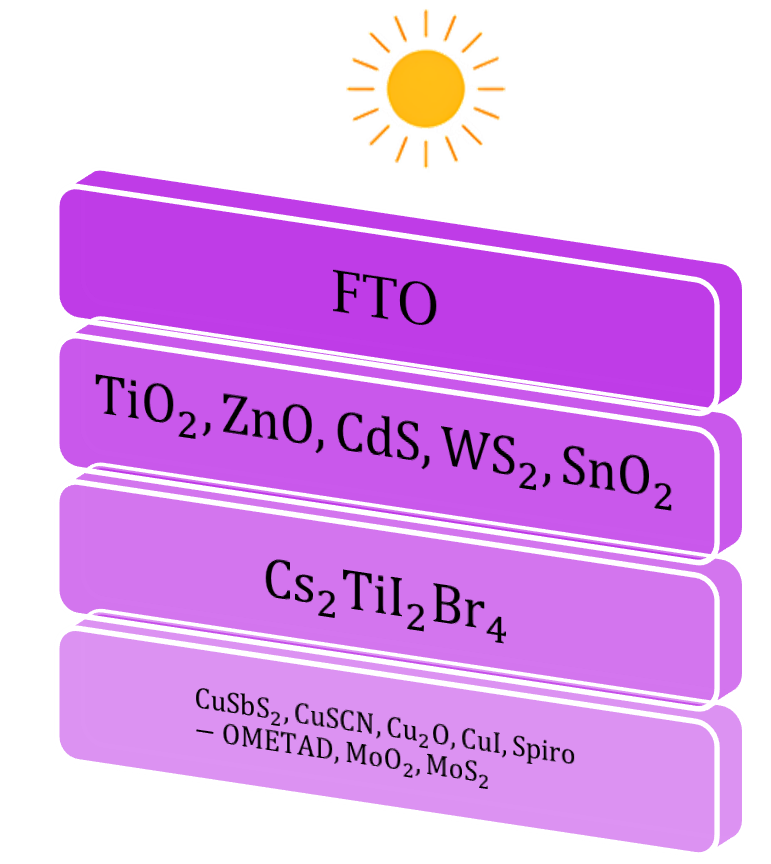
The significant surge in energy use and escalating environmental concerns have sparked worldwide interest towards the study and implementation of solar cell technology. Perovskite solar cells (PSCs) have garnered remarkable attention as an emerging third-generation solar cell technology. This paper presents an in-depth analysis of lead-free mixed halide double perovskites in the context of their potential uses in solar cell technology. Through the previous studies of various mixed halide double perovskite materials as potential absorber layer materials, it has been observed that Cs$_2$TiI$_{6-x}$Br$_x$ possesses promising characteristics. In this study, simulations were conducted using SCAPS-1D software to explore all possible combinations for x= 0 to 6. The materials for the Hole Transport Layer (HTL) and Electron Transport Layer (ETL) and absorber layer, along with their optimal thicknesses, are selected to yield the most promising results in terms of open-circuit voltage (V$_{oc}$), short-circuit current density (J$_{sc}$), fill factor (FF), and power conversion efficiency. A novel tolerance factor is employed to assess structural stability of perovskites. FTO/Cu$_2$O/Cs$_2$TiI$_5$Br$_1$/WS$_2$ emerges as the best combination in terms of the efficiency with 19.03% but FTO/Cu$_2$O/Cs$_2$TiI$_2$Br$_4$/WS$_2$ shows good stability with 13.31% efficiency.
Motivation & Objective
- To evaluate lead-free mixed halide double perovskites as viable absorber materials for third-generation solar cells.
- To identify optimal electron transport layer (ETL), hole transport layer (HTL), and absorber layer combinations for enhanced efficiency and stability.
- To assess structural stability using an improved tolerance factor (τ) beyond the conventional Goldschmidt factor.
- To determine the optimal composition of Cs₂TiI₆₋ₓBrₓ (x = 0 to 6) for maximum power conversion efficiency and stability.
- To balance efficiency and defect tolerance by analyzing the impact of defect density and layer thickness on device performance.
Proposed method
- Simulations were performed using SCAPS-1D to model PSC devices with varying ETL, HTL, and absorber layer configurations.
- The improved tolerance factor τ = (r_X / r_B) - n_A(n_A - (r_A / r_B) / ln(r_A / r_B)) was applied to predict structural stability of Cs₂TiI₆₋ₓBrₓ.
- Material parameters such as bandgap, electron affinity, dielectric constant, carrier mobility, and defect density (10¹⁵ cm⁻³) were systematically varied.
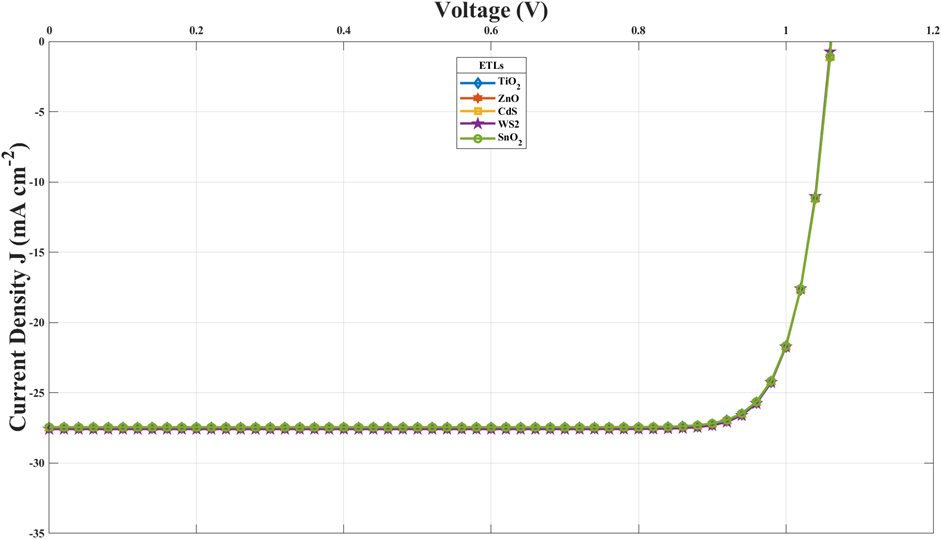
- J-V characteristics and spectral responsivity were analyzed across x = 0 to 6 to evaluate performance trends.
- Optimal thicknesses for ETL and HTL were determined by simulating efficiency across multiple thickness values.
- Defect density and carrier concentration were tuned to evaluate their impact on open-circuit voltage (Voc), short-circuit current (Jsc), fill factor (FF), and efficiency.
Experimental results
Research questions
- RQ1Which combination of ETL, HTL, and absorber layer yields the highest power conversion efficiency in lead-free double perovskite solar cells?
- RQ2How does varying the bromine content (x) in Cs₂TiI₆₋ₓBrₓ affect the open-circuit voltage and current density?
- RQ3To what extent does the improved tolerance factor τ predict the structural stability of mixed halide double perovskites?
- RQ4What is the optimal absorber layer thickness and defect density that maximizes efficiency while maintaining stability?
- RQ5Which material composition offers the best trade-off between high efficiency and high structural stability?
Key findings
- FTO/Cu₂O/Cs₂TiI₅Br₁/WS₂ achieved the highest power conversion efficiency of 19.03% among all configurations tested.
- Cs₂TiI₂Br₄ demonstrated the best balance of efficiency (13.31%) and structural stability, with a τ value of 4.167 and stability probability P(τ) = 0.540.
- The open-circuit voltage (Voc) remained relatively stable for x = 1 to 5, but dropped significantly at x = 0 and x = 6, indicating compositional sensitivity.
- Short-circuit current density (Jsc) decreased with increasing x from 1 to 5, indicating reduced photon absorption efficiency in higher bromine content compositions.
- The fill factor (FF) remained high (80–87%) across most compositions, with only minor sensitivity to defect density, indicating robustness against moderate defects.
- Cu₂O emerged as the most effective HTL, outperforming other HTL materials like MoO₂ and CuSbS₂, especially at optimal acceptor doping of 8.5 × 10¹⁹ cm⁻³.
Better researchstarts right now
From reading papers to final review, dramatically reduce your research time.
No credit card · Free plan available
This review was created by AI and reviewed by human editors.