
[Paper Review] Exploring the spectrum of stochastic gravitational-wave anisotropies with pulsar timing arrays
This paper presents an analytical model for stochastic gravitational-wave background anisotropies from supermassive black-hole binaries (SMBHBs) in pulsar timing arrays (PTAs), showing that anisotropies are frequency-dependent due to shot noise and enhanced by dynamical processes like stellar scattering. The key result is that anisotropy measurements provide new information beyond the isotropic background, particularly through the second moment of the GW amplitude distribution, and predict significant polarization anisotropies due to binary inclination angles.
Anisotropies in the nanohertz gravitational-wave background are a compelling next target for pulsar timing arrays (PTAs). Measurements or informative upper limits to the anisotropies are expected in the near future and can offer important clues about the origin of the background and the properties of the sources. Given that each source is expected (in the simplest scenario of circular inspirals) to emit at a fixed frequency, the anisotropy will most generally vary from one frequency to another. The main result presented in this work is an analytical model for the anisotropies produced by a population of inspiralling supermassive black-hole binaries (SMBHBs). This model can be immediately connected with parametrizations of the SMBHB mass function and can be easily expanded to account for new physical processes taking place within the PTA frequency band. We show that a variety of SMBHB models predict significant levels of anistropy at the highest frequencies accessible to PTA observations and that measurements of anisotropies can offer new information regarding this population beyond the isotropic component. We also model the impact of additional dynamical effects driving the binary towards merger and show that, if these processes are relevant within the PTA band, the detectability of anisotropies relative to the isotropic background will be enhanced. Finally, we use the formalism presented in this work to predict the level anisotropy of the circular and linear polarizations of the SGWB due to the distribution of binary orientation angles with respect to the line of sight.
Motivation & Objective
- To develop a predictive analytical framework for gravitational-wave background anisotropies in pulsar timing arrays (PTAs) due to finite-source shot noise.
- To connect anisotropy predictions directly with astrophysical parameters such as the SMBHB mass function and population distribution.
- To investigate how dynamical processes like stellar scattering and gas interactions affect the detectability of anisotropies relative to the isotropic background.
- To compute the expected levels of linear and circular polarization anisotropies arising from the angular distribution of SMBHBs.
Proposed method
- Derives anisotropy power spectra using a shot-noise model for a population of SMBHBs, with frequency-dependent source counts.
- Uses a parametrization of the SMBHB mass function to compute the variance of the GW amplitude field, linking it to the second moment of the distribution.
- Applies spherical harmonic decomposition to model intensity and polarization anisotropies, with orientation angles distributed isotropically.
- Incorporates the effects of additional inspiral mechanisms (e.g., stellar scattering, gas drag) by modifying the effective number density of sources in the PTA band.
- Computes polarization anisotropies via angular integrals over binary inclination angles, deriving the variance of circular and linear polarization components.
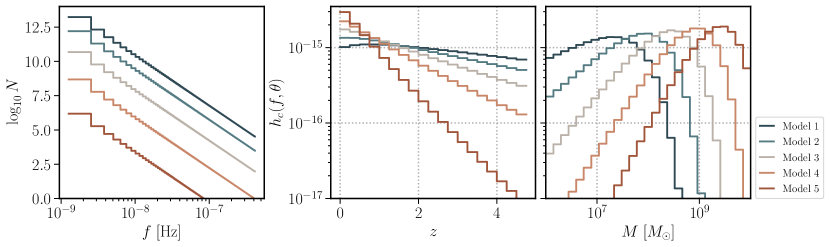
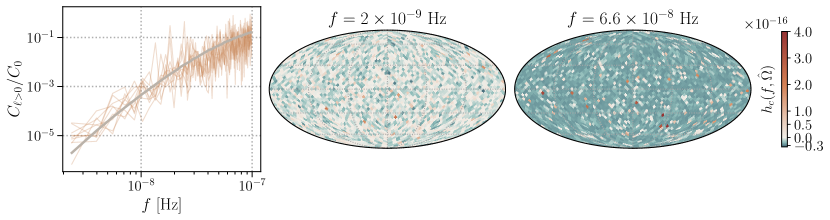
- Uses the formalism to predict that anisotropy levels scale as $ C_{\ell>0}/C_0 \propto f^{11/3} $ in the GW-dominated regime, with enhanced detectability under dynamical acceleration.
Experimental results
Research questions
- RQ1How do anisotropies in the stochastic gravitational-wave background (SGWB) depend on frequency, given the finite number of SMBHBs?
- RQ2To what extent can anisotropy measurements break degeneracies in SMBHB population parameters that are unresolvable from the isotropic background alone?
- RQ3How do additional dynamical processes such as stellar scattering or gas drag affect the relative amplitude of anisotropies compared to the isotropic component?
- RQ4What are the expected levels of linear and circular polarization anisotropies in the SGWB due to the distribution of SMBHB inclination angles?
- RQ5Can the formalism predict detectable anisotropy levels at the highest PTA frequencies, and how should frequency binning be optimized for detection?
Key findings
- Anisotropies in the SGWB scale as $ C_{\ell>0}/C_0 \propto f^{11/3} $ at high frequencies due to shot noise, indicating stronger anisotropy at higher frequencies.
- The variance of the intensity field is proportional to $ \int d\Omega_\iota / 4\pi \, g_I^2(\iota) = 284/315 $, showing significant intensity anisotropy from finite source counts.
- Circular polarization anisotropy is expected to be approximately 25% of the intensity anisotropy level, with variance proportional to $ 23/105 $.
- Linear polarization anisotropy is expected to be around 3% of the intensity anisotropy, with $ Q $ and $ U $ variance components each half that of $ L $.
- Dynamical processes such as stellar scattering or gas drag reduce the number of detectable binaries and attenuate the GW spectrum, but enhance the relative amplitude of anisotropies.
- The model enables self-consistent prediction of both the GW spectrum and its anisotropies, offering a framework to break degeneracies in SMBHB population parameters beyond isotropic measurements.
Better researchstarts right now
From reading papers to final review, dramatically reduce your research time.
No credit card · Free plan available
This review was created by AI and reviewed by human editors.