
[Paper Review] Exponential Quantum Communication Advantage in Distributed Inference and Learning
This paper proposes a quantum communication framework for distributed machine learning that achieves exponential reductions in communication cost for training and inference using parameterized quantum circuits. By encoding data into quantum states and leveraging quantum interference, the method enables exponential quantum advantage in communication complexity for deep, nonlinear models—without relying on specialized data access models—while also providing inherent privacy via quantum mechanics.
Training and inference with large machine learning models that far exceed the memory capacity of individual devices necessitates the design of distributed architectures, forcing one to contend with communication constraints. We present a framework for distributed computation over a quantum network in which data is encoded into specialized quantum states. We prove that for models within this framework, inference and training using gradient descent can be performed with exponentially less communication compared to their classical analogs, and with relatively modest overhead relative to standard gradient-based methods. We show that certain graph neural networks are particularly amenable to implementation within this framework, and moreover present empirical evidence that they perform well on standard benchmarks. To our knowledge, this is the first example of exponential quantum advantage for a generic class of machine learning problems that hold regardless of the data encoding cost. Moreover, we show that models in this class can encode highly nonlinear features of their inputs, and their expressivity increases exponentially with model depth. We also delineate the space of models for which exponential communication advantages hold by showing that they cannot hold for linear classification. Our results can be combined with natural privacy advantages in the communicated quantum states that limit the amount of information that can be extracted from them about the data and model parameters. Taken as a whole, these findings form a promising foundation for distributed machine learning over quantum networks.
Motivation & Objective
- To address the communication bottleneck in distributed machine learning where classical data and models exceed individual device memory.
- To demonstrate that quantum communication can provide exponential reductions in communication cost for training and inference in a broad class of machine learning models.
- To show that this advantage holds regardless of data encoding costs and is not limited to sparse or special-purpose data access models.
- To establish that quantum advantages are not merely artifacts of encoding by showing the advantage vanishes for linear classifiers.
- To explore the interplay between quantum expressivity, model depth, and communication efficiency in distributed learning.
Proposed method
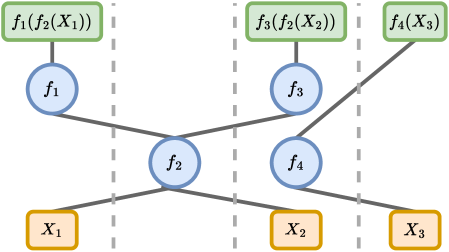
- Data is encoded into quantum states using parameterized quantum circuits, enabling distributed inference and training over a quantum network.
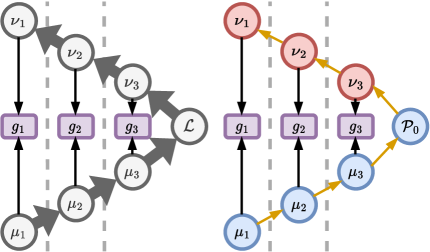
- Gradient descent is performed using quantum-assisted estimation of loss and gradients, with measurements used to update parameters.
- The framework leverages quantum interference and amplitude encoding to represent nonlinear features in the amplitudes of quantum states.
- Communication complexity is analyzed via information-theoretic bounds, showing exponential separation between quantum and classical protocols.
- The method uses shadow tomography-like techniques for gradient estimation, though the paper notes this may be suboptimal due to lack of correlation reuse across iterations.
- A subclass of circuits is identified where the entire training process achieves exponential communication advantage, not just gradient estimation.
Experimental results
Research questions
- RQ1Can quantum communication provide exponential reductions in communication cost for distributed machine learning with dense classical data?
- RQ2Does the quantum advantage persist when accounting for the cost of data encoding into quantum states?
- RQ3Is the communication advantage specific to nonlinear models, or does it also apply to linear classifiers?
- RQ4Can quantum circuits be designed such that expressivity grows exponentially with depth while maintaining low communication overhead?
- RQ5To what extent can quantum advantages in communication be achieved without requiring complex data access models like QRAM?
Key findings
- For a broad class of parameterized quantum circuits, quantum communication enables exponential reductions in communication cost for both gradient estimation and full training, compared to classical protocols.
- The communication advantage is not a consequence of data encoding alone, as it does not hold for linear classifiers, indicating it arises from nonlinear expressivity and quantum interference.
- Model expressivity increases exponentially with depth due to the recursive composition of unitaries that encode nonlinear features in state amplitudes.
- The framework provides inherent privacy via Holevo’s bound, limiting the amount of classical information that can be extracted from transmitted quantum states.
- The advantage holds without requiring QRAM or sparsity assumptions, and is robust even under realistic noise models for near-term quantum devices.
- For a subclass of circuits, such as those used in fine-tuning with pre-trained features, the entire training process benefits from exponential communication savings under convexity assumptions.
Better researchstarts right now
From reading papers to final review, dramatically reduce your research time.
No credit card · Free plan available
This review was created by AI and reviewed by human editors.