
[Paper Review] Extinction, the elephant in the room that hinders optical Galactic observations
This paper argues that interstellar extinction is a major but often poorly handled obstacle in optical Galactic astronomy, highlighting three key issues: non-linear photometric effects due to wavelength-dependent extinction, sightline-dependent variations in the extinction law (especially $R_{5495}$), and the limited accuracy of existing extinction law families across UV-optical-IR wavelengths. It proposes using monochromatic color excesses (e.g., $E(4405-5495)$) and $R_{5495}$ instead of traditional $E(B-V)$ and $R_V$, and advocates for future spectrophotometric surveys—especially from Gaia XP and JWST—to enable more accurate, multi-parameter extinction laws incorporating atomic/molecular lines and DIBs.
Extinction is the elephant in the room that almost everyone tries to avoid when analyzing optical/IR data: astronomers tend to find a quick fix for it that the referee will accept, but that does not mean such a solution is correct or even optimal. In this contribution I address three important issues related to extinction that are commonly ignored and present current and future solutions for them: [1] Extinction produces non-linear photometric effects, [2] the extinction law changes between sightlines, and [3] not all families of extinction laws have the same accuracy.
Motivation & Objective
- To address the widespread underestimation and oversimplification of interstellar extinction in optical/IR Galactic surveys.
- To highlight that traditional extinction measures like $E(B-V)$ and $R_V$ are inadequate due to non-linear photometric effects and sightline variability.
- To argue that current extinction law families (e.g., CC, F99) fail to accurately model extinction across the full UV-optical-IR range, especially at high extinction.
- To promote the development of multi-parameter extinction laws that incorporate atomic/molecular lines and DIBs for improved ISM diagnostics.
- To advocate for future spectrophotometric surveys (e.g., Gaia XP, JWST) to replace photometric methods and resolve uncertainties in extinction behavior.
Proposed method
- Replaces traditional $E(B-V)$ and $R_V$ with monochromatic color excesses like $E(4405-5495)$ and $R_{5495}$ to account for non-linear extinction effects.
- Uses monochromatic extinction $A(\lambda)$ defined as $A(\lambda) = -2.5 \log_{10}(F_\lambda/F_{\lambda,0})$ to model wavelength-dependent extinction.
- Analyzes photometric data from large surveys (e.g., Gaia, 2MASS, SDSS, IPHAS) to quantify deviations in $R_{5495}$ across different sightlines.
- Evaluates the performance of existing extinction law families (e.g., CC, F99) by comparing their photometric residuals against observed data at varying extinction levels.
- Proposes that spectrophotometry—especially from Gaia XP and future JWST observations—will enable accurate, continuous extinction laws by resolving spectral features.
- Suggests extending extinction laws to include atomic/molecular lines (e.g., Na i, Ca ii) and diffuse interstellar bands (DIBs), which correlate with extinction and sightline type.
Experimental results
Research questions
- RQ1Why do traditional extinction corrections in optical Galactic surveys lead to biased results despite widespread use?
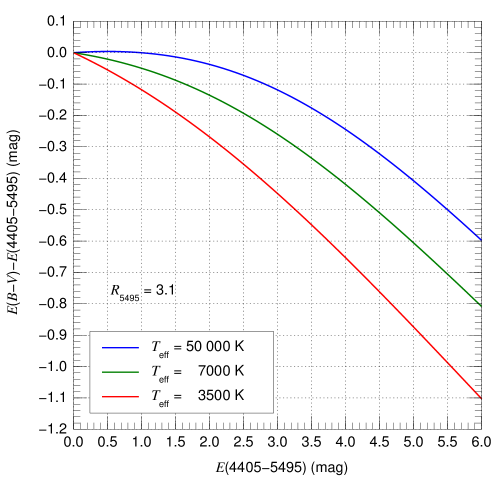
- RQ2How do non-linear photometric effects in magnitude and color arise from wavelength-dependent extinction, and why are $E(B-V)$ and $R_V$ insufficient to describe them?
- RQ3To what extent does the extinction law $R_{5495}$ vary between different Galactic sightlines, and what causes such variations?
- RQ4Why do commonly used extinction law families (e.g., CC, F99) produce significant photometric residuals, especially at high extinction levels?
- RQ5Can future spectrophotometric surveys enable the development of multi-parameter extinction laws that incorporate atomic/molecular lines and DIBs for improved ISM diagnostics?
Key findings
- Non-linear extinction effects mean that doubling dust extinction does not linearly double $A_V$ or $E(B-V)$, and the same dust produces different extinction on stars with different spectral energy distributions (SEDs).
- The use of $E(B-V)$ and $R_V$ is fundamentally flawed because they are band-integrated and not monochromatic; monochromatic equivalents like $E(4405-5495)$ and $R_{5495}$ are required for accuracy.
- The value of $R_{5495}$ varies significantly between sightlines, with many sightlines having $R_{5495} > 3.2$, and it is not constant even within small regions like H II regions.
- Existing extinction law families such as CC and F99 produce increasing photometric residuals with increasing extinction, with F99 showing significant errors already at $E(4405-5495) \sim 1.0$, and CC failing in the UV and IR.
- The 0.8–5.5 μm range yields a lower average power-law index $\alpha$ than the $JHK$ range due to the flattening of the extinction law at longer wavelengths, which invalidates simple power-law fits over broad bands.
- Future spectrophotometry from Gaia XP and JWST, combined with improved calibrations from Gaia (spectro)photometry, will enable the development of accurate, multi-parameter extinction laws incorporating atomic/molecular lines and DIBs.
Better researchstarts right now
From reading papers to final review, dramatically reduce your research time.
No credit card · Free plan available
This review was created by AI and reviewed by human editors.