
[Paper Review] Extreme damped Lyman-$α$ absorption in young star-forming galaxies at $z=9-11$
JWST observations reveal extreme damped Lyα absorbers with log N_HI > 22 around three galaxies at z ≈ 9–11, indicating abundant local HI gas and implications for early galaxy formation and reionization.
The onset of galaxy formation is thought to be initiated by the infall of neutral, pristine gas onto the first protogalactic halos. However, direct constraints on the abundance of neutral atomic hydrogen (HI) in galaxies have been difficult to obtain at early cosmic times. Here we present spectroscopic observations with JWST of three galaxies at redshifts $z=8.8 - 11.4$, about $400-600$ Myr after the Big Bang, that show strong damped Lyman-$α$ absorption ($N_{ m HI} > 10^{22}$ cm$^{-2}$) from HI in their local surroundings, an order of magnitude in excess of the Lyman-$α$ absorption caused by the neutral intergalactic medium at these redshifts. Consequently, these early galaxies cannot be contributing significantly to reionization, at least at their current evolutionary stages. Simulations of galaxy formation show that such massive gas reservoirs surrounding young galaxies so early in the history of the universe is a signature of galaxy formation in progress.
Motivation & Objective
- Investigate the abundance and distribution of neutral hydrogen (HI) in the environments of galaxies during the epoch of reionization (z>8).
- Characterize the damping-wing Lyα absorption features and disentangle IGM and local (ISM/halo) HI contributions.
- Derive physical properties (SFR, metallicity, gas mass, gas fraction) of the parent galaxies and assess implications for reionization and galaxy formation.
- Compare observed HI reservoirs with simulations to understand gas accretion histories in the early universe.
Proposed method
- Obtain JWST/NIRSpec prism spectra of three z>8 galaxy systems with robust emission-line redshifts.
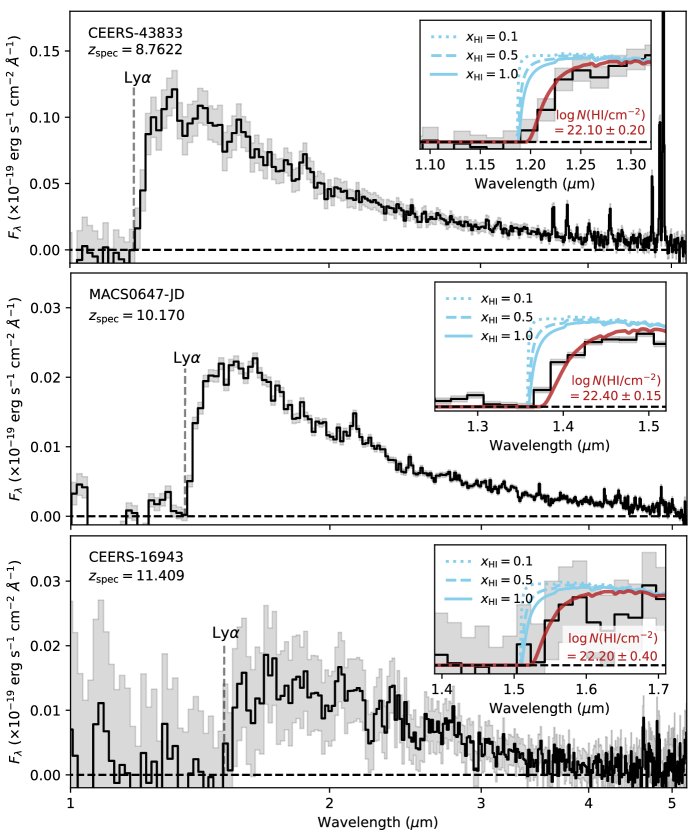
- Model Lyα absorption by combining IGM Gunn-Peterson damping with a local DL A (Voigt) profile to fit N_HI.
- Use Bayesian multimodal nested sampling (PyMultiNest) to constrain free parameters: A_V, x_HI, and N_HI.
- Fix intrinsic continua with BPASS+Cloudy templates and assess robustness to template choices (Δlog N_HI ≲ 0.1 dex).
- Explore IGM scenarios (x_HI = 0.1, 0.5, 1.0) and compare with sightline simulations to attribute absorption to local HI around galaxies.
Experimental results
Research questions
- RQ1What is the column density of HI in the immediate environments of galaxies forming at z≈9–11?
- RQ2To what extent does local HI (DLAs) around these galaxies contribute to Lyα damping wings compared to the IGM?
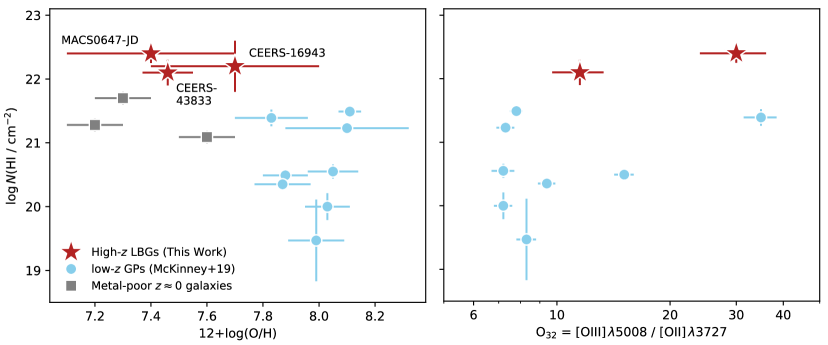
- RQ3What are the physical properties (SFR, metallicity, stellar mass, gas content) of these galaxies and how do they compare to lower-redshift analogs?
- RQ4Do the observed HI reservoirs align with galaxy formation simulations for gas accretion and gas fractions during reionization?
Key findings
- All three z=9–11 galaxies show extreme DLAs with log10(N_HI/cm^-2) = 22.10 ± 0.20 (CEERS-43833), 22.20 ± 0.40 (CEERS-16943), and 22.40 ± 0.15 (MACS0647-JD).
- DLAs dominate the Lyα absorption beyond the IGM damping wing, indicating HI in the immediate galaxy environments rather than solely IGM neutrality.
- Derived HI masses imply substantial circumgalactic gas, with estimated HI masses around 10^7.5–10^9 M_sun and gas fractions M_gas/M_* ≈ 5 across the sample.
- SFRs range from ~1.4 to 14.5 M_sun/yr (from nebular lines), with stellar masses ~10^8–10^9 M_sun and low metallicities (12+log(O/H) ≈ 7.4–7.7).
- Gas surface densities inferred from DLAs are high, suggesting large total gas reservoirs possibly larger than inferred from DLAs alone and potentially requiring a KS-consistent total gas mass.
- Simulations (Astraeus) predict gas masses and gas fractions roughly consistent with the observed high-z systems, implying active gas build-up in the early epoch.
Better researchstarts right now
From reading papers to final review, dramatically reduce your research time.
No credit card · Free plan available
This review was created by AI and reviewed by human editors.