
[Paper Review] Extreme mass ratio inspirals in galaxies with dark matter halos
The paper derives analytic expressions for EMRI orbital dynamics and gravitational wave signals in Schwarzschild black hole spacetimes embedded in Hernquist-type dark matter halos, showing DM halos imprint detectable dephasing and mismatches in LISA-band signals.
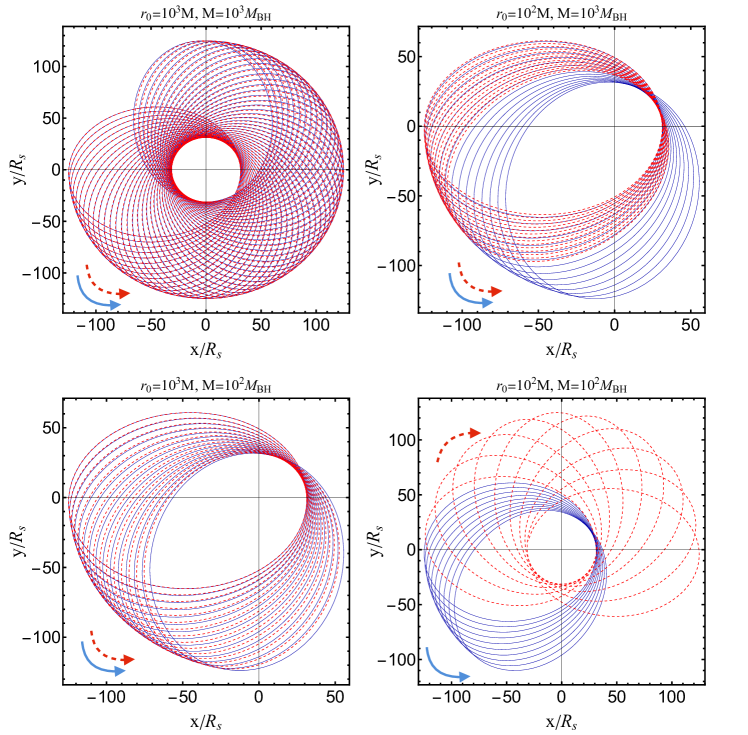
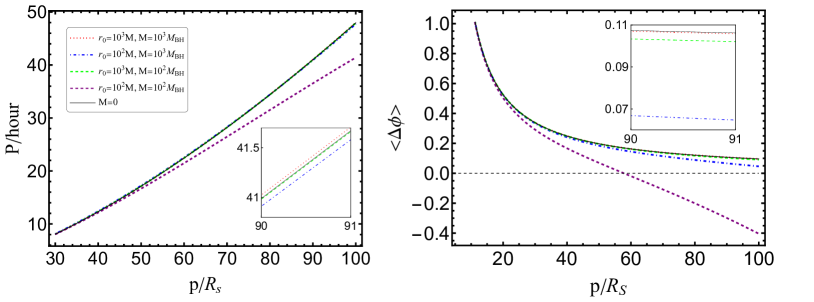
Using an analytic, static, and spherically symmetric metric for a Schwarzschild black hole immersed in a dark matter (DM) halo with the Hernquist-type profile, we derive analytic expressions for the orbital period and precession of eccentric extreme mass ratio inspirals (EMRIs) surrounded by DM halos, and we show how the precession rates decrease and even undergo a prograde-to-retrograde precession transition if the density of DM halo is large enough. The presence of local DM halos also retards the decrease of the semi-latus rectum and the eccentricity. The orbital evolution of EMRIs immersed in DM halos is then calculated numerically by considering the combined effects of gravitational radiation reaction, dynamical friction, and accretion. Comparing the number of orbital cycles accumulated over a one-year evolution for EMRIs with and without DM halos, we find that DM halos with compactness as small as $10^{-5}$ can be detected. From the mismatch between gravitational waveforms of EMRIs with and without DM halos, we show that EMRIs in galaxies can be used to probe the existence of DM halos and detect the compactness of DM halos as small as $10^{-5}$. Employing the Fisher information matrix method, we find that larger compactness and density values of DM halos help to reduce the estimation error of parameters and further break the degeneracy between the parameters.
Motivation & Objective
- Assess how dark matter halos around massive black holes affect EMRI orbits and GW signals.
- Derive analytic formulae for orbital period and precession in DM environments.
- Quantify GW dephasing and waveform mismatch due to DM halos for LISA detectability.
Proposed method
- Use static, spherically symmetric metric for a Schwarzschild black hole inside Hernquist-type DM halos.
- Derive analytic expressions for orbital elements (p, e) and precession from geodesic motion.
- Compute leading-order GW fluxes including environmental corrections (dE/dt, dL/dt).
- Evolve p(t) and e(t) from energy and angular momentum balance with GW emission.
- Calculate time-domain GW waveforms and dephasing relative to vacuum cases.
- Evaluate detectability via the number of orbital cycles and waveform mismatch for LISA.
Experimental results
Research questions
- RQ1How does a Hernquist DM halo modify geodesic orbits around a central Schwarzschild BH?
- RQ2What are the analytic corrections to orbital period, precession, and orbital-element evolution due to DM halos?
- RQ3Can DM halos produce measurable dephasing or waveform mismatches in EMRI signals observed by space-based detectors like LISA?
- RQ4What are the detectable thresholds for DM halo compactness M/r0 using GW observations?
- RQ5How do eccentric orbits influence the detectability of DM halos in EMRIs?
Key findings
- DM halos decrease orbital precession and can cause retrograde precession for sufficiently dense halos.
- DM halos slow the decrease of the semi-latus rectum p and eccentricity under GW emission.
- Over one year before merger, DM halos with compactness as small as 10^-4 can be detected via cycle counting dephasing.
- Waveform mismatches between DM-embedded and vacuum EMRIs can probe DM halos with compactness down to ~10^-5 for LISA.
- Eccentric orbits enhance the ability to detect smaller DM halo compactness compared to circular orbits.
- The study provides analytic expressions for T (orbital period) and Δφ (apsidal precession) including DM halo corrections (Eq. 23–24 in the text).
Better researchstarts right now
From reading papers to final review, dramatically reduce your research time.
No credit card · Free plan available
This review was created by AI and reviewed by human editors.