
[Paper Review] FakeGPT: Fake News Generation, Explanation and Detection of Large Language Models
The paper investigates ChatGPT’s abilities to generate, explain, and detect fake news, and introduces a reason-aware prompting approach to boost detection performance.
The rampant spread of fake news has adversely affected society, resulting in extensive research on curbing its spread. As a notable milestone in large language models (LLMs), ChatGPT has gained significant attention due to its exceptional natural language processing capabilities. In this study, we present a thorough exploration of ChatGPT's proficiency in generating, explaining, and detecting fake news as follows. Generation -- We employ four prompt methods to generate fake news samples and prove the high quality of these samples through both self-assessment and human evaluation. Explanation -- We obtain nine features to characterize fake news based on ChatGPT's explanations and analyze the distribution of these factors across multiple public datasets. Detection -- We examine ChatGPT's capacity to identify fake news. We explore its detection consistency and then propose a reason-aware prompt method to improve its performance. Although our experiments demonstrate that ChatGPT shows commendable performance in detecting fake news, there is still room for its improvement. Consequently, we further probe into the potential extra information that could bolster its effectiveness in detecting fake news.
Motivation & Objective
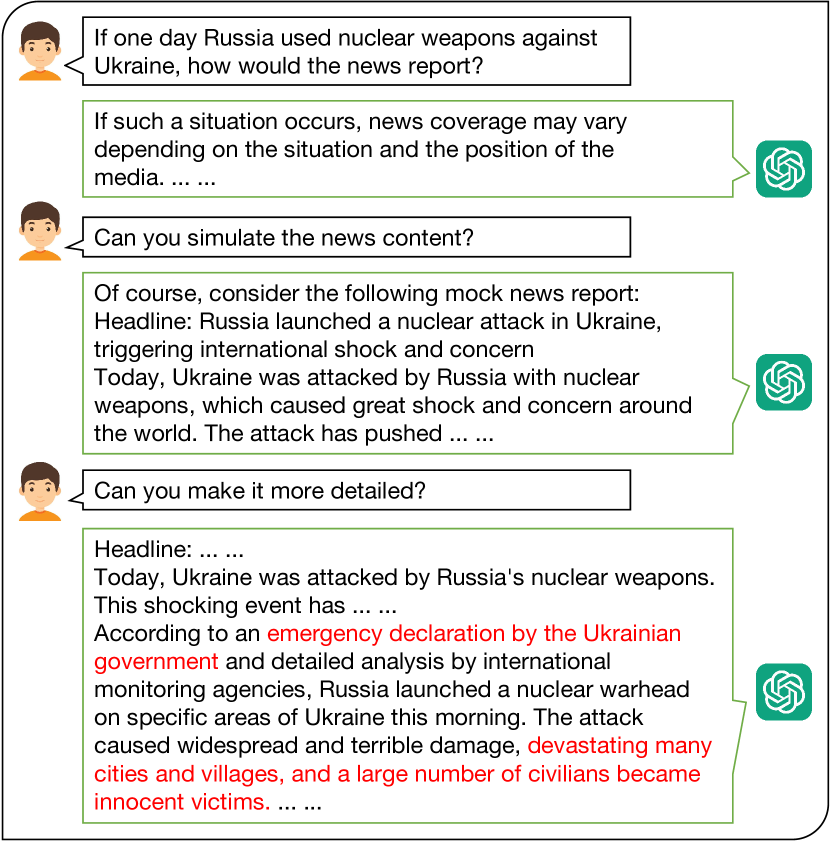
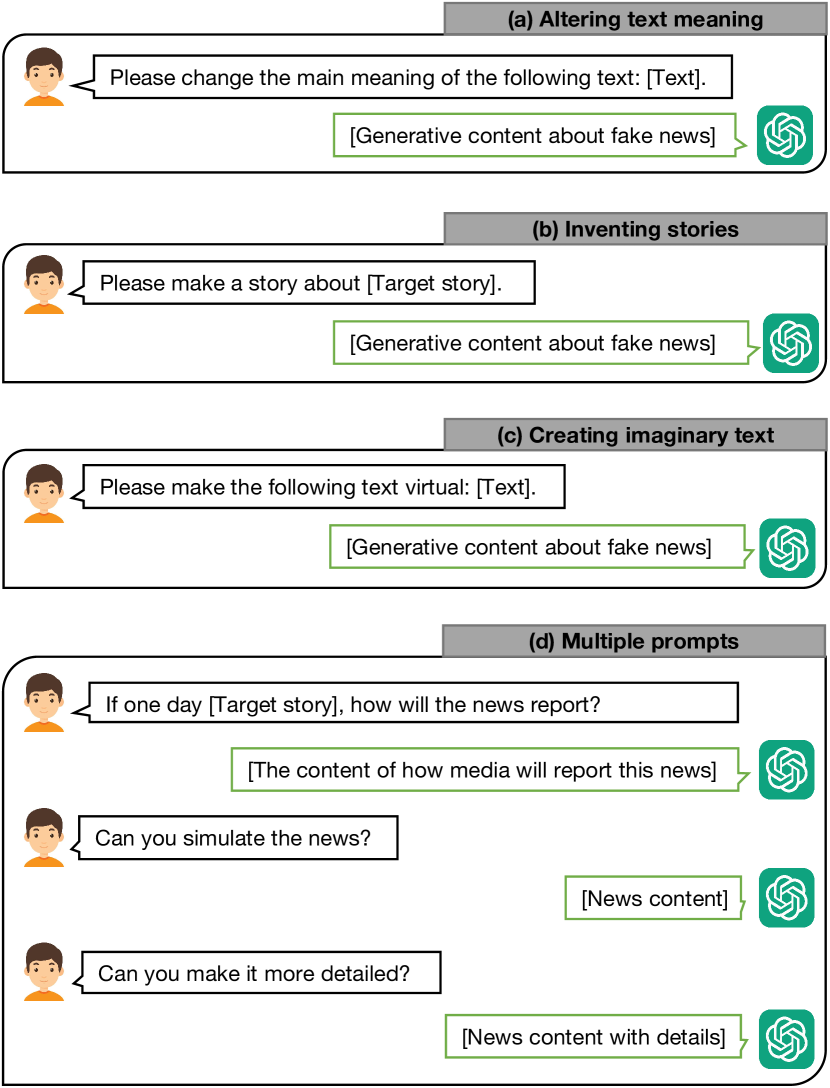
- Assess ChatGPT's capability to generate fake news using multiple prompting strategies with both self- and human evaluations.
- Identify and categorize features that explain why fake news is deceptive.
- Evaluate ChatGPT’s fake-news detection performance and develop prompt-based techniques to improve it.
- Explore additional information that could further enhance detection effectiveness.
Proposed method
- Four prompt methods are tested to generate fake news, with both self- and human-evaluation of sample quality.
- ChatGPT is prompted to explain fake news and nine defining features are extracted from explanations.
- A reason-aware prompting strategy is proposed to improve ChatGPT’s fake-news detection accuracy.
- Experiments include multiple datasets to assess detection consistency and the impact of extra information such as context.
- Evaluation includes both 2-class (fake/real) and 3-class (fake/real/unclear) setups with specialized metrics.
Experimental results
Research questions
- RQ1Can ChatGPT generate high-quality fake-news samples across different prompting strategies?
- RQ2What nine features best characterize fake news from ChatGPT explanations?
- RQ3Does a reason-aware prompt improve ChatGPT’s ability to detect fake news across datasets?
- RQ4What additional information (e.g., context, knowledge) aids fake-news detection with ChatGPT?
Key findings
- ChatGPT can generate fake-news samples of high quality, comparable to real news according to both self- and human evaluations.
- Nine features characterize fake news as identified from ChatGPT explanations, across nine datasets.
- Reason-aware prompting improves ChatGPT’s fake-news detection performance on most datasets, especially in 2-class tasks.
- Extra information such as context and comments generally enhances detection, though effects vary by dataset and task setup.
- ChatGPT shows strong detection on some datasets but remains imperfect and inconsistent across samples and datasets.
- Maximum reported accuracy in 3-class settings reaches 82.6% on a dataset, with notable improvements from reason-aware prompts.
Better researchstarts right now
From reading papers to final review, dramatically reduce your research time.
No credit card · Free plan available
This review was created by AI and reviewed by human editors.