
[Paper Review] FAST Observations of FRB 20220912A: Burst Properties and Polarization Characteristics
FAST observed FRB 20220912A over 17 sessions totaling 8.67 hours, detecting 1076 bursts with a broken-power-law energy distribution, near-zero mean RM, and prevalent linear polarization with substantial circular polarization in many bursts.
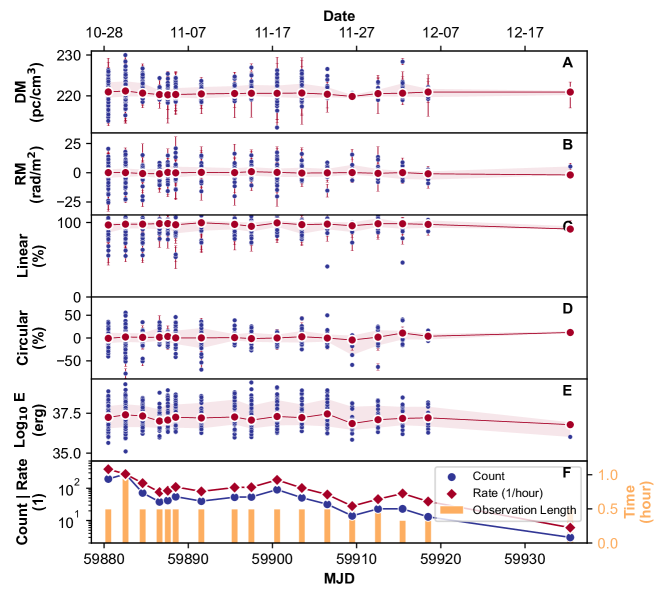
We report the observations of FRB 20220912A using the Five-hundred-meter Aperture Spherical radio Telescope (FAST). We conducted 17 observations totaling 8.67 hours and detected a total of 1076 bursts with an event rate up to 390 hr$^{-1}$. The cumulative energy distribution can be well described using a broken power-law function with the lower and higher-energy slopes of $-0.38\pm0.02$ and $-2.07\pm0.07$, respectively. We also report the L band ($1-1.5$ GHz) spectral index of the synthetic spectrum of FRB~20220912A bursts, which is $-2.6\pm0.21$. The average rotation measure (RM) value of the bursts from FRB~20220912A is $-0.08\pm5.39\ m rad\,m^{-2}$, close to 0 $ m rad\,m^{-2}$ and maintain relatively stable over two months. Most bursts have nearly 100\% linear polarization. About 45\% of the bursts have circular polarization with SNR $>$ 3, and the highest circular polarization degree can reach 70\%. Our observations suggest that FRB~20220912A is located in a relatively clean local environment with complex circular polarization characteristics. These various behaviors imply that the mechanism of circular polarization of FRBs likely originates from an intrinsic radiation mechanism, such as coherent curvature radiation or inverse Compton scattering inside the magnetosphere of the FRB engine source (e.g. a magnetar).
Motivation & Objective
- Characterize the burst properties of FRB 20220912A with FAST fast radio telescope observations.
- Determine the energy distribution and spectral properties of bursts.
- Analyze DM and polarization to infer the local environment and potential emission mechanisms.
Proposed method
- Conduct 17 FAST observations totaling 8.67 hours on FRB 20220912A.
- Detect 1076 bursts using offline burst searches with a de-dispersion DM of 219.6 pc cm^-3.
- Compute burst properties: peak flux, fluence, energy, and duration via radiometer equation and integration over bandwidth.
- Model energy distribution with a broken power-law and fit using two Log-Normal functions for differential energy.
- Perform RM synthesis to derive RM for bursts with RM errors < 10 rad m^-2 and de-bias linear polarization.
- Fit synthetic spectrum with a power-law I = A × F^α + C and find α = -2.60 ± 0.21.
Experimental results
Research questions
- RQ1What is the energy distribution of FRB 20220912A bursts and does it follow a broken power-law?
- RQ2What are the polarization properties and RM behavior of the bursts, and what do they imply about the local environment and emission mechanism?
- RQ3Do the center frequencies and bandwidths of bursts show systematic patterns or narrow-band characteristics within FAST’s band?
- RQ4Is there evidence for periodicity or characteristic waiting times in the burst activity?
- RQ5How does the observed energy budget constrain magnetar or other progenitor models?
Key findings
- The cumulative energy distribution is well described by a broken power-law with slopes -0.38 ± 0.02 (low energy) and -2.07 ± 0.07 (high energy).
- The synthetic spectrum spectral index is α = -2.60 ± 0.21 (in 1–1.5 GHz band).
- Mean RM is -0.08 ± 5.39 rad m^-2, near zero and stable over two months.
- Most bursts exhibit nearly 100% linear polarization; about 45% show circular polarization with SNR > 3, with the maximum circular polarization up to 70%.
- Energy calculations for FRB 20220912A yield an emitted energy of 3.49 × 10^45 erg during the 17-day period, implying energy budget implications for magnetar models under assumed radiative efficiency and beaming.
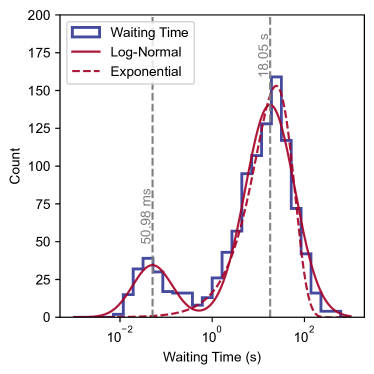
- The waiting-time distribution is bimodal with peaks around 18 s and 50 ms; no reliable periodicity is found in Lomb-Scargle or phase-folding analyses.
- Center frequencies peak around 1.02, 1.08, and 1.38 GHz; bursts are very narrow-band with a mode bandwidth around 181 MHz; Δν/ν0 distributions show narrow fractional bandwidth for bursts fully within FAST band.
Better researchstarts right now
From reading papers to final review, dramatically reduce your research time.
No credit card · Free plan available
This review was created by AI and reviewed by human editors.