
[Paper Review] First Dark Matter Search with Nuclear Recoils from the XENONnT Experiment
XENONnT performs a nuclear recoil WIMP search with 5.9 t of liquid xenon, achieving a 1.09 t·y exposure and reporting the leading 90% CL upper limit on spin-independent WIMP-nucleon cross section of 2.58×10^-47 cm^2 at 28 GeV/c^2, with no significant excess detected.
We report on the first search for nuclear recoils from dark matter in the form of weakly interacting massive particles (WIMPs) with the XENONnT experiment which is based on a two-phase time projection chamber with a sensitive liquid xenon mass of $5.9$ t. During the approximately 1.1 tonne-year exposure used for this search, the intrinsic $^{85}$Kr and $^{222}$Rn concentrations in the liquid target were reduced to unprecedentedly low levels, giving an electronic recoil background rate of $(15.8\pm1.3)~\mathrm{events}/(\mathrm{t\cdot y \cdot keV})$ in the region of interest. A blind analysis of nuclear recoil events with energies between $3.3$ keV and $60.5$ keV finds no significant excess. This leads to a minimum upper limit on the spin-independent WIMP-nucleon cross section of $2.58 imes 10^{-47}~\mathrm{cm}^2$ for a WIMP mass of $28~\mathrm{GeV}/c^2$ at $90\%$ confidence level. Limits for spin-dependent interactions are also provided. Both the limit and the sensitivity for the full range of WIMP masses analyzed here improve on previous results obtained with the XENON1T experiment for the same exposure.
Motivation & Objective
- Motivate a direct detection search for WIMPs using a larger two-phase LXe TPC with improved background suppression.
- Achieve unprecedented low electronic recoil background to enhance sensitivity to nuclear recoils from WIMPs.
- Calibrate NR/ER responses and quantify neutron veto efficiency to robustly constrain WIMP signals.
- Provide updated limits on spin-independent and spin-dependent WIMP-nucleon cross sections across a range of WIMP masses.
Proposed method
- Use a two-phase time projection chamber with 5.9 t sensitive LXe mass to detect S1 and S2 signals from interactions.
- Operate in a low-background regime with Kr-85 and Rn-222 suppression to reach ER background of 15.8 ± 1.3 events/(t·y·keV) below 30 keV.
- Calibrate NR/ER responses with AmBe neutron source and Pb-212 and Ar-37 sources, and model backgrounds with a Markov-Chain Monte Carlo fit.
- Apply a blind analysis in the NR ROI defined by cS1 and cS2, and use a neutron veto (NV) to tag neutrons with ~53% efficiency.
- Extract WIMP search results via a likelihood approach incorporating NR/ER models and detector efficiencies.
![Figure 1: NR and ER calibration data from \isotope [241]AmBe (orange), \isotope [220]Rn (blue) and \isotope [37]Ar (black). The median and the $\pm 2\text{\,}\sigma$ contours of the NR and ER model are shown in blue and red respectively. The gray dash-dotted contour lines show the reconstructed NR e](https://ar5iv.labs.arxiv.org/html/2303.14729/assets/SR0_ER_NR_calibration.png)
Experimental results
Research questions
- RQ1What is the resulting upper limit on the spin-independent WIMP-nucleon cross section given the SR0 exposure and background conditions?
- RQ2How does the XENONnT NR search performance (efficiency, background, and energy range) compare to XENON1T for the same exposure?
- RQ3What are the NR/ER response calibrations and how do they impact the interpretation of a potential WIMP signal?
- RQ4What are the implications of the NV tagging efficiency and ER background on the sensitivity to WIMPs across masses?
- RQ5What are the limits for spin-dependent WIMP-nucleon interactions derived from this dataset?
Key findings
- No significant excess of nuclear recoils was observed in the ROI.
- The analysis yields a minimum upper limit on the spin-independent WIMP-nucleon cross section of 2.58×10^-47 cm^2 at 90% CL for a 28 GeV/c^2 WIMP.
- For spin-dependent interactions, limits are provided (specific values not stated in the excerpt).
- The SR0 exposure corresponds to 1.09 ± 0.03 t·y with a fiducial LXe mass of 4.18 ± 0.13 t after field distortion corrections.
- The achieved electronic recoil background is 15.8 ± 1.3 events/(t·y·keV) in the ROI, enabling improved sensitivity over XENON1T for the same exposure.
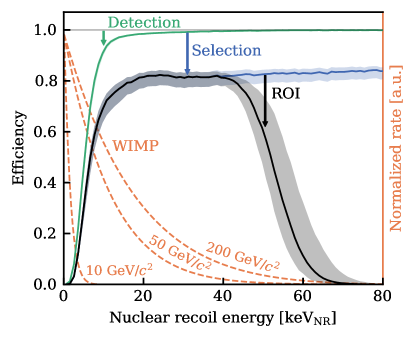
- NR energy range of the search is 3.3 keV_NR to 60.5 keV_NR, with cS1 in [0, 100] PE and cS2 in [126, 12589] PE.
Better researchstarts right now
From reading papers to final review, dramatically reduce your research time.
No credit card · Free plan available
This review was created by AI and reviewed by human editors.