
[Paper Review] First Indication of Solar $^8$B Neutrino Flux through Coherent Elastic Neutrino-Nucleus Scattering in PandaX-4T
The PandaX-4T experiment detects solar 8B neutrinos via CEvNS in liquid xenon, reporting a flux consistent with the standard solar model and a 2.64 sigma hint above background.
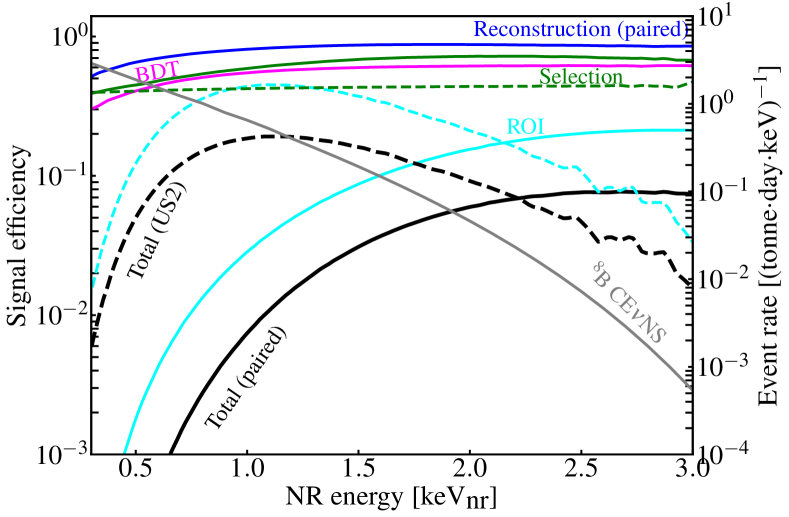
The PandaX-4T liquid xenon detector at the China Jinping Underground Laboratory is used to measure the solar $^8$B neutrino flux by detecting neutrinos through coherent scattering with xenon nuclei. Data samples requiring the coincidence of scintillation and ionization signals (paired), as well as unpaired ionization-only signals (US2), are selected with energy threshold of approximately 1.1 keV (0.33 keV) nuclear recoil energy. Combining the commissioning run and the first science run of PandaX-4T, a total exposure of 1.20 and 1.04 tonne$\cdot$year are collected for the paired and US2, respectively. After unblinding, 3 and 332 events are observed with an expectation of 2.8$\pm$0.5 and 251$\pm$32 background events, for the paired and US2 data, respectively. A combined analysis yields a best-fit $^8$B neutrino signal of 3.5 (75) events from the paired (US2) data sample, with $\sim$37\% uncertainty, and the background-only hypothesis is disfavored at 2.64$σ$ significance. This gives a solar $^8$B neutrino flux of ($8.4\pm3.1$)$ imes$10$^6$ cm$^{-2}$s$^{-1}$, consistent with the standard solar model prediction. It is also the first indication of solar $^8$B neutrino ``fog'' in a dark matter direct detection experiment.
Motivation & Objective
- Motivate the measurement of solar 8B neutrino flux using CEvNS in a large liquid xenon detector.
- Demonstrate feasibility of low-threshold CEvNS detection in PandaX-4T.
- Combine multiple data streams (paired S1-S2 and unpaired US2) to improve sensitivity.
- Characterize backgrounds (AC, cathode, MD, ER) to extract a potential 8B signal.
- Compare the measured flux with standard solar model predictions.
Proposed method
- Utilize a dual-phase liquid xenon TPC with 3.7 tonne xenon and specific S1/S2 signal requirements.
- Analyze two data classes: paired S1-S2 events and unpaired S2-only (US2) events.
- Define ROIs with NR energy thresholds of 1.1 keV (paired) and 0.33 keV (US2).
- Model backgrounds including accidental coincidences, cathode, micro-discharging, and ERs; validate with off-window and sideband data.
- Apply a two-sided profile likelihood ratio to combine paired and US2 data for signal extraction.
- Implement a Boosted Decision Tree to enhance AC background rejection and optimize ROI.
Experimental results
Research questions
- RQ1Can solar 8B neutrino CEvNS be detected in a future multi-ton liquid xenon DM detector like PandaX-4T?
- RQ2What is the inferred solar 8B CEvNS neutrino flux from PandaX-4T Run0 and Run1 data?
- RQ3How do backgrounds (AC, cathode, MD, ER) impact the extraction of a CEvNS signal in paired and US2 data?
- RQ4Does the measured flux align with standard solar model predictions within uncertainties?
Key findings
- A combined analysis yields a best-fit 8B CEvNS signal of 3.5 (75) events from paired data and 332 events in US2, disfavoring background-only at 2.64 sigma.
- The inferred solar 8B neutrino flux is (8.4 ± 3.1) × 10^6 cm^-2 s^-1.
- Backgrounds are quantified with specific expectations and uncertainties, enabling a CEvNS signal extraction in both data channels.
- The result is consistent with the standard solar model prediction for solar 8B flux.
Better researchstarts right now
From reading papers to final review, dramatically reduce your research time.
No credit card · Free plan available
This review was created by AI and reviewed by human editors.