
[Paper Review] First Principles Investigation of Polymorphism in Halide Perovskites
This study presents a comprehensive first-principles DFT investigation of polymorphism in halide perovskites, analyzing phase stability, lattice strain, octahedral distortion, and cation ordering across diverse compositions. Using multiple DFT functionals—including PBE, PBEsol, PBE-D3, and HSE+SOC with tuned mixing parameters—it reveals that band gaps and photovoltaic efficiencies vary significantly with phase and structural distortion, even for the same composition, and provides a publicly available dataset to train machine learning models for accelerated materials discovery.
Halide perovskites have been extensively studied as materials of interest for optoelectronic applications. There is a major emphasis on ways to tailor the stability, defect behavior, electronic band structure, and optical absorption in halide perovskites, by changing the composition or structure. In this work, we present our contribution to this field in the form of a comprehensive computational investigation of properties as a function of the perovskite phase, different degrees of lattice strains and octahedral distortion and rotation, and the ordering of cations in perovskite alloys. We performed first principles-based density functional theory computations using multiple semi-local and non-local hybrid functionals to calculate optimized lattice parameters, energies of decomposition, electronic band gaps, and theoretical photovoltaic efficiencies. Trends and critical observations from the high-throughput dataset are discussed, especially in terms of the range of optoelectronic properties achievable while keeping the material in a (meta)stable phase or distorted, strained, or differently ordered polymorph. All data is made openly available to the community and is currently being utilized to train state-of-the-art machine learning models for accelerated prediction and discovery, as well as to guide rational experimental discovery.
Motivation & Objective
- To systematically investigate how polymorphism—including different perovskite phases, lattice strains, octahedral distortions, and cation ordering—affects the stability and optoelectronic properties of halide perovskites.
- To evaluate the performance of various DFT functionals (PBE, PBEsol, PBE-D3, HSE+SOC) in predicting lattice parameters, band gaps, and decomposition energies with respect to experimental benchmarks.
- To identify optimal mixing parameters (α) for the HSE functional in non-local hybrid DFT calculations for key perovskites like FAPbI₃ and CsPbI₃, improving accuracy in band gap prediction.
- To generate a high-throughput, open-access dataset of DFT-computed properties across diverse perovskite structures to enable training of machine learning models for inverse design and accelerated discovery.
- To guide rational experimental synthesis by identifying stable, metastable, and distorted polymorphs with tunable band gaps and high theoretical photovoltaic efficiencies.
Proposed method
- Conducted high-throughput density functional theory (DFT) computations using semi-local (PBE, PBEsol, PBE-D3) and non-local hybrid (HSE+SOC) functionals to compute lattice parameters, decomposition energies, band gaps, and photovoltaic efficiencies.
- Employed the special quasi-random structures (SQS) approach to model A/B/X-site alloys in large supercells, accounting for cation ordering effects in mixed compositions.
- Performed static HSE+SOC calculations with tunable Hartree-Fock mixing parameters (α) from 0.20 to 0.50 to optimize band gap predictions for key halide perovskites.
- Used crystal graph neural networks (GNNs) and composition-based descriptors to represent structural and compositional features for training predictive machine learning models.
- Validated DFT results against experimental data, particularly for band gaps in FAPbI₃, CsPbI₃, and CsPbBr₃, to calibrate functional parameters.
- Generated and made publicly available a comprehensive dataset of optimized structures, energies, band gaps, and efficiencies across multiple polymorphs and compositions via GitHub and supplementary files.
Experimental results
Research questions
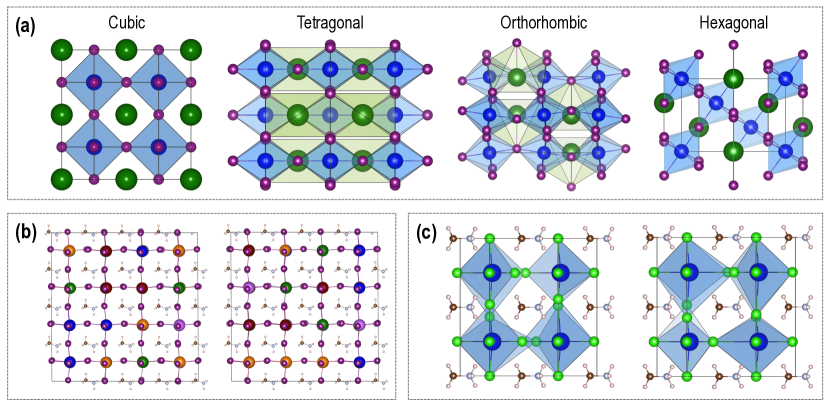
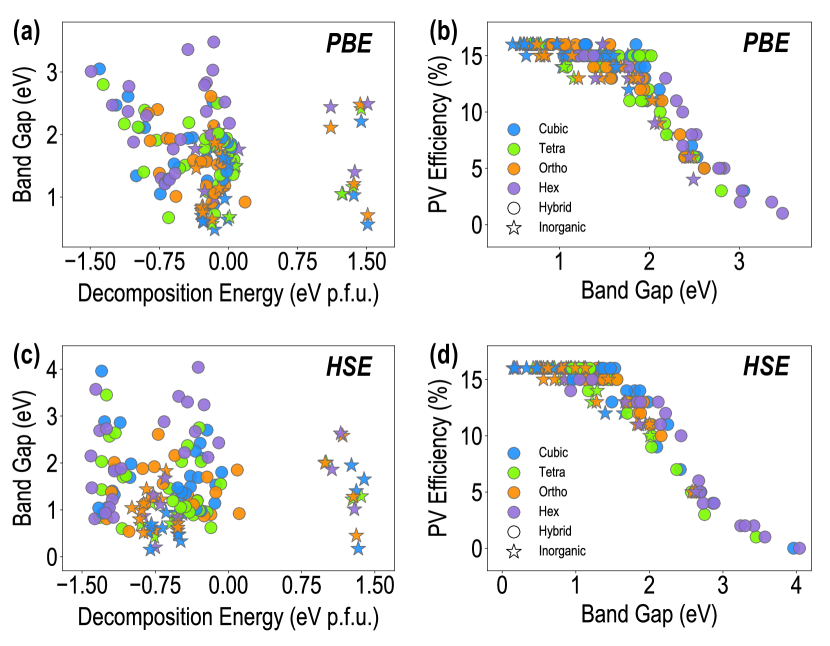
- RQ1How do different perovskite phases (cubic, tetragonal, orthorhombic, hexagonal) influence the electronic band gap and photovoltaic efficiency of halide perovskites?
- RQ2To what extent does cation ordering in ABX₃ alloys affect the stability and optoelectronic properties of halide perovskites?
- RQ3What is the optimal Hartree-Fock mixing parameter (α) in the HSE+SOC functional for accurate band gap prediction in key halide perovskites like FAPbI₃ and CsPbI₃?
- RQ4How do lattice strains and octahedral distortions impact the band gap and thermodynamic stability of halide perovskites?
- RQ5Can a unified DFT framework using multiple functionals predict reliable trends in decomposition energy, band gap, and efficiency across a vast chemical and structural space of halide perovskites?
Key findings
- The HSE+SOC functional with tuned α = 0.50 reproduces the experimental band gap perfectly for cubic FAPbI₃, while α = 0.48 yields the best agreement for orthorhombic CsPbI₃ and CsPbBr₃.
- Different polymorphs of the same composition—such as cubic vs. orthorhombic phases—can exhibit significantly different band gaps and photovoltaic efficiencies, even when thermodynamically stable.
- PBEsol and PBE-D3 functionals are more accurate than standard PBE for predicting lattice parameters, especially in the presence of dispersion forces and structural distortions.
- Cation ordering in quinary alloys like MA(Pb-Sn-Ba-Sr-Ca)I₃ leads to distinct polymorphs that significantly alter optoelectronic properties, highlighting the importance of considering ionic ordering beyond average compositions.
- The study identifies that octahedral distortion and lattice strain can be used as effective engineering tools to stabilize materials while tuning their band gaps without altering composition.
- All DFT-computed data, including crystal structures and properties, are openly shared via GitHub and are already being used to train advanced machine learning models, including GNNs and inverse design frameworks.
Better researchstarts right now
From reading papers to final review, dramatically reduce your research time.
No credit card · Free plan available
This review was created by AI and reviewed by human editors.