
[Paper Review] First Scan Search for Dark Photon Dark Matter with a Tunable Superconducting Radio-Frequency Cavity
This study presents the first scan search for dark photon dark matter using a tunable superconducting radio-frequency (SRF) cavity, leveraging its ultra-high quality factor (~10^10) to achieve unprecedented sensitivity. By mechanically tuning the cavity's resonant frequency across 1.37 MHz centered at 1.3 GHz, the experiment sets the most stringent constraint to date on the kinetic mixing coefficient, ε < 2.2 × 10^−16, across a broad mass range.
Dark photons have emerged as promising candidates for dark matter, and their search is a top priority in particle physics, astrophysics, and cosmology. We report the first use of a tunable niobium superconducting radio-frequency cavity for a scan search of dark photon dark matter with innovative data analysis techniques. We mechanically adjusted the resonant frequency of a cavity submerged in liquid helium at a temperature of $2$ K, and scanned the dark photon mass over a frequency range of $1.37$ MHz centered at $1.3$ GHz. Our study leveraged the superconducting radio-frequency cavity's remarkably high quality factors of approximately $10^{10}$, resulting in the most stringent constraints to date on a substantial portion of the exclusion parameter space on the kinetic mixing coefficient $ε$ between dark photons and electromagnetic photons, yielding a value of $ε< 2.2 imes 10^{-16}$.
Motivation & Objective
- To develop and implement a novel scan-based search for dark photon dark matter (DPDM) using a tunable superconducting radio-frequency (SRF) cavity.
- To exploit the ultra-high quality factor (Q ~ 10^10) of SRF cavities to enhance sensitivity to weakly coupled dark photons.
- To establish the first experimental scan of the DPDM mass window using a mechanically tunable cavity, enabling frequency coverage over 1.37 MHz.
- To set stringent upper limits on the kinetic mixing coefficient ε between dark photons and standard model photons.
- To demonstrate the feasibility and sensitivity of SRF cavities as a new platform for ultralight dark matter detection.
Proposed method
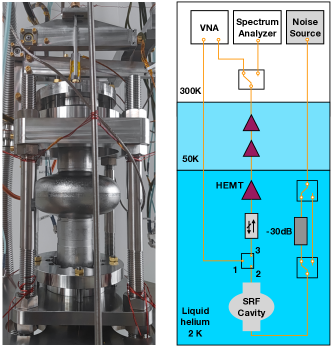
- A single-cell, 1.3 GHz elliptical SRF cavity was mechanically tuned via a cryogenic actuator to scan its resonant frequency over a 1.37 MHz bandwidth centered at 1.3 GHz.
- The cavity was operated at 2 K in liquid helium, maintaining a quality factor of approximately 10^10, enabling high signal-to-noise ratio and enhanced sensitivity.
- A reference signal power $ P_{\text{ref}}^{i} $ was defined based on the expected signal for ε = 1, scaled by system parameters including effective voltage, coupling, and net gain.
- Statistical analysis used a likelihood function $ \text{Pr}(p_i|\epsilon, m_{A'}) $, combining data from adjacent frequency bins to compute 90% confidence upper limits on ε.
- Uncertainties in system parameters (e.g., $ V_{\text{eff}}, \beta, G_{\text{net}} $) were propagated into the reference power using a Fisher matrix approach, as detailed in the Supplemental Materials.
- The final sensitivity was validated by comparing measured signal power to the reference signal, with the product of bin-wise likelihoods used to derive exclusion limits.
Experimental results
Research questions
- RQ1Can a mechanically tunable SRF cavity be used to perform a continuous scan of the dark photon dark matter mass window?
- RQ2What is the sensitivity limit achievable for the kinetic mixing coefficient ε using a high-Q SRF cavity in a scan-based search?
- RQ3How does the ultra-high quality factor of SRF cavities enhance the detection sensitivity for weakly coupled dark photons?
- RQ4To what extent can the scan range be extended with improved tuning mechanisms in future experiments?
- RQ5Can the data analysis framework based on likelihood ratios and reference signal normalization effectively suppress systematics and yield robust exclusion limits?
Key findings
- The experiment achieved the most stringent constraints to date on the kinetic mixing coefficient ε for dark photon dark matter, with ε < 2.2 × 10^−16 across a significant portion of the scanned mass window.
- The sensitivity was limited primarily by the cavity's quality factor and system noise, with the measured Q ~ 10^10 enabling high signal accumulation and low noise levels.
- The scan covered a frequency range of 1.37 MHz centered at 1.3 GHz, corresponding to a dark photon mass range of approximately 1.37 MHz in width.
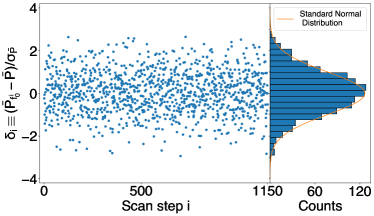
- The data analysis strategy, based on likelihood functions combining adjacent frequency bins, successfully suppressed statistical fluctuations and enabled robust 90% confidence upper limits.
- The results validate the use of SRF cavities as a promising platform for future dark matter searches, with potential for further sensitivity enhancement via squeezing, multi-mode coupling, or networked detectors.
- The study demonstrates the feasibility of using tunable SRF cavities for continuous scanning, with plans underway to extend the scan window using improved tuning mechanisms.
Better researchstarts right now
From reading papers to final review, dramatically reduce your research time.
No credit card · Free plan available
This review was created by AI and reviewed by human editors.