
[Paper Review] Floquet codes with a twist
The paper introduces a method to insert twist defects into the Z2 Floquet code, enabling fault-tolerant quantum information storage and processing, and extends the construction to ZN Floquet codes with twist defects and associated topological orders.
We describe a method for creating twist defects in the honeycomb Floquet code of Hastings and Haah. In particular, we construct twist defects at the endpoints of condensation defects, which are built by condensing emergent fermions along one-dimensional paths. We argue that the twist defects can be used to store and process quantum information fault tolerantly, and demonstrate that, by preparing twist defects on a system with a boundary, we obtain a planar variant of the $\mathbb{Z}_2$ Floquet code. Importantly, our construction of twist defects maintains the connectivity of the hexagonal lattice, requires only 2-body measurements, and preserves the three-round period of the measurement schedule. We furthermore generalize the twist defects to $\mathbb{Z}_N$ Floquet codes defined on $N$-dimensional qudits. As an aside, we use the $\mathbb{Z}_N$ Floquet codes and condensation defects to define Floquet codes whose instantaneous stabilizer groups are characterized by the topological order of certain Abelian twisted quantum doubles.
Motivation & Objective
- Motivate and develop twist defects in the honeycomb Z2 Floquet code to enable robust quantum information storage and processing.
- Preserve lattice connectivity and the three-round measurement schedule while introducing twist defects.
- Generalize the twist defect construction to ZN Floquet codes on N-dimensional qudits.
- Explore how condensation of emergent fermions along open paths yields endpoints that host twist defects.
- Bridge Floquet code dynamics with condensation defect concepts to realize planar and boundary variants.
Proposed method
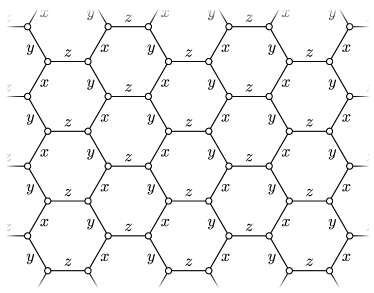
- Define emergent fermion string operators W^{ψ}_{γ} along open paths γ and use their condensation at endpoints to host twist defects.
- Modify the check operators along an open path to create defect checks that implement a defect line while preserving ISG structure.
- Use a four-step procedure to insert defect lines: define W^{ψ}_{γ}, truncate endpoints, decompose into two-body defect checks, and remove non-commuting original checks.
- Show that e and m anyons are permuted across the defect line and that emergent fermions can be condensed at endpoints, realizing twist defects.
- Provide a periodic measurement schedule that includes defect checks and analyze the resulting instantaneous stabilizer groups (ISGs).
- Extend the construction to ZN Floquet codes on N-dimensional qudits and relate to twisted quantum doubles.
Experimental results
Research questions
- RQ1How can twist defects be embedded in the Z2 Floquet code without breaking the measurement schedule or lattice connectivity?
- RQ2Can emergent fermion condensation at defect endpoints produce robust twist defects that store and manipulate quantum information?
- RQ3How do twist defects behave under the Floquet dynamics, and how can logical information be encoded and read out?
- RQ4Does the construction extend naturally to ZN Floquet codes and produce more exotic topological orders such as Abelian twisted quantum doubles?
Key findings
- Twist defects can be inserted in the Z2 Floquet code by a mild modification of the two-body checks along an open path, preserving the three-round cycle and lattice connectivity.
- The endpoints of the defect lines host twist defects where emergent fermions can condense, creating a robust defect structure.
- Across the ISG sequence, e and m anyons are permuted by the defect line, while ψ anyons (the emergent fermions) can be condensed at the endpoints, realizing twist defects.
- The construction yields a planar variant of the Z2 Floquet code with boundaries and supports fault-tolerant storage and processing of quantum information.
- The approach generalizes to ZN Floquet codes on N-dimensional qudits, and can be used to define Floquet codes with ISGs matching Abelian twisted quantum doubles.
Better researchstarts right now
From reading papers to final review, dramatically reduce your research time.
No credit card · Free plan available
This review was created by AI and reviewed by human editors.