
[Paper Review] Fluctuation without dissipation: Microcanonical Langevin Monte Carlo
This paper proposes Microcanonical Langevin Monte Carlo (MCLMC), a dissipation-free stochastic sampling method that maintains energy conservation while achieving the target canonical distribution on configuration space. Unlike traditional Langevin dynamics, MCLMC uses noise that preserves energy, enabling faster convergence—12× faster than HMC on 8×8 lattices and 32× faster on 64×64 lattices—due to bias-free discretization and geometric ergodicity for convex potentials.
Stochastic sampling algorithms such as Langevin Monte Carlo are inspired by physical systems in a heat bath. Their equilibrium distribution is the canonical ensemble given by a prescribed target distribution, so they must balance fluctuation and dissipation as dictated by the fluctuation-dissipation theorem. In contrast to the common belief, we show that the fluctuation-dissipation theorem is not required because only the configuration space distribution, and not the full phase space distribution, needs to be canonical. We propose a continuous-time Microcanonical Langevin Monte Carlo (MCLMC) as a dissipation-free system of stochastic differential equations (SDE). We derive the corresponding Fokker-Planck equation and show that the stationary distribution is the microcanonical ensemble with the desired canonical distribution on configuration space. We prove that MCLMC is ergodic for any nonzero amount of stochasticity, and for smooth, convex potentials, the expectation values converge exponentially fast. Furthermore, the deterministic drift and the stochastic diffusion separately preserve the stationary distribution. This uncommon property is attractive for practical implementations as it implies that the drift-diffusion discretization schemes are bias-free, so the only source of bias is the discretization of the deterministic dynamics. We applied MCLMC on a lattice $ϕ^4$ model, where Hamiltonian Monte Carlo (HMC) is currently the state-of-the-art integrator. For the same accuracy, MCLMC converges 12 times faster than HMC on an $8 imes8$ lattice. On a $64 imes64$ lattice, it is already 32 times faster. The trend is expected to persist to larger lattices, which are of particular interest, for example, in lattice quantum chromodynamics.
Motivation & Objective
- To develop a stochastic sampling method that bypasses the fluctuation-dissipation theorem by focusing only on the configuration space distribution.
- To show that energy-conserving dynamics can yield the correct target distribution without phase-space canonical equilibrium.
- To design a continuous-time SDE framework—Microcanonical Langevin Monte Carlo (MCLMC)—that ensures ergodicity and fast convergence.
- To demonstrate superior performance of MCLMC over HMC and NUTS in high-dimensional lattice field theories, especially under critical slowing down.
- To enable practical, bias-free discretization schemes by separating drift and diffusion in a way that preserves the stationary distribution.
Proposed method
- Proposes a continuous-time SDE system where stochastic noise conserves total energy, eliminating the need for velocity damping.
- Derives the corresponding Fokker-Planck equation for MCLMC, proving its stationary distribution matches the target on configuration space.
- Establishes that the deterministic drift and stochastic diffusion components each preserve the stationary distribution independently.
- Proves ergodicity for any nonzero noise level and geometric ergodicity under smooth, convex potentials.
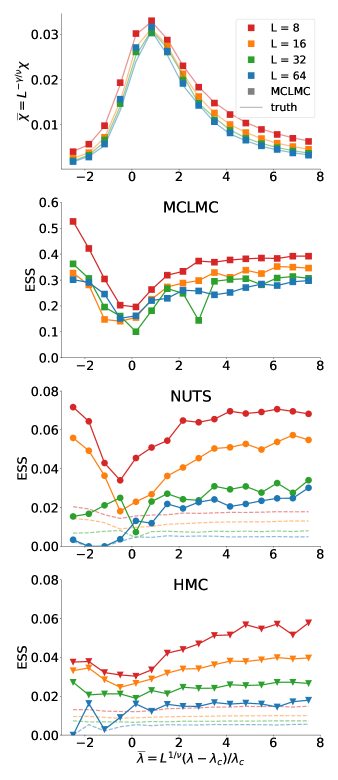
- Applies MCLMC to a lattice φ⁴ model and compares it with HMC and NUTS using susceptibility and ESS per gradient evaluation as metrics.
- Uses an annealing scheme with warm-up sampling and includes tuning costs in performance comparisons for fair benchmarking.
Experimental results
Research questions
- RQ1Can a stochastic sampling method avoid the fluctuation-dissipation theorem while still achieving the correct target distribution on configuration space?
- RQ2Does energy-conserving noise in an SDE framework lead to a stationary distribution matching the desired canonical distribution?
- RQ3Can MCLMC achieve faster convergence than HMC in high-dimensional lattice field theories, especially near phase transitions?
- RQ4Is the discretization of MCLMC free of bias when the drift and diffusion are treated separately?
- RQ5How does MCLMC performance scale with lattice size compared to HMC and NUTS, particularly under critical slowing down?
Key findings
- MCLMC achieves a 12× speedup over HMC on an 8×8 lattice and a 32× speedup on a 64×64 lattice for the same accuracy in the φ⁴ model.
- The effective sample size (ESS) per gradient evaluation for MCLMC is nearly independent of lattice size and coupling strength, unlike HMC and NUTS, which suffer from critical slowing down.
- MCLMC outperforms both HMC and NUTS by at least 40× when tuning costs are included, with a projected advantage of 2–3 orders of magnitude at d=10⁸.
- The method is geometrically ergodic for smooth, log-convex potentials, ensuring exponential convergence of expectation values.
- Discretization of MCLMC introduces no bias from drift-diffusion coupling, as both components separately preserve the stationary distribution.
- MCLMC's wall-clock time at L=64 is a fraction of a second on a GPU, while normalizing flow-based samplers require hours and become infeasible at larger lattices.
Better researchstarts right now
From reading papers to final review, dramatically reduce your research time.
No credit card · Free plan available
This review was created by AI and reviewed by human editors.