
[Paper Review] Forecasting Large Realized Covariance Matrices: The Benefits of Factor Models and Shrinkage
This paper proposes a factor-based, shrinkage-regularized vector heterogeneous autoregressive (VHAR) model to forecast large realized covariance matrices of S&P 500 stocks. By decomposing covariance via firm-level factors (size, value, profitability) and imposing sectoral restrictions on residuals, then estimating with LASSO, the method significantly improves forecast accuracy and minimum variance portfolio performance over standard benchmarks.
We propose a model to forecast large realized covariance matrices of returns, applying it to the constituents of the S\&P 500 daily. To address the curse of dimensionality, we decompose the return covariance matrix using standard firm-level factors (e.g., size, value, and profitability) and use sectoral restrictions in the residual covariance matrix. This restricted model is then estimated using vector heterogeneous autoregressive (VHAR) models with the least absolute shrinkage and selection operator (LASSO). Our methodology improves forecasting precision relative to standard benchmarks and leads to better estimates of minimum variance portfolios.
Motivation & Objective
- To address the curse of dimensionality in forecasting large realized covariance matrices of financial assets.
- To improve forecasting precision and portfolio risk management in high-dimensional settings using economic factors and shrinkage.
- To evaluate the model’s performance in conditional mean-variance portfolio allocation under realistic constraints like no short-selling and position limits.
- To compare the proposed method against standard benchmarks, including random walk, DCC, BEKK, and nonlinear GARCH models.
- To demonstrate the effectiveness of combining factor models with LASSO regularization in handling high-dimensional, time-varying covariance matrices.
Proposed method
- Decompose the realized covariance matrix into a factor component using standard firm-level factors: size, value, and profitability.
- Apply sectoral restrictions to the residual covariance matrix to reduce dimensionality and improve estimation stability.
- Model the dynamics of the residual covariance using vector heterogeneous autoregressive (VHAR) processes with daily, weekly, and monthly lags.
- Estimate the VHAR models using the least absolute shrinkage and selection operator (LASSO) to handle high-dimensional parameter spaces and promote sparsity.
- Use the composite realized kernel estimator (Lunde et al., 2016) to compute intraday-based realized covariance matrices.
- Evaluate model performance using out-of-sample forecasting accuracy and portfolio optimization metrics such as Sharpe ratio and turnover.
Experimental results
Research questions
- RQ1Can a factor-based decomposition combined with LASSO regularization improve the forecasting accuracy of large realized covariance matrices?
- RQ2How does the proposed model compare to standard benchmarks like random walk, DCC-NL, BEKK-NL, and AFM1-DCC-NL in forecasting large covariance matrices?
- RQ3To what extent does the model enhance the performance of minimum variance portfolios under long-only and position-constrained conditions?
- RQ4Does incorporating sectoral restrictions in the residual covariance matrix lead to more stable and accurate forecasts?
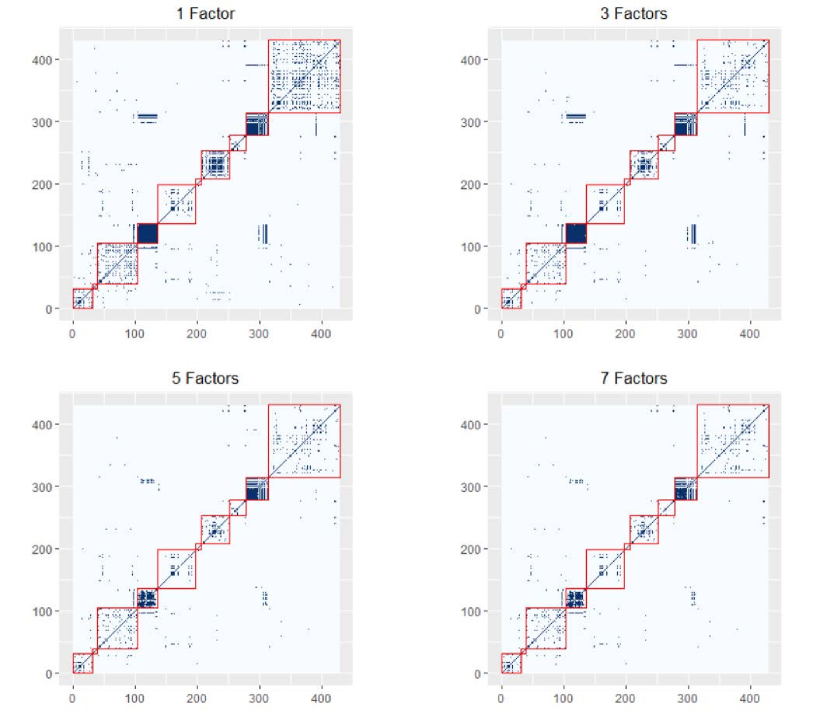
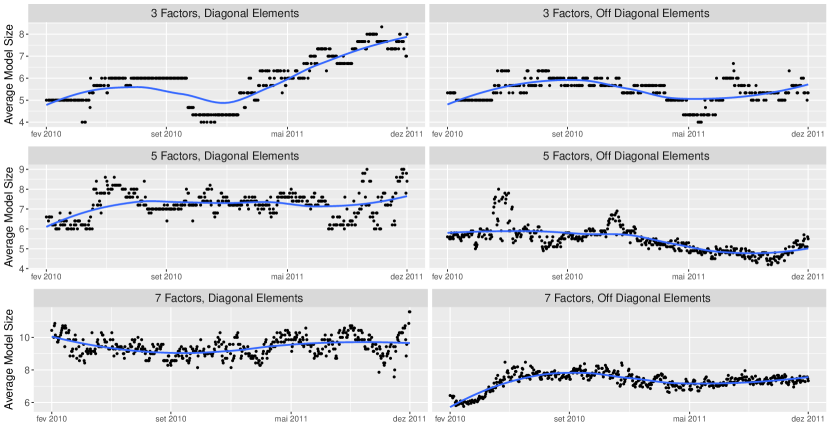
- RQ5What is the impact of using different numbers of factors (1 to 7) on forecasting and portfolio performance?
Key findings
- The VHAR model with seven factors estimated via LASSO achieved the highest Sharpe ratio of 1.10 in the long-only minimum variance portfolio, outperforming all benchmarks.
- The model reduced portfolio standard deviation to 16.31% (vs. 17.10% for random walk) and improved cumulative return to 37.38% over the out-of-sample period.
- The LASSO-estimated VHAR with seven factors achieved the lowest lower partial standard deviation (16.89%) and kurtosis (3.69), indicating better risk control.
- The model significantly outperformed the random walk and EWMA benchmarks in terms of Sharpe ratio, cumulative return, and turnover, especially under long-only constraints.
- The inclusion of sectoral restrictions in the residual covariance matrix enhanced forecast stability and contributed to improved portfolio diversification and lower concentration risk.
- The adaptive LASSO variant slightly outperformed standard LASSO in some metrics, but the difference was marginal, suggesting robustness of the LASSO approach.
Better researchstarts right now
From reading papers to final review, dramatically reduce your research time.
No credit card · Free plan available
This review was created by AI and reviewed by human editors.