
[Paper Review] Fractional quantum anomalous Hall states in twisted bilayer MoTe$_2$ and WSe$_2$
The paper shows, via exact diagonalization, that AA-stacked twisted bilayer MoTe2 and WSe2 host fractional quantum anomalous Hall states at zero magnetic field at fillings n=1/3 and 2/3, with Ising ferromagnetism pervasive across densities.
We demonstrate via exact diagonalization that AA-stacked TMD homobilayers host fractional quantum anomalous Hall (FQAH) states with fractionally quantized Hall conductance at fractional fillings $n=\frac{1}{3},\, \frac{2}{3}$ and zero magnetic field. While both states are most robust at angles near $θ\approx 2^{\circ}$, the $n=\frac{1}{3}$ state gives way to a charge density wave with increasing twist angle whereas the $n=\frac{2}{3}$ state survives across a much broader range of twist angles. We show that the competition between FQAH states and charge density wave or metallic phases is primarily controlled by the wavefunctions and dispersion of the underlying Chern band, respectively. Additionally, Ising ferromagnetism is found across a broad range of fillings where the system is insulating or metallic alike. The spin gap is enhanced at filling fractions where integer and fractional quantum anomalous Hall states are formed.
Motivation & Objective
- Motivate the search for zero-field fractional quantum anomalous Hall states in moiré TMD homobilayers.
- Identify how band topology, bandwidth, and interactions yield FQAH states at fractional fillings in realistic twist angles.
- Demonstrate Ising ferromagnetism across broad carrier densities and its relation to topological phases.
Proposed method
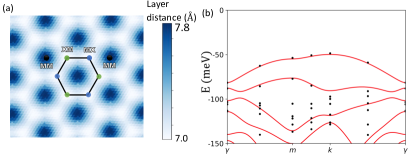
- Construct a continuum model for AA-stacked twisted TMD homobilayers with layer pseudospin and spin-valley locking.
- Fit moiré potential and interlayer tunneling to first-principles DFT results and derive a low-energy Hamiltonian.
- Project to the lowest moiré band and use exact diagonalization with unscreened Coulomb interaction to study many-body states.
- Analyze ground-state degeneracies, spectral flow under flux insertion, and crystal momenta to identify FQAH states.
- Compare twist-angle and interaction strength effects on the FQAH stability and competing phases such as CDW and metal.

Experimental results
Research questions
- RQ1Do AA-stacked twisted TMD homobilayers host fractional quantum anomalous Hall states at zero magnetic field?
- RQ2What fractional fillings (n) realize FQAH, and how robust are these states across twist angles and interactions?
- RQ3How do band topology and dispersion influence competition between FQAH, CDW, and metallic phases?
- RQ4Ising ferromagnetism and spin gaps persist across fillings and how do they relate to topological states?
- RQ5What signatures (ground-state degeneracy, spectral flow) confirm FQAH in finite-size studies?
Key findings
- FQAH states are stabilized at fillings n=1/3 and n=2/3 in twisted MoTe2/WSe2, with fractionally quantized Hall conductance at zero field.
- The n=1/3 state is robust near twists around 2 degrees but transitions to a CDW with larger twist angles; the n=2/3 state persists over a broader twist-angle range before giving way to a metal.
- Ising ferromagnetism is widespread across fillings, with spin gaps enhanced where integer and fractional QAH states form, and a spin gap >10 meV at n=1.
- Top moiré bands have Chern numbers of opposite sign for the two valleys, and the FQAH states exhibit threefold ground-state degeneracy and spectral flow consistent with FQH on a torus.
- The transition between FQAH and competing CDW/metal phases is controlled by Bloch-wavefunction topology (for n=1/3) and band dispersion (for n=2/3).
- The study links twist-angle–dependent band structure and interaction energy to the stabilization of FQAH states in realistic TMD moiré systems.
Better researchstarts right now
From reading papers to final review, dramatically reduce your research time.
No credit card · Free plan available
This review was created by AI and reviewed by human editors.