
[Paper Review] FraGNNet: A Deep Probabilistic Model for Tandem Mass Spectrum Prediction
FraGNNet is a deep probabilistic model that integrates a fragmentation DAG with two-stage graph neural networks to predict high-resolution MS/MS spectra and enable interpretable fragment annotations, achieving state-of-the-art C2MS performance.
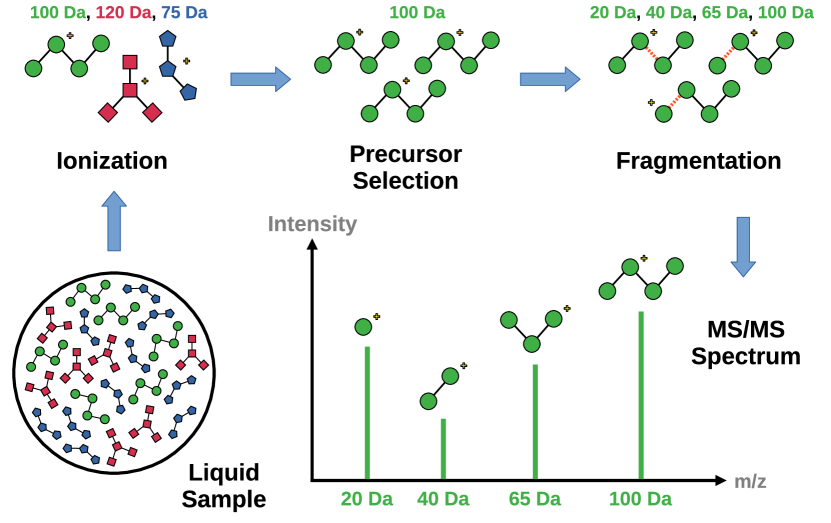
Compound identification from tandem mass spectrometry (MS/MS) data is a critical step in the analysis of complex mixtures. Typical solutions for the MS/MS spectrum to compound (MS2C) problem involve comparing the unknown spectrum against a library of known spectrum-molecule pairs, an approach that is limited by incomplete library coverage. Compound to MS/MS spectrum (C2MS) models can improve retrieval rates by augmenting real libraries with predicted MS/MS spectra. Unfortunately, many existing C2MS models suffer from problems with mass accuracy, generalization, or interpretability. We develop a new probabilistic method for C2MS prediction, FraGNNet, that can efficiently and accurately simulate MS/MS spectra with high mass accuracy. Our approach formulates the C2MS problem as learning a distribution over molecule fragments. FraGNNet achieves state-of-the-art performance in terms of prediction error and surpasses existing C2MS models as a tool for retrieval-based MS2C.
Motivation & Objective
- Motivate the need for high-resolution, scalable, and interpretable C2MS spectrum prediction to augment spectral libraries.
- Propose FraGNNet, a probabilistic C2MS model that combines heuristic fragmentation with learned latent distributions.
- Demonstrate state-of-the-art spectrum prediction and improved retrieval performance on NIST20 data.
- Provide interpretable fragment annotations and uncertainty signals (OS, latent entropy).
- Explore annotation consistency via ensemble analyses to assess fragmentation ambiguity.
Proposed method
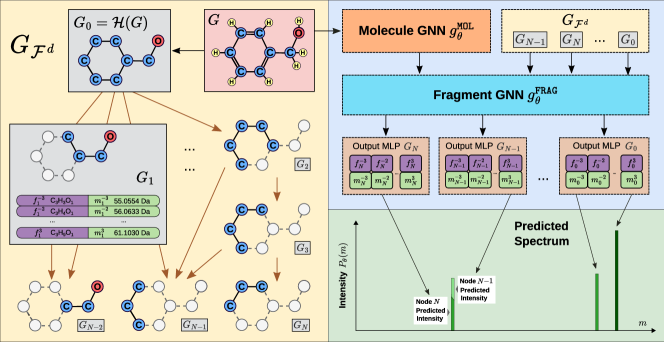
- Two-stage approach: generate an approximate fragmentation DAG G_F^d from the input molecule G and a heavy-atom skeleton; use a Fragment GNN to model distributions over fragments and associated formulae.
- Two latent distributions parameterized by a GNN: P_theta(n) over DAG nodes and P_theta(f|n) over formulae at each node.
- Mass spectrum P_theta(m) is a mixture of Gaussians over formula masses, with variance linked to mass and a truncation reflecting instrument error.
- Molecule GNN (GINE-based) produces atom/bond embeddings; Fragment GNN processes DAG nodes, incorporating subgraph features (heavy-atom skeleton, formula, DAG depth).
- Loss combines negative log-likelihood with optional outside-support (OS) handling and an entropy-regularized objective to encourage interpretable latent structure.
- Entropy-regularized latent terms H_hat_theta(n), H_hat_theta(f), H_hat_theta(f|n), H_hat_theta(n|f) to balance predictive performance and fragmentation interpretability.
Experimental results
Research questions
- RQ1Can FraGNNet achieve high-resolution spectrum predictions for C2MS while maintaining scalability?
- RQ2Does integrating a fragmentation DAG with neural latent variables improve retrieval-based MS2C performance compared to binned and other high-resolution models?
- RQ3To what extent can the model provide interpretable peak annotations via latent distributions over fragments and formulas?
- RQ4How does the depth of fragmentation (d) and hydrogen tolerance (j) affect spectrum coverage and prediction quality?
- RQ5Can entropy regularization yield meaningful variation in fragment annotations without sacrificing accuracy?
Key findings
- FraGNNet-D4 achieves state-of-the-art cosine similarity in spectrum prediction on NIST20 relative to baselines, outperforming other models on multiple metrics.
- In MS2C retrieval, FraGNNet-D4 and FraGNNet-D3 achieve top-1 to top-10 accuracies significantly higher than ICEBERG, MassFormer, and NEIMS.
- FraGNNet provides per-node formula-to-mpeak mappings, enabling interpretable peak annotations and the potential to identify OS (outside of the support) peaks.
- Increasing fragmentation depth from d=3 to d=4 improves performance, and lower P(M_OS) indicates better mass coverage.
- Latent annotation distributions exhibit variability across ensembles, illustrating both predictive consistency and fragmentation ambiguity, with entropy-regularized ensembles showing distinct annotation behavior.
Better researchstarts right now
From reading papers to final review, dramatically reduce your research time.
No credit card · Free plan available
This review was created by AI and reviewed by human editors.