
[Paper Review] From existing and new nuclear and astrophysical constraints to stringent limits on the equation of state of neutron-rich dense matter
This paper assembles diverse nuclear and astrophysical constraints within a physics-agnostic Bayesian framework to derive stringent limits on the neutron-star equation of state, yielding notable bounds on canonical neutron-star radii and maximum mass.
Through continuous progress in nuclear theory and experiment and an increasing number of neutron-star observations, a multitude of information about the equation of state (EOS) for matter at extreme densities is available. To constrain the EOS across its entire density range, this information needs to be combined consistently. However, the impact and model-dependency of individual observations vary. We present a broad compendium of different constraints and apply them individually to a large set of EOS candidates within a Bayesian framework. Specifically, we explore different ways how chiral effective field theory and perturbative quantum chromodynamics can be used to place a likelihood on EOS candidates. We also investigate the impact of nuclear experimental constraints, as well as different radio and X-ray observations of neutron star (NS) masses and radii. This is augmented by reanalyses of the existing data from BNS coalescences, in particular of GW170817, with improved models for the tidal waveform and kilonova light curves, which we also utilize to construct a tight upper limit of 2.39$\,$M$_\odot$ on the TOV mass based on GW170817's remnant. Our diverse set of constraints is eventually combined to obtain stringent limits on NS properties. We organize the combination in a way to distinguish between constraints where the systematic uncertainties are deemed small and those that rely on less conservative assumptions. For the former, we find the radius of the canonical 1.4$\,$M$_\odot$ neutron star to be $R_{1.4}= 12.26_{-0.91}^{+0.80}\,$km and the TOV mass at $M_{ m TOV}= 2.25_{-0.22}^{+0.42}\,$M$_\odot$ (95% credibility). Including all the presented constraints yields $R_{1.4}= 12.20_{-0.48}^{+0.50}\,$km and $M_{ m TOV}= 2.30_{-0.20}^{+0.07}\,$M$_\odot$.
Motivation & Objective
- Assess how different nuclear and astrophysical inputs constrain the dense-matter EOS.
- Construct a large, physics-agnostic prior set of EOS candidates spanning nucleonic to non-nucleonic high-density regimes.
- Quantify the impact of individual constraints (χEFT, pQCD, neutron skins, heavy-ion collisions, NS mass-radius data, GW, kilonovae) on EOS parameters.
- Combine constraints to infer canonical NS radius and TOV maximum mass with quantified uncertainties.
- Evaluate how different constraint combinations affect the inferred EOS and associated observables (R1.4, M_TOV, p3n_sat, n_TOV).
Proposed method
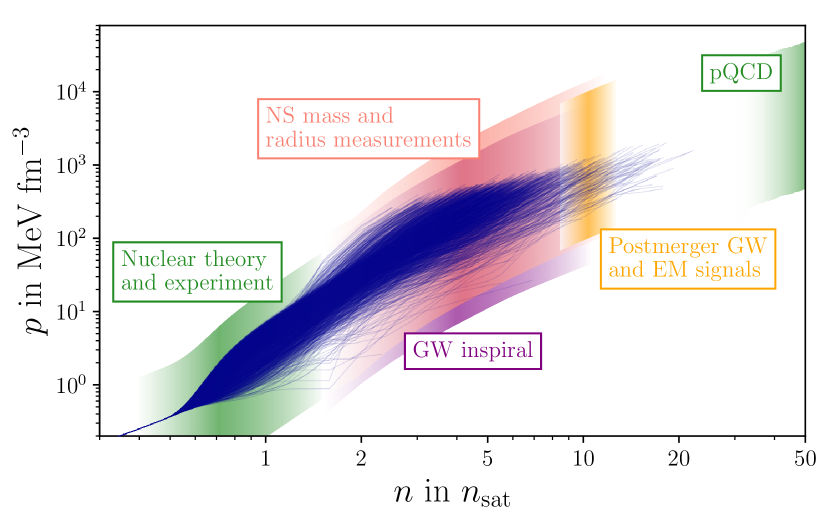
- Build an EOS prior set of 100,000 candidates using a meta-model for nucleonic matter up to n_break, with a crust model fixed at low densities.
- Attach a model-agnostic high-density extrapolation via a speed-of-sound approach with 9 grid points up to 25 n_sat, interpolating c_s^2(n).
- Apply χEFT constraints through a score function f(p,n) based on an AFDMC band, and compute the likelihood by product/integral over p(n) curves.
- Incorporate pQCD constraints by testing mechanical stability and causality of interpolations between low-density EOS and high-density pQCD regimes, with both a conservative matching at n_L = n_TOV and a more stringent pQCD* approach.
- Incorporate neutron-skin and heavy-ion data to constrain symmetry-energy parameters E_sym and L_sym via correlations with neutron-skin thickness.
- Use Bayesian posterior weighing of EOS candidates to derive distributions for R1.4, M_TOV, and related quantities.
Experimental results
Research questions
- RQ1What are the individual and combined impacts of χEFT, pQCD, neutron-skin, heavy-ion, and NS observations on the neutron-star EOS?
- RQ2How do constraints map onto the density regime of the EOS and which observables (R1.4, M_TOV) are most affected?
- RQ3What canonical NS radius R1.4 and TOV mass M_TOV are favored when all constraints are applied with varying stringency?
- RQ4How does the choice of pQCD matching prescription (conservative vs. pQCD*). influence the posterior EOS?
Key findings
- The analysis yields R1.4 = 12.27_{-0.94}^{+0.83} km and M_TOV = 2.26_{-0.22}^{+0.45} M_sun at 95% credibility when including constrained systematics.
- A less conservative combination of constraints gives R1.4 = 12.20_{-0.50}^{+0.53} km and M_TOV = 2.31_{-0.20}^{+0.08} M_sun.
- χEFT constraints prefer softer EOS at low densities but do not fully rule out stiff high-mass configurations due to high-density extrapolation flexibility.
- pQCD constraints disfavor very stiff or very soft EOS, with the pQCD* approach providing stronger constraints and shifting posteriors toward more informative M_TOV and p3n_sat ranges.
- Neutron-skinn measurements (PREX-II, CREX) influence the symmetry-energy parameters E_sym and L_sym, affecting the neutron-rich EOS region relevant for NSs.
![Figure 2: Score function $f(p,n)$ from Eq. ( 4 ) used in Eq. ( 6 ) to calculate the likelihood of an EOS given $\chi$ EFT constraints. The black dashed lines show the band obtained by $\chi$ EFT calculations in Ref. [ 46 ] .](https://ar5iv.labs.arxiv.org/html/2402.04172/assets/x2.png)
Better researchstarts right now
From reading papers to final review, dramatically reduce your research time.
No credit card · Free plan available
This review was created by AI and reviewed by human editors.