
[Paper Review] From Factor Models to Deep Learning: Machine Learning in Reshaping Empirical Asset Pricing
A comprehensive review of how machine learning and AI reshape empirical asset pricing, from traditional factor models to ML-based prediction, optimization, and multimodal data integration.
This paper comprehensively reviews the application of machine learning (ML) and AI in finance, specifically in the context of asset pricing. It starts by summarizing the traditional asset pricing models and examining their limitations in capturing the complexities of financial markets. It explores how 1) ML models, including supervised, unsupervised, semi-supervised, and reinforcement learning, provide versatile frameworks to address these complexities, and 2) the incorporation of advanced ML algorithms into traditional financial models enhances return prediction and portfolio optimization. These methods can adapt to changing market dynamics by modeling structural changes and incorporating heterogeneous data sources, such as text and images. In addition, this paper explores challenges in applying ML in asset pricing, addressing the growing demand for explainability in decision-making and mitigating overfitting in complex models. This paper aims to provide insights into novel methodologies showcasing the potential of ML to reshape the future of quantitative finance.
Motivation & Objective
- Assess limitations of traditional asset pricing models and need for flexible, data-driven approaches.
- Survey how ML methods (supervised, unsupervised, semi-supervised, reinforcement learning) address predictive accuracy and data heterogeneity.
- examine ML-augmented portfolio optimization and risk management.
- highlight challenges such as explainability, overfitting, data quality, and regulatory considerations, and outline future directions.
Proposed method
- Review traditional asset pricing frameworks and their limitations.
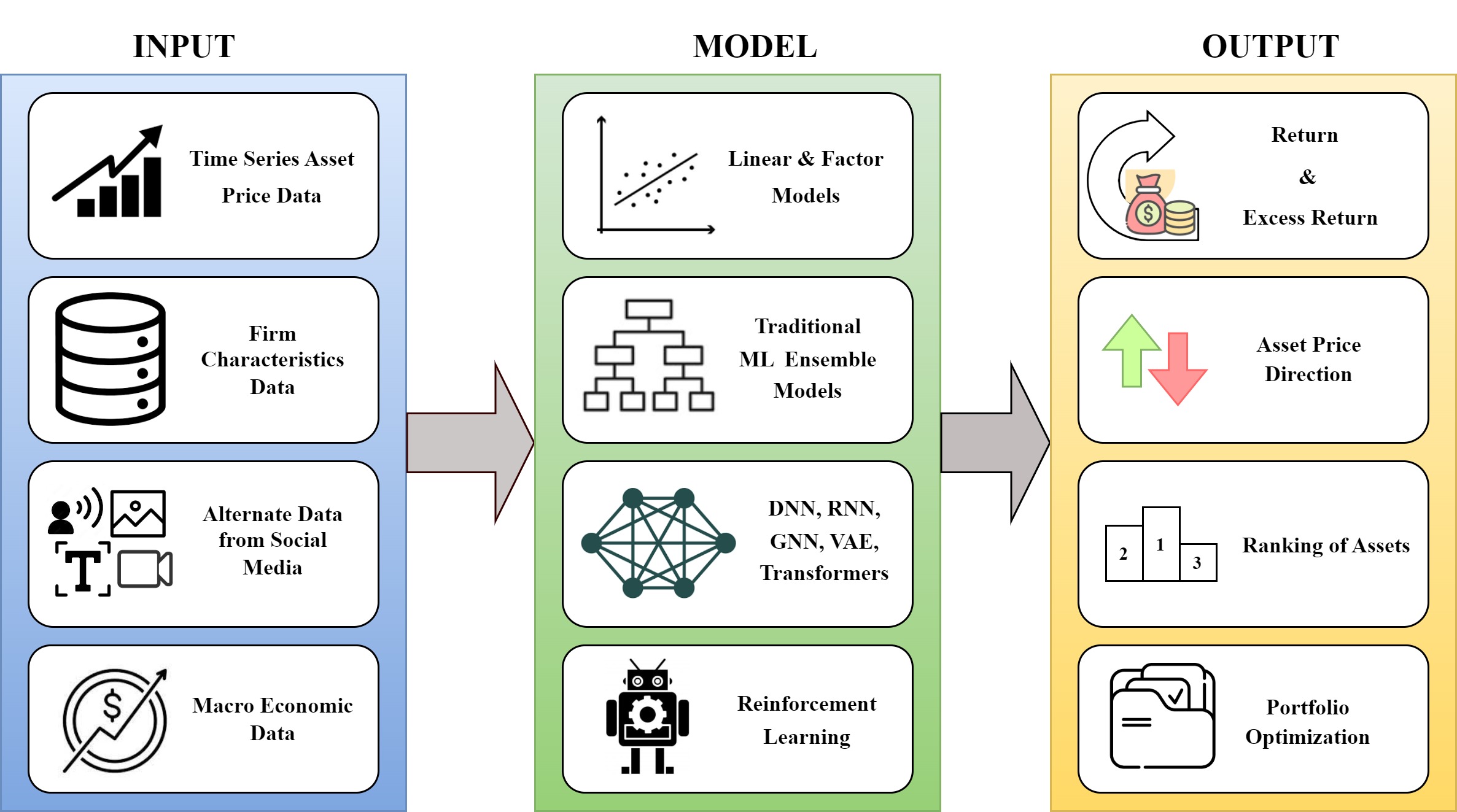
- Map ML families to asset pricing tasks (prediction, ranking, optimization).
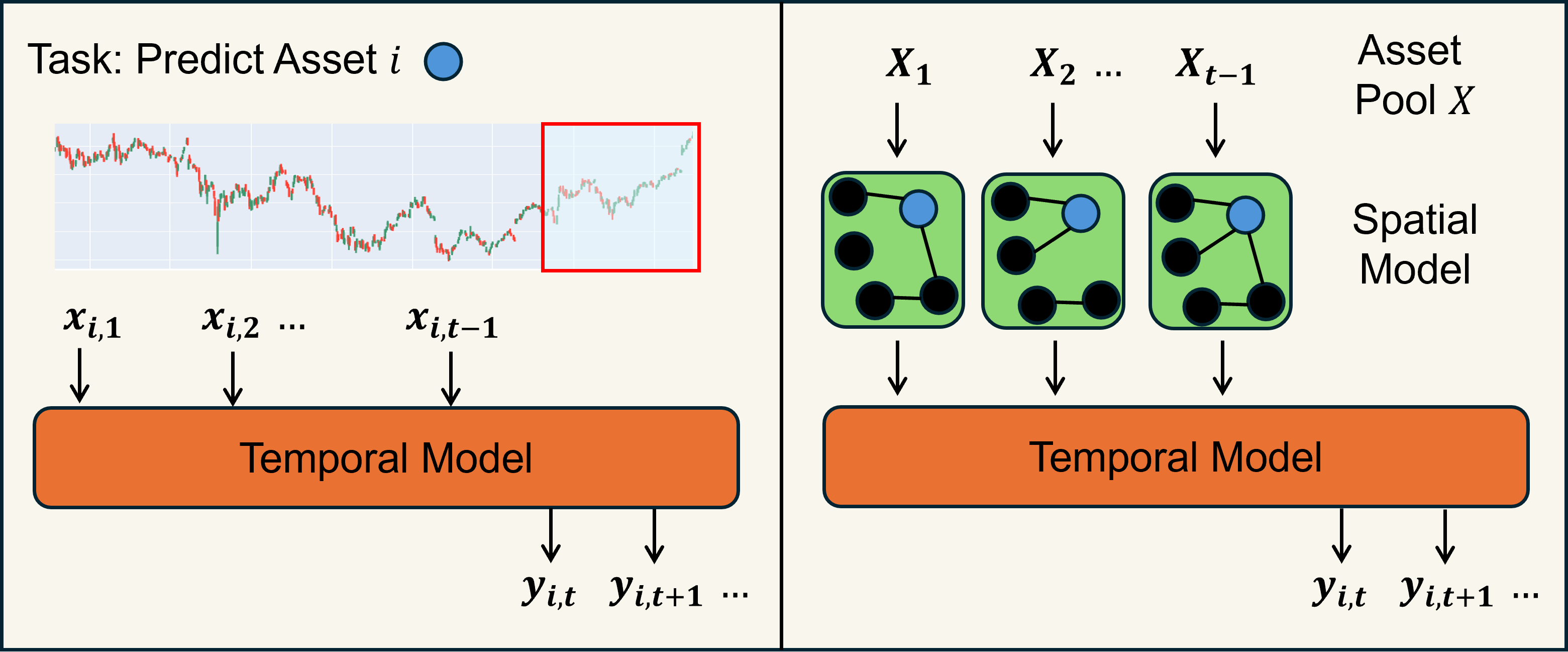
- Describe temporal and spatio-temporal ML models for asset pricing, including graphs/transformers.
- Discuss dimensionality reduction, missing data imputation, and incorporation of alternate data.
- Examine challenges and future directions in ML-based asset pricing.
Experimental results
Research questions
- RQ1How do ML approaches improve estimation of asset risk premia beyond traditional factor models?
- RQ2What ML architectures best capture temporal and cross-sectional dynamics in asset pricing (including graphs and transformers)?
- RQ3How can ML enhance portfolio optimization and risk management in empirical finance?
- RQ4What are the main challenges (overfitting, interpretability, data quality, regulation) and how can they be mitigated in ML-based asset pricing?
- RQ5What future research directions are most promising for integrating ML into asset pricing?
Key findings
- ML and AI offer flexible frameworks to model nonlinearities and incorporate heterogeneous data sources into asset pricing.
- ML advances span prediction, ranking, and portfolio optimization, with temporal and spatio-temporal models including graph-based methods.
- Dimensionality reduction and imputation techniques alleviate factor zoo issues and missing data, improving stability and interpretability.
- Incorporation of alternate data (text, images, speech) via multimodal models enhances pricing insights, aided by advances in transformers and DL.
- Authors discuss challenges such as overfitting, explainability, data access, regulatory compliance, and the need for online/adaptive learning frameworks.
Better researchstarts right now
From reading papers to final review, dramatically reduce your research time.
No credit card · Free plan available
This review was created by AI and reviewed by human editors.