
[Paper Review] Froude number scaling unifies impact trajectories into granular media across gravitational conditions
This study demonstrates that Froude number scaling collapses impact trajectories of intruders into granular media across varying gravitational conditions, revealing a universal dynamic behavior. Using hundreds of discrete element method (DEM) simulations, the authors show that when initial velocities are scaled by the Froude number, trajectories collapse onto a single curve, unifying behavior from Earth to low-gravity environments.
The interactions of solid objects with granular media is countered by a resistance force that stems from frictional forces between the grains and the media's resistance to inertia imposed by the intruder. Earlier theories of granular intrusion have suggested an additive contribution of these two families of forces and had tremendous success in predicting resistive forces on arbitrary shaped objects. However, it remains unclear how these forces are influenced by gravitational conditions. We examine the role of gravity on surface impact behavior into cohesionless granular media using hundreds of soft-sphere discrete element simulations, we demonstrate that the outcome of impacts remain qualitatively similar under varying gravitational conditions if initial velocities are scaled with the Froude number, suggesting an underlying law. Using theoretical arguments, we provide reasoning for the observed universality and show that there is a hidden dependency in resistive forces into granular media on Froude number. Following the theoretical framework, we show that Froude number scaling precisely collapses impact trajectories across gravitational conditions, setting the foundation for explorations in granular behavior beyond Earth.
Motivation & Objective
- Understand how gravity influences the dynamics of intruder impacts into cohesionless granular media.
- Address the challenge of simulating granular behavior under non-Earth gravity conditions due to experimental limitations.
- Identify a dimensionless scaling parameter that collapses trajectories across different gravitational environments.
- Establish a theoretical basis for Froude number scaling in granular impact dynamics.
- Provide a foundation for predicting granular behavior beyond Earth, including on asteroids and moons.
Proposed method
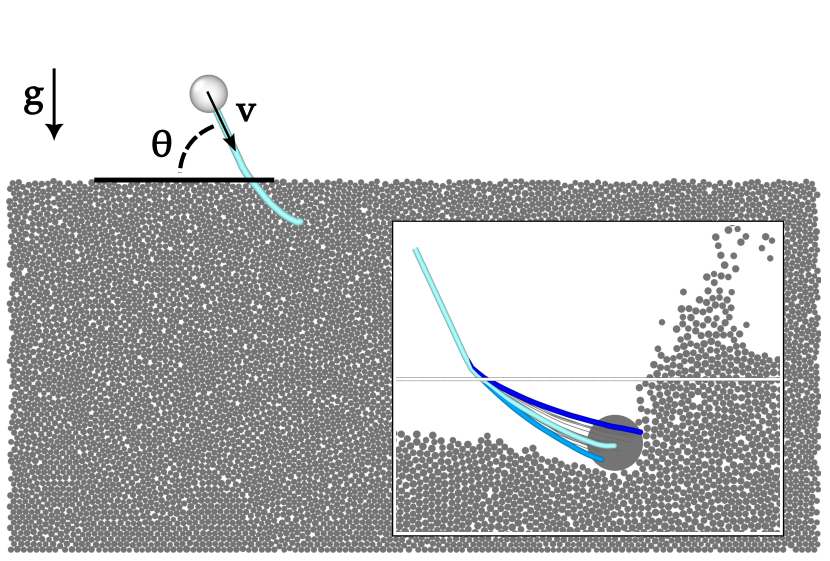
- Employed soft-sphere discrete element method (DEM) simulations using LAMMPS to model granular media and intruder interactions.
- Used Hertzian elastic contact forces with damping based on Tsuji et al. and Coulombic friction for particle-particle interactions.
- Applied the Discrete Resistive Force Theory (DRFT) numerically by discretizing the projectile into 20 segments and solving forces incrementally with fixed time steps.
- Tested numerical convergence for segment count (10–100) and time step (1e-3s to 1e-7s), settling on 20 segments and 1e-5s as baseline.
- Scaled initial velocities using the Froude number (Fr = v² / (gR)) to normalize dynamics across gravitational conditions.
- Theoretical analysis linked Froude scaling to the balance between inertial and gravitational forces, explaining trajectory collapse.
Experimental results
Research questions
- RQ1How does gravity influence the trajectory of an intruder during low-velocity oblique impact into granular media?
- RQ2Can a single dimensionless parameter unify impact trajectories across different gravitational environments?
- RQ3What is the theoretical basis for Froude number scaling in granular impact dynamics?
- RQ4To what extent does Froude scaling collapse trajectories when gravity and initial velocity are varied?
- RQ5How do temporal and spatial scales of impact dynamics relate across different gravities under Froude scaling?
Key findings
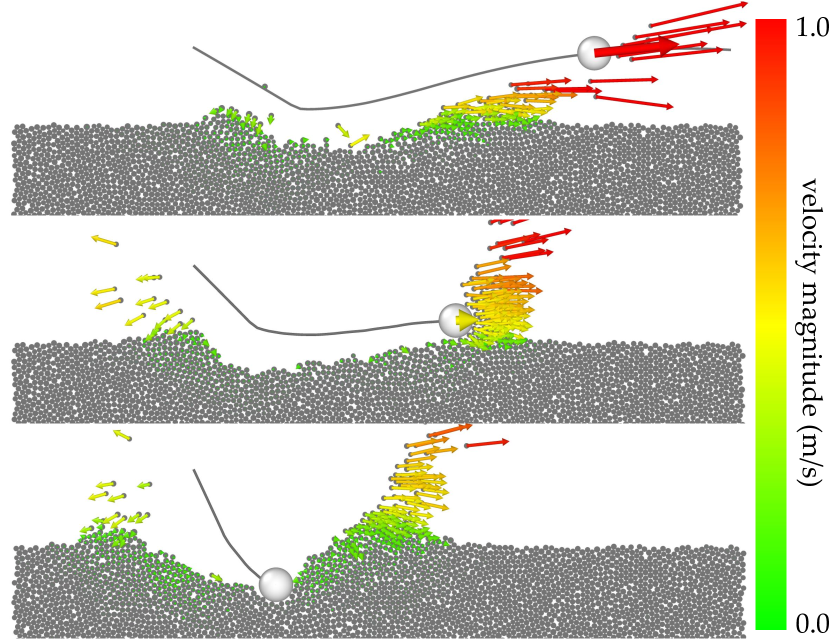
- Froude number scaling collapses impact trajectories into a single universal curve across gravitational conditions, from Earth to low-gravity environments.
- Theoretical analysis confirms that resistive forces in granular media depend on the Froude number, revealing a hidden scaling law.
- Trajectories simulated under varying gravity (from 0.1g to 1g) collapse precisely when initial velocity is scaled by √g, confirming Froude scaling.
- Temporal evolution of impact is also scaled by a factor derived from the Froude number, enabling time-domain collapse.
- The scaling holds under the assumption of cohesionless media and constant compaction, isolating gravity as the sole variable.
- The study provides a framework for predicting granular impact behavior on non-Earth bodies, such as asteroids and moons, using Earth-based simulations with Froude scaling.
Better researchstarts right now
From reading papers to final review, dramatically reduce your research time.
No credit card · Free plan available
This review was created by AI and reviewed by human editors.