
[Paper Review] FuNVol: A Multi-Asset Implied Volatility Market Simulator using Functional Principal Components and Neural SDEs
FuNVol proposes a generative model for multi-asset implied volatility (IV) surfaces using functional principal components (FPCs) and neural stochastic differential equations (SDEs), enabling realistic simulation of arbitrage-free IV dynamics. The method projects IV surfaces onto Legendre basis functions, reduces dimensionality via FPCA, and models temporal evolution with neural SDEs, producing P&L distributions from delta hedging that closely match real market outcomes.
We introduce a new approach for generating sequences of implied volatility (IV) surfaces across multiple assets that is faithful to historical prices. We do so using a combination of functional data analysis and neural stochastic differential equations (SDEs) combined with a probability integral transform penalty to reduce model misspecification. We demonstrate that learning the joint dynamics of IV surfaces and prices produces market scenarios that are consistent with historical features and lie within the sub-manifold of surfaces that are essentially free of static arbitrage. Finally, we demonstrate that delta hedging using the simulated surfaces generates profit and loss (P&L) distributions that are consistent with realised P&Ls.
Motivation & Objective
- To develop a generative model that simulates realistic, arbitrage-free implied volatility (IV) surfaces across multiple assets over time.
- To overcome limitations of parametric models (e.g., SVI, SABR) and interpolation methods that may introduce static arbitrage or impose strong shape assumptions.
- To jointly model IV surface dynamics and underlying asset prices in a way that preserves historical market features and consistency with real-world P&L behavior.
- To enable downstream applications such as reinforcement learning for hedging, portfolio allocation, and statistical arbitrage by generating large-scale, realistic market scenarios.
- To demonstrate that simulated delta-hedging P&L distributions align closely with realized P&L from actual market data.
Proposed method
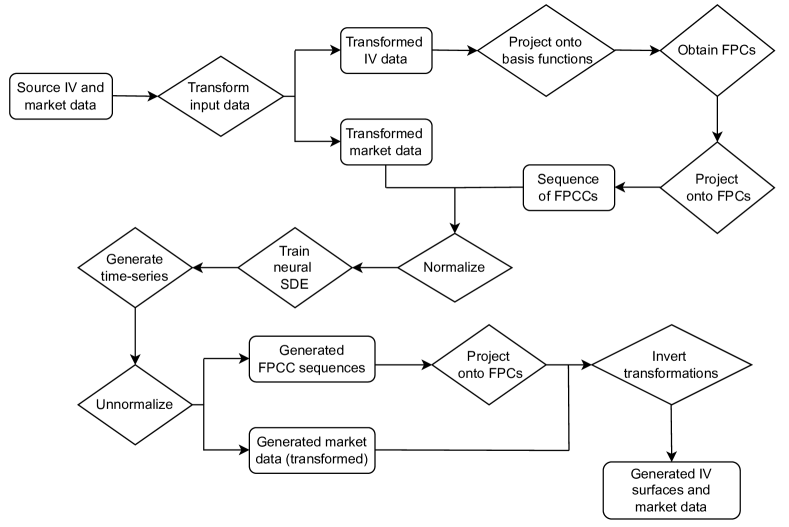
- Project discrete IV data (on a grid of strikes and maturities) onto Legendre basis functions to create continuous, orthogonal functional representations of IV surfaces.
- Apply functional principal component analysis (FPCA) to extract dominant modes of variation across multiple assets and reduce dimensionality to a low-rank functional subspace.
- Model the temporal evolution of FPC scores using non-Markovian neural SDEs with learnable drift and diffusion functions parameterized by neural networks.
- Incorporate a probability integral transform penalty to enforce that simulated IV surfaces remain free of static arbitrage, even when training data contains arbitrage.
- Simultaneously generate correlated sequences of IV surfaces and underlying asset prices by conditioning the neural SDE on historical price paths.
- Validate the model by applying delta-hedging strategies on simulated paths and comparing resulting P&L distributions to those from real market data.
Experimental results
Research questions
- RQ1Can a functional data analysis and neural SDE-based framework generate multi-asset implied volatility surfaces that are consistent with historical market dynamics and free of static arbitrage?
- RQ2How well can the model simulate joint dynamics of IV surfaces and underlying asset prices without assuming a parametric form for the surfaces?
- RQ3To what extent do P&L distributions from delta-hedging strategies based on simulated surfaces match those observed in real market data?
- RQ4Can the model generate realistic, arbitrage-free IV surfaces even when trained on data containing static arbitrage?
- RQ5How effective is the probability integral transform penalty in enforcing arbitrage-free constraints without explicit penalization?
Key findings
- The model successfully generates multi-asset implied volatility surfaces that are consistent with historical market features and lie within the sub-manifold of arbitrage-free surfaces, even without explicit arbitrage penalties.
- The P&L distribution from delta hedging on 10,000 simulated paths for four equities (AMZN, IBM, INTC, TSLA) closely matches the realized P&L distribution observed in actual market data.
- For the ATM option, the realized P&L of 25.0 (AMZN), -0.87 (IBM), -0.01 (INTC), and -12.08 (TSLA) fell within the interquartile range of the simulated P&L distributions, indicating strong realism.
- The model achieves accurate surface reconstruction and dynamics modeling without assuming parametric forms like SABR or SVI, relying instead on functional basis projections and neural SDEs.
- The use of Legendre basis functions enables stable and orthogonal functional representation, simplifying FPCA and improving numerical stability.
- The framework is flexible and extensible, allowing integration of additional market features (e.g., interest rates, VIX, volume) into the neural SDE for enhanced realism.
Better researchstarts right now
From reading papers to final review, dramatically reduce your research time.
No credit card · Free plan available
This review was created by AI and reviewed by human editors.