
[Paper Review] Future changes in the vertical structure of severe convective storm environments over the U.S. central Great Plains
This study investigates how climate change will alter the full vertical structure of severe convective storm environments across the U.S. central Great Plains, focusing on thermodynamic and kinematic profiles under fixed high CAPE and high shear conditions. Despite modest changes in boundary layer moisture and free tropospheric lapse rate, increased low-level wind shear and storm-relative helicity suggest a heightened potential for tornadoes, though opposing effects from entrainment and higher LCLs may offset these trends.
The effect of warming on severe convective storm potential is commonly explained in terms of changes in vertically-integrated ("bulk") environmental parameters, such as CAPE and 0--6 km shear. However, such events are known to depend on details of the vertical structure of the thermodynamic and kinematic environment that can change independently of these bulk parameters. This work examines how warming may affect the complete vertical structure of these environments for fixed ranges of values of high CAPE and bulk shear, using data over the central Great Plains from two high-performing climate models. Temperature profiles warm relatively uniformly with height, with a slight decrease in free tropospheric lapse rate, and the tropopause shifts upwards at constant temperature. The boundary layer becomes slightly drier (-2--4\% relative humidity) while the free troposphere becomes slightly moister (+2--3\%). Moist static energy (MSE) increases relatively uniformly with height with slightly larger increase within the boundary layer. Moist static energy deficit increases slightly above 4 km altitude. Wind shear and storm-relative helicity increase within the lowest 1.5 km associated with stronger hodograph curvature. Changes are broadly consistent between the two models despite differing biases relative to ERA5. The increased low-level shear and SRH suggests an increased potential for severe thunderstorms and tornadoes, while the slight increase in free tropospheric MSE deficit (enhanced entrainment) and decrease in boundary layer relative humidity (higher LCL) may oppose these effects. Evaluation of the net response of severe convective storm outcomes cannot be ascertained here but could be explored in simulation experiments.
Motivation & Objective
- To assess how the complete vertical thermodynamic and kinematic structure of severe convective storm environments may change under climate warming, independent of bulk parameters like CAPE and shear.
- To evaluate whether changes in vertical profile details—such as lapse rate, moisture, and hodograph curvature—could alter the risk of severe thunderstorms and tornadoes beyond what is predicted by bulk parameters alone.
- To test the robustness of these changes across two high-performing climate models despite differing biases relative to ERA5 reanalysis.
- To identify key environmental changes that may influence tornadogenesis and convective intensity, even when CAPE and bulk shear are held constant.
Proposed method
- Used 6-hourly ERA5 reanalysis data and CMIP6 model outputs (historical and SSP585 scenarios) for the central Great Plains region.
- Selected environments with fixed high CAPE and high 0–6 km shear (S06) to isolate changes in vertical structure independent of bulk parameters.
- Analyzed temperature, moisture, wind, and derived variables (e.g., moist static energy, storm-relative helicity) across the full atmospheric column.
- Computed vertical profiles of key variables including lapse rate, relative humidity, moist static energy (MSE), and hodograph curvature to assess changes in entrainment and low-level vorticity.
- Compared results between two CMIP6 models (with different biases relative to ERA5) to test robustness of findings.
- Used statistical and visual analysis (e.g., profile plots, anomaly maps) to interpret changes in environmental structure.
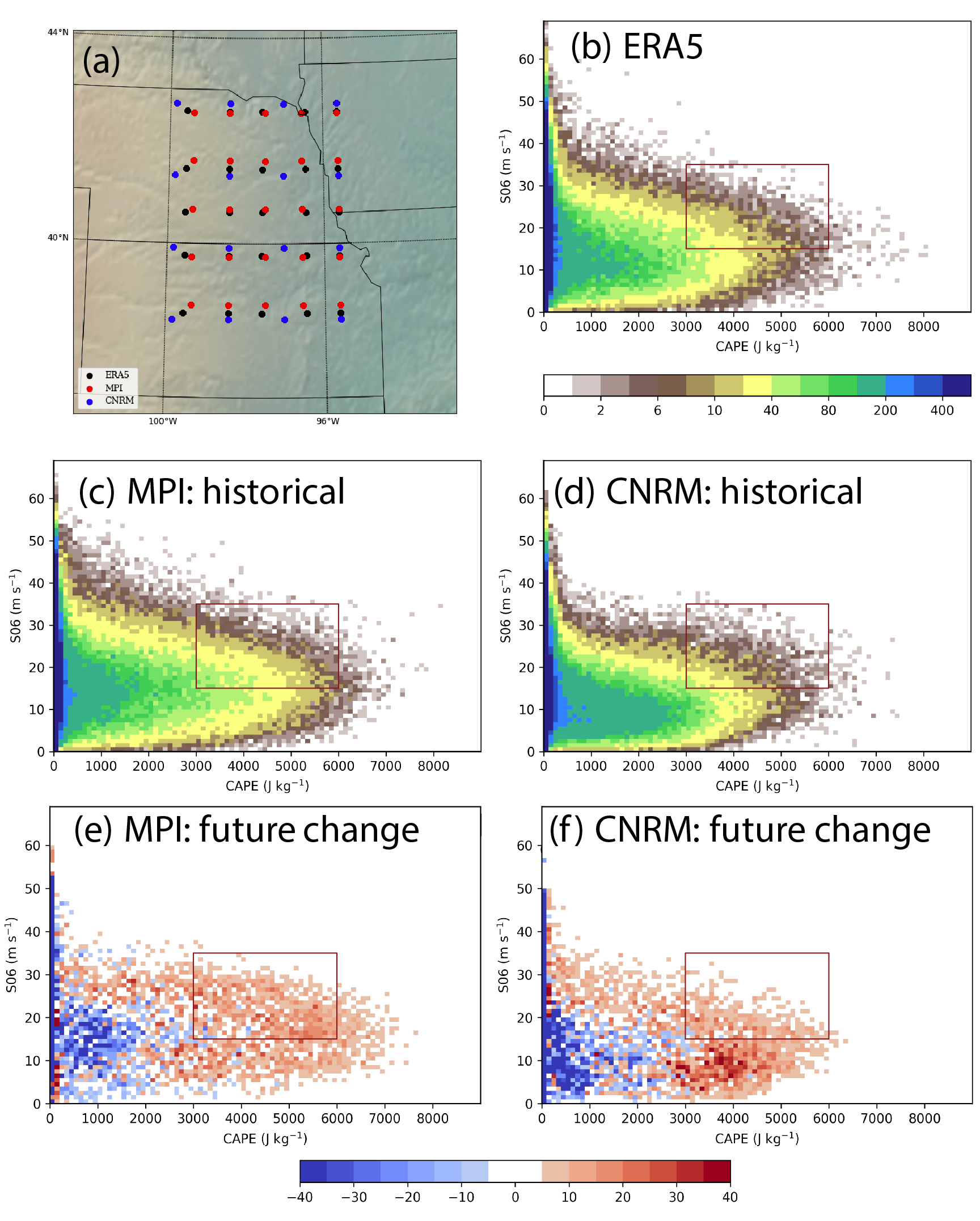
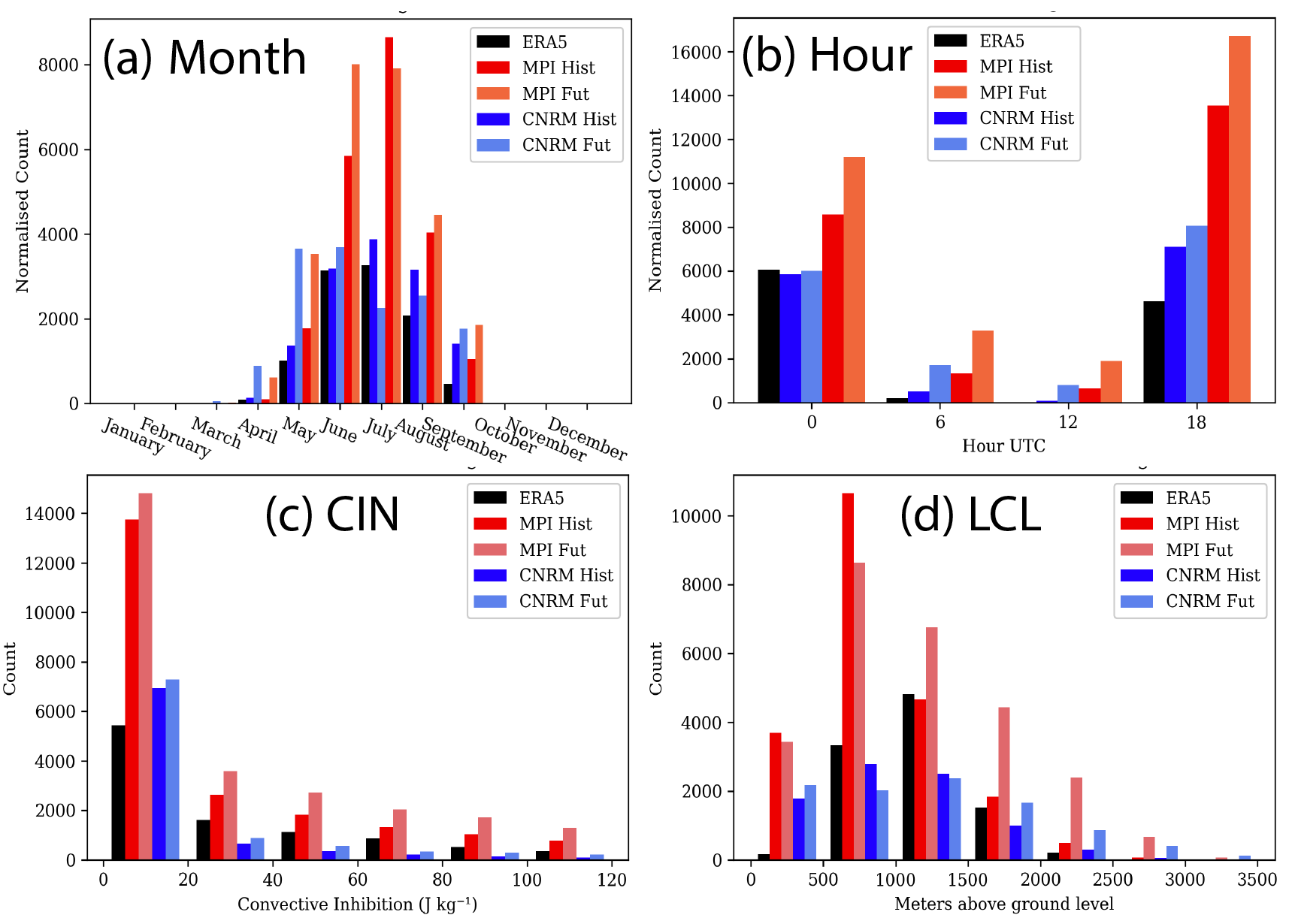
Experimental results
Research questions
- RQ1How does climate warming alter the vertical thermodynamic structure of severe convective storm environments when CAPE and 0–6 km shear are held constant?
- RQ2What changes occur in low-level wind shear and storm-relative helicity, and how might they affect tornadogenesis potential?
- RQ3How do changes in boundary layer relative humidity and free tropospheric lapse rate influence convective initiation and entrainment effects?
- RQ4To what extent are the projected structural changes robust across different climate models with varying biases?
- RQ5How do changes in moist static energy and MSE deficit affect the potential for deep convection and severe storm intensity?
Key findings
- Temperature profiles warmed uniformly with height, and the tropopause shifted upward at constant temperature, indicating a thermally expanded troposphere.
- Boundary layer relative humidity decreased slightly by 2–4%, increasing the level of free convection (LCL) and potentially reducing convective initiation efficiency.
- The free troposphere became slightly moister (+2–3% relative humidity), while the free tropospheric lapse rate decreased slightly, reducing instability at higher altitudes.
- Moist static energy (MSE) increased uniformly with height, with a slightly larger increase in the boundary layer, suggesting enhanced energy availability for convection.
- Low-level wind shear and storm-relative helicity increased within the lowest 1.5 km due to stronger hodograph curvature, indicating a higher potential for tornadogenesis.
- A slight increase in free tropospheric MSE deficit was observed above 4 km, suggesting enhanced entrainment and dilution effects that could suppress updrafts and reduce severe storm intensity.
Better researchstarts right now
From reading papers to final review, dramatically reduce your research time.
No credit card · Free plan available
This review was created by AI and reviewed by human editors.