
[Paper Review] Gaia Data Release 1: Astrometry - one billion positions, two million proper motions and parallaxes
Gaia DR1 presents astrometric results for over 1 billion stars, with a primary 2 million-star subset providing hipparcos-type precision, using TGAS and auxiliary data, and a secondary dataset with epoch J2015.0 positions for over 1.14 billion sources.
Gaia Data Release 1 (Gaia DR1) contains astrometric results for more than 1 billion stars brighter than magnitude 20.7 based on observations collected by the Gaia satellite during the first 14 months of its operational phase. We give a brief overview of the astrometric content of the data release and of the model assumptions, data processing, and validation of the results. For stars in common with the Hipparcos and Tycho-2 catalogues, complete astrometric single-star solutions are obtained by incorporating positional information from the earlier catalogues. For other stars only their positions are obtained by neglecting their proper motions and parallaxes. The results are validated by an analysis of the residuals, through special validation runs, and by comparison with external data. Results. For about two million of the brighter stars (down to magnitude ~11.5) we obtain positions, parallaxes, and proper motions to Hipparcos-type precision or better. For these stars, systematic errors depending e.g. on position and colour are at a level of 0.3 milliarcsecond (mas). For the remaining stars we obtain positions at epoch J2015.0 accurate to ~10 mas. Positions and proper motions are given in a reference frame that is aligned with the International Celestial Reference Frame (ICRF) to better than 0.1 mas at epoch J2015.0, and non-rotating with respect to ICRF to within 0.03 mas/yr. The Hipparcos reference frame is found to rotate with respect to the Gaia DR1 frame at a rate of 0.24 mas/yr. Based on less than a quarter of the nominal mission length and on very provisional and incomplete calibrations, the quality and completeness of the astrometric data in Gaia DR1 are far from what is expected for the final mission products. The results nevertheless represent a huge improvement in the available fundamental stellar data and practical definition of the optical reference frame.
Motivation & Objective
- Provide an overview of Gaia DR1 astrometric content and its model assumptions, data processing, and validation.
- Describe the two data sets (primary TGAS and secondary) and their precision, reference frame, and limitations.
- Explain the input data, reference frames, and relativistic modeling used in Gaia DR1.
- Summarize the attitude and instrument calibration and how they feed into the astrometric solutions.
Proposed method
- Combine Gaia observations with Hipparcos and Tycho-2 prior positions for the primary solution (TGAS).
- Apply a six-parameter astrometric model (α, δ, π, μ_α*, μ_δ, v_r) with v_r set to zero for Gaia DR1.
- Use a relativistic Gaia model (GREM) to transform BCRS directions to Gaia-observed directions in CoMRS/SRS.
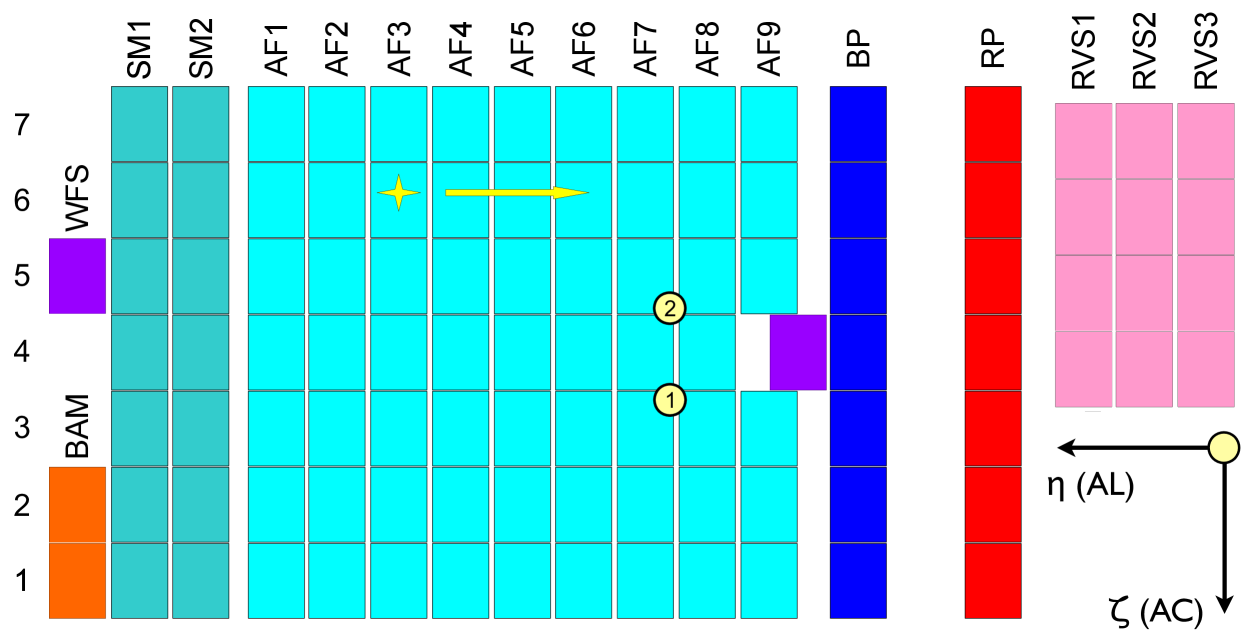
- Model the instrument geometry with a geometric calibration and attitude spline representation.
- Incorporate onboard metrology (BAM) data and auxiliary solar-system ephemerides in the calibration.
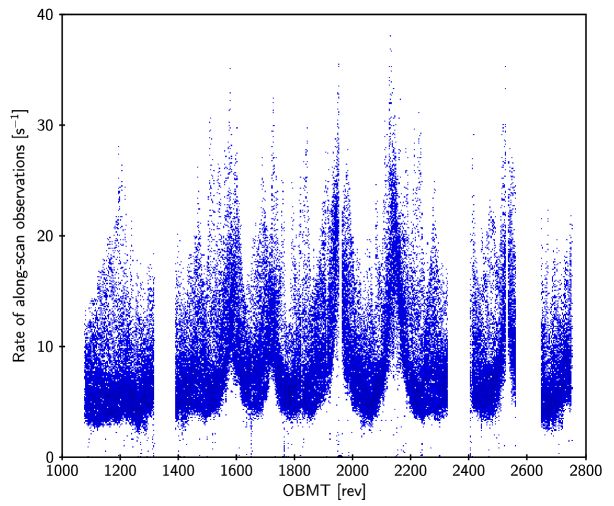
- Process nearly 35 million elementary records in the primary solution and 1.7×10^10 records in the secondary solution.
Experimental results
Research questions
- RQ1What is the astrometric content of Gaia DR1 and how is it organized into primary and secondary data sets?
- RQ2What is the achieved precision and reference-frame alignment of Gaia DR1 for bright stars versus faint sources?
- RQ3How are the astrometric solutions constructed (TGAS and secondary) and what priors are used?
- RQ4How are relativistic effects and instrument calibrations modeled and incorporated into the Gaia DR1 processing?
- RQ5What are the limitations and provisional nature of Gaia DR1 results, and how will future releases improve them?
Key findings
- The primary data set contains positions, parallaxes, and mean proper motions for about 2.06 million bright stars, with typical uncertainties around 0.3 mas for positions/parallaxes and ~1 mas/yr for proper motions.
- For ~93,635 Hipparcos-backed stars, proper motions reach ~0.06 mas/yr precision.
- faint sources yield positions at epoch J2015.0 with ~10 mas accuracy, while the reference frame is aligned to ICRF with better than 0.1 mas at J2015.0.
- Overall Gaia DR1 provides an astrometric solution that is provisional due to short time span and ongoing calibrations, but already represents a substantial improvement over prior data for fundamental stellar data and the optical reference frame.
- The Hipparcos reference frame is found to rotate with Gaia DR1 at about 0.24 mas/yr with respect to Gaia DR1’s frame.
Better researchstarts right now
From reading papers to final review, dramatically reduce your research time.
No credit card · Free plan available
This review was created by AI and reviewed by human editors.