
[Paper Review] Galaxy Formation and Reionization: Key Unknowns and Expected Breakthroughs by the James Webb Space Telescope
This paper reviews the current state of galaxy formation and reionization research ahead of the James Webb Space Telescope (JWST) launch, proposing that JWST will revolutionize our understanding by enabling deep, high-resolution infrared surveys and rest-frame optical spectroscopy of galaxies at z ≈ 8–10. The key contribution is the prediction that JWST will complete the census of early galaxies, measure their star formation rates, metallicities, and ionization states, and definitively test for evolved stellar populations at z ≈ 8–10, providing direct evidence for star formation out to z ≈ 15.
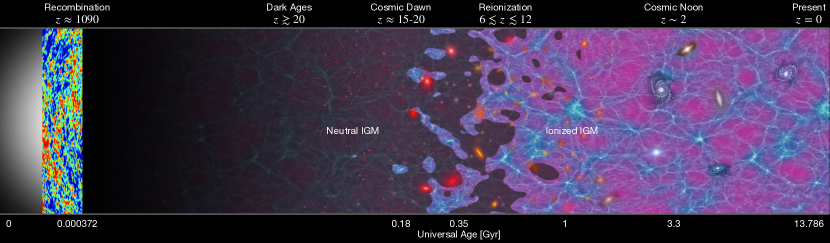
The scheduled launch of James Webb Space Telescope (JWST) in late 2021 marks a new start for studies of galaxy formation at high redshift z>~6 during the era of Cosmic Reionization. JWST can capture sensitive, high-resolution images and multi-object spectroscopy in the infrared that will transform our view of galaxy formation during the first billion years of cosmic history. This review summarizes our current knowledge of the role of galaxies in reionizing intergalactic hydrogen ahead of JWST, achieved through observations with Hubble Space Telescope and ground-based facilities including Keck, the Very Large Telescope, Subaru, and the Atacama Large Millimeter/Submillimeter Array. We identify outstanding questions in the field that JWST can address during its mission lifetime, including with the planned JWST Cycle 1 programs. (Abridged)
Motivation & Objective
- To summarize current knowledge of galaxy formation and reionization based on Hubble and ground-based observations (Keck, VLT, ALMA).
- To identify critical unknowns in the astrophysics of early galaxies and their role in cosmic reionization.
- To outline the transformative capabilities of JWST for resolving outstanding questions in high-redshift galaxy evolution.
- To predict how JWST's deep surveys and spectroscopy will enable definitive constraints on star formation, metallicity, and ionizing photon escape at z ≈ 8–10.
Proposed method
- Leveraging existing photometric and spectroscopic data from Hubble, Keck, VLT, and ALMA to calibrate current understanding of high-redshift galaxy properties.
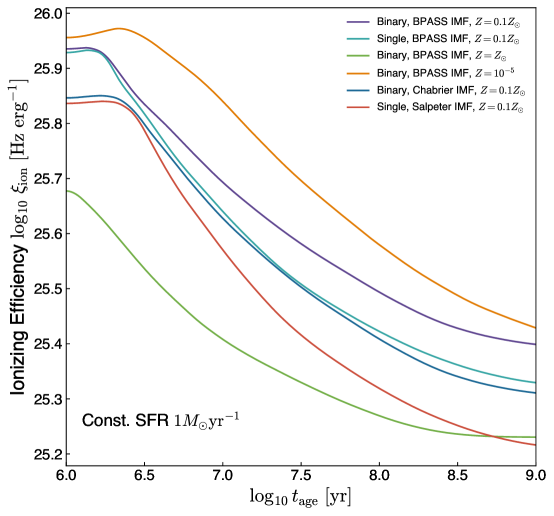
- Modeling the evolution of ionizing photon production, escape fractions, and luminosity density across z ≈ 6–10 to assess reionization contributions.
- Evaluating the sensitivity and survey depth of JWST instruments (NIRCam, NIRSpec, MIRI, NIRISS) for detecting and characterizing galaxies at z > 8.
- Using population synthesis models and nebular emission diagnostics to interpret expected rest-frame optical spectra from JWST.
- Assessing the feasibility of detecting evolved stellar populations at z ≈ 8–10 as evidence for extended star formation to z ≈ 15.
- Analyzing the impact of multiplexed spectroscopy and wide-field slitless surveys on constraining galaxy physical properties at high redshift.
Experimental results
Research questions
- RQ1Can JWST complete the census of galaxy formation at the current redshift frontier (z ≈ 8–10) with sufficient sensitivity and area?
- RQ2Can rest-frame optical spectroscopy with JWST at z ≈ 8–9 provide robust measurements of star formation rate, metallicity, and ionization state in early galaxies?
- RQ3Can JWST definitively test for the presence of evolved stellar populations at z ≈ 8–10, indicating star formation out to z ≈ 15?
- RQ4How will the escape fraction of Lyman continuum photons evolve with galaxy properties such as metallicity and star formation efficiency at high redshift?
- RQ5To what extent will the discovery of very bright, distant galaxies at z > 10 alter our understanding of the relative importance of bright versus faint galaxies in cosmic reionization?
Key findings
- JWST surveys will have sufficient depth and area to complete the census of galaxy formation at z ≈ 8–10, resolving the full population of early galaxies.
- Rest-frame optical spectroscopy with JWST will enable direct measurements of star formation rates, metallicities, and ionization states in galaxies at z ≈ 8–9 for the first time.
- The presence of evolved stellar populations at z ≈ 8–10 can be definitively tested by JWST, providing evidence for star formation extending to z ≈ 15.
- JWST will constrain the escape fraction of Lyman continuum photons and its dependence on galaxy properties, resolving a key uncertainty in reionization physics.
- The decline in ultraviolet luminosity density from z ≈ 6 to 10 is observed, but its continuation beyond z ≈ 10 remains unconfirmed, and JWST will test this trend.
- JWST will enable direct calibration of metallicity indicators and study of near-UV metal lines, Lyα propagation, and interstellar absorption in high-redshift galaxies.
Better researchstarts right now
From reading papers to final review, dramatically reduce your research time.
No credit card · Free plan available
This review was created by AI and reviewed by human editors.