
[Paper Review] Gauge invariant quantum thermodynamics: consequences for the first law
This paper introduces a gauge-invariant framework for quantum thermodynamics that eliminates redundant information from quantum state descriptions using emergent gauge symmetry, enabling a consistent definition of work and heat. It demonstrates that invariant heat and work are derived from time-dependent coherences and eigenbasis changes, with numerical validation in the Lipkin-Meshkov-Glick model showing long-term Krylov complexity as a dynamical order parameter.
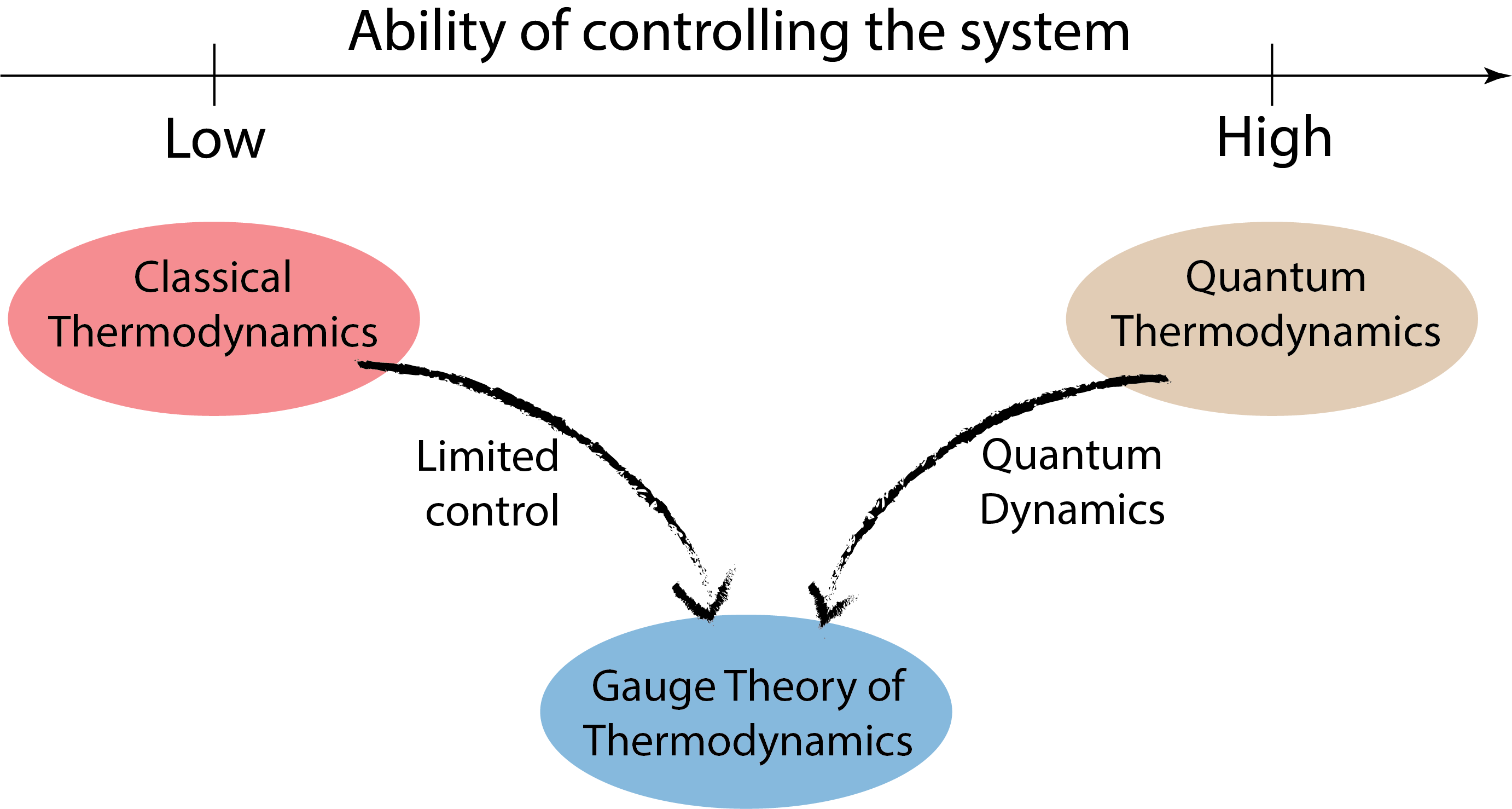
Universality of classical thermodynamics rests on the central limit theorem, due to which, measurements of thermal fluctuations are unable to reveal detailed information regarding the microscopic structure of a macroscopic body. When small systems are considered and fluctuations become important, thermodynamic quantities can be understood in the context of classical stochastic mechanics. A fundamental assumption behind thermodynamics is therefore that of coarse-graning, which stems from a substantial lack of control over all degrees of freedom. However, when quantum systems are concerned, one claims a high level of control. As a consequence, information theory plays a major role in the identification of thermodynamic functions. Here, drawing from the concept of gauge symmetry, essential in all modern physical theories, we put forward a new possible, intermediate route. Working within the realm of quantum thermodynamics we explicitly construct physically motivated gauge transformations which encode a gentle variant of coarse-graining behind thermodynamics. As a consequence, we reinterpret quantum work and heat, as well as the role of quantum coherence.
Motivation & Objective
- To develop a gauge-invariant formulation of quantum thermodynamics that removes redundant information from quantum state descriptions.
- To define thermodynamic quantities like work and heat operationally through gauge symmetry, rather than relying on basis-dependent representations.
- To establish a framework where thermodynamic quantities emerge from the interplay between quantum dynamics and coarse-graining, analogous to classical thermodynamics.
- To validate the framework numerically in the Lipkin-Meshkov-Glick model, particularly focusing on dynamical phase transitions and complexity measures.
Proposed method
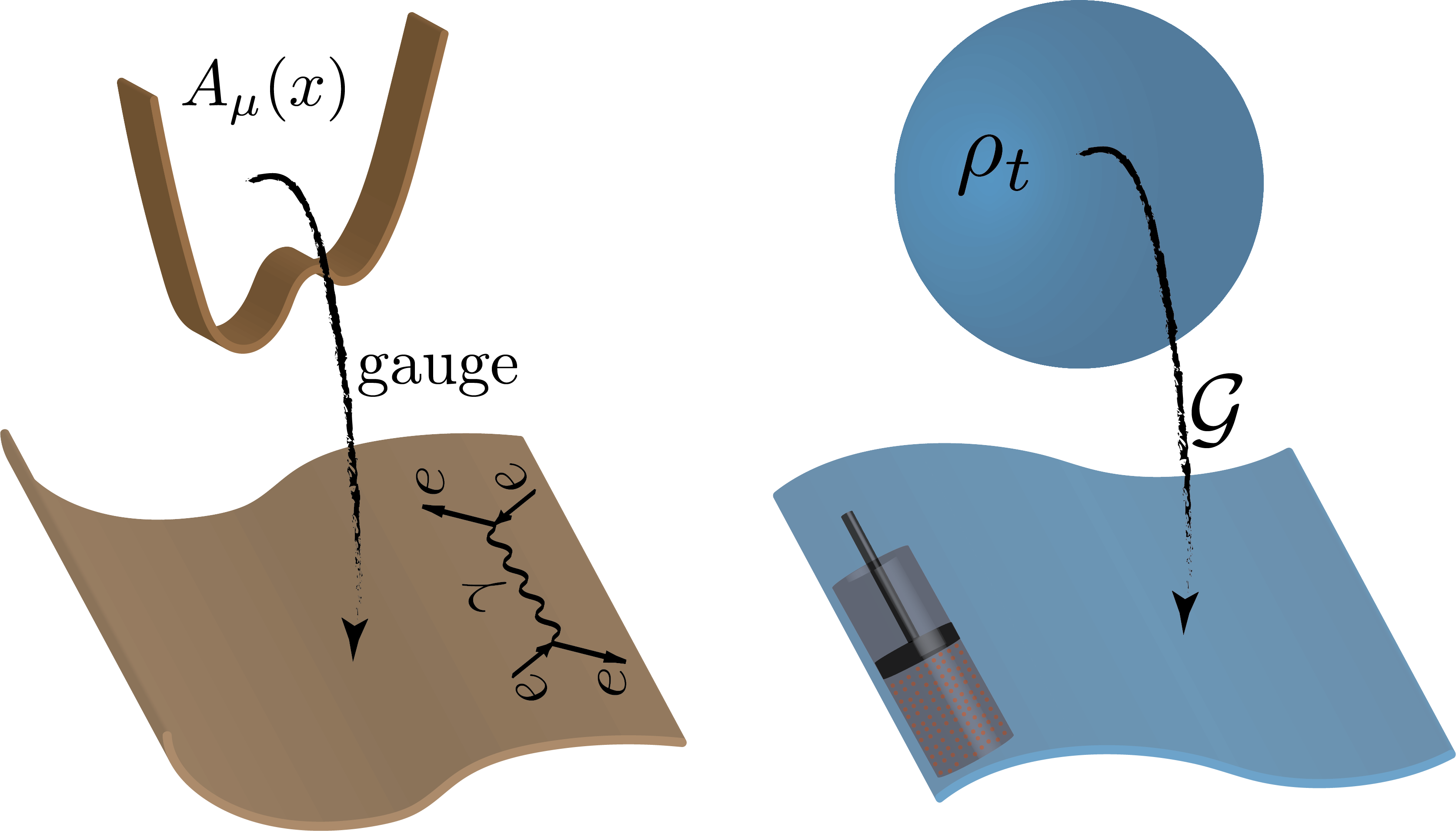
- Introduce an emergent gauge symmetry that acts on time-dependent density operators, removing basis-dependent redundancies.
- Define invariant work and heat using time derivatives of the Hamiltonian eigenvalues and coherences in the energy basis.
- Derive the invariant heat as $ Q_{\mathrm{inv}} = 2\int_{0}^{\tau} \mathrm{Re}[c_{12}(t)] \frac{\dot{\gamma}_{t}}{\lambda_{t}} dt $, depending on coherence evolution.
- Define invariant work as $ W_{\mathrm{inv}} = \int_{0}^{\tau} [c_{22}(t) - c_{11}(t)] \dot{\lambda}_{t} dt $, sensitive to population changes.
- Numerically solve the Schrödinger equation in the angular momentum basis for the LMG model to compute time evolution of coefficients $ c_m(t) $.
- Compute Krylov complexity, inverse participation ratio, and Shannon entropy in both Krylov and energy bases to compare dynamical behavior.
Experimental results
Research questions
- RQ1How can gauge invariance be used to define thermodynamic quantities like work and heat in a basis-independent way in quantum systems?
- RQ2What is the role of coherence and eigenbasis evolution in determining the heat transfer in closed quantum systems?
- RQ3Can Krylov complexity serve as a dynamical order parameter in quantum phase transitions, even when the initial state breaks symmetry?
- RQ4How do complexity measures like inverse participation ratio and Shannon entropy behave in the Krylov basis versus the energy basis under symmetric initial conditions?
- RQ5Under what conditions does the Krylov basis coincide with the standard angular momentum basis in the LMG model?
Key findings
- The long-term averaged Krylov complexity acts as a dynamical order parameter that distinguishes between two phases induced by a quench from a null magnetic field, with the same critical point as the conventional order parameter.
- The Krylov basis for the LMG model is analytically shown to be equivalent to the standard angular momentum basis, explaining the observed equivalence in dynamical behavior between the Krylov and energy bases under symmetric initial states.
- Identical dynamical behaviors for inverse participation ratio and Shannon entropy are observed in both the Krylov and energy bases when the initial state possesses the required symmetry.
- The invariant heat $ Q_{\mathrm{inv}} $ depends solely on the time derivative of the eigenbasis and the coherences in the energy basis, not on the diagonal populations.
- The invariant work $ W_{\mathrm{inv}} $ is determined by the time derivative of the coupling parameter $ \lambda_t $ and the population difference $ c_{22}(t) - c_{11}(t) $.
- Numerical integration of the Schrödinger equation in the angular momentum basis confirms the consistency of the derived expressions for work and heat, validating the gauge-invariant thermodynamic framework.
Better researchstarts right now
From reading papers to final review, dramatically reduce your research time.
No credit card · Free plan available
This review was created by AI and reviewed by human editors.