
[Paper Review] Gaussian Boson Sampling with Pseudo-Photon-Number Resolving Detectors and Quantum Computational Advantage
This paper demonstrates Gaussian Boson Sampling using pseudo-photon-number-resolving detectors (PPNRD) in the Jiǔzhāng 3.0 quantum computer, achieving a quantum computational advantage (QCA) by generating samples that would take classical supercomputers over 600 years to produce. The experiment validates the samples against all current classical spoofing models using Bayesian tests and correlation function analysis, confirming the quantum advantage with a 1.5×10¹⁶ speedup over the Frontier supercomputer.
We report new Gaussian boson sampling experiments with pseudo-photon-number-resolving detection, which register up to 255 photon-click events. We consider partial photon distinguishability and develop a more complete model for the characterization of the noisy Gaussian boson sampling. In the quantum computational advantage regime, we use Bayesian tests and correlation function analysis to validate the samples against all current classical mockups. Estimating with the best classical algorithms to date, generating a single ideal sample from the same distribution on the supercomputer Frontier would take ~ 600 years using exact methods, whereas our quantum computer, Jiuzhang 3.0, takes only 1.27 us to produce a sample. Generating the hardest sample from the experiment using an exact algorithm would take Frontier ~ 3.1*10^10 years.
Motivation & Objective
- To demonstrate quantum computational advantage (QCA) in Gaussian Boson Sampling using pseudo-photon-number-resolving detection (PPNRD).
- To develop a more complete model for noisy Gaussian Boson Sampling that accounts for partial photon distinguishability.
- To validate experimental samples against all known classical spoofing models, including the treewidth sampler and IPS mockups.
- To benchmark the classical simulation cost of the experiment using exact algorithms on the Frontier supercomputer.
- To establish a robust validation framework using Bayesian tests and second-order correlation analysis to rule out classical simulations.
Proposed method
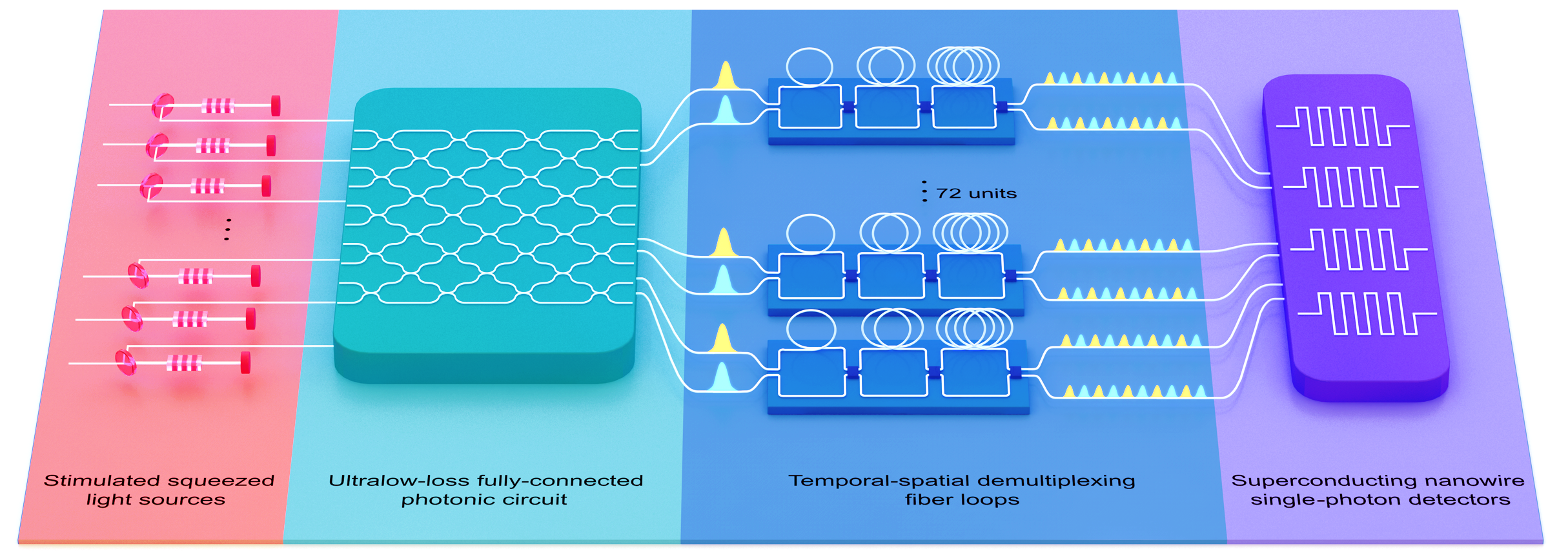
- The experiment uses Jiǔzhāng 3.0 with 1152 fan-out bins as individual output modes, each equipped with threshold detection, to simulate pseudo-photon-number-resolving detection (PPNRD).
- The PPNRD model is formalized by treating each of the 1152 output bins as a separate mode, increasing the effective number of detected events and computational complexity.
- A modified loop hafnian simulation method is applied, with computational cost modeled as $ T(\vec{N}) = \frac{1}{2} C_{\text{Frontier}} M N^3 G^{N/2} $, where $ G = \left( \prod_{i=1}^{M} (n_i + 1) \right)^{1/N} $, capturing the effect of photon-click multiplicity.
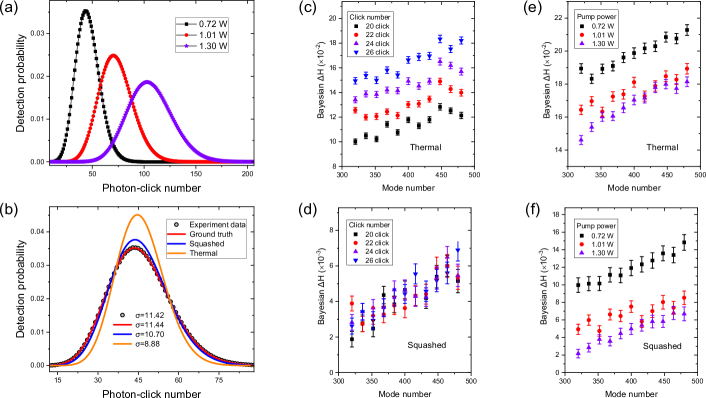
- Bayesian hypothesis testing is used to compare experimental samples against classical spoofing distributions, assessing statistical plausibility.
- Second-order correlation functions are computed and compared between experiment, ground truth, and mockups to detect deviations and rule out classical simulations.
- The simulation cost is estimated using the Frontier supercomputer, with $ C_{\text{Frontier}} $ derived from prior benchmarks, to quantify the quantum speedup.
Experimental results
Research questions
- RQ1Can Gaussian Boson Sampling with pseudo-photon-number-resolving detection achieve a verifiable quantum computational advantage over classical supercomputers?
- RQ2How do partial photon distinguishability and experimental noise affect the validity and simulation cost of GBS experiments?
- RQ3Can all known classical spoofing models—including the treewidth sampler and IPS mockup—be ruled out using correlation-based and Bayesian validation methods?
- RQ4What is the classical simulation cost of generating a single sample from the experiment using exact algorithms on the Frontier supercomputer?
- RQ5Does the use of PPNRD significantly increase the computational complexity of GBS compared to standard threshold detection?
Key findings
- The Jiǔzhāng 3.0 quantum computer produces a single sample in 1.27 μs, while the same task would take the Frontier supercomputer approximately 600 years using exact classical simulation methods.
- The hardest sample from the experiment would require over 3.1×10¹⁰ years to generate using exact classical algorithms on Frontier, demonstrating a quantum speedup of 1.5×10¹⁶.
- The treewidth sampler, previously considered a strong classical spoofing model, is unambiguously ruled out by second-order correlation analysis, which shows significant deviation from the experimental and theoretical ground truth.
- The experimental second-order correlation function has a two-norm distance of D=0.040 and slope K=1.006 to the ground truth, outperforming the thermal state mockup (D=0.275, K=2.108) and the squashed state mockup (D=0.052, K=1.110).
- Bayesian testing confirms that the experimental samples are statistically indistinguishable from the ideal GBS distribution and are ruled out as being generated by any of the current classical spoofing models.
- The PPNRD detection scheme increases the simulation complexity by increasing the number of effective output modes and the value of G in the simulation cost formula, making exact classical simulation infeasible even for moderate photon-click counts.
Better researchstarts right now
From reading papers to final review, dramatically reduce your research time.
No credit card · Free plan available
This review was created by AI and reviewed by human editors.