
[Paper Review] Generalized cluster states from Hopf algebras: non-invertible symmetry and Hopf tensor network representation
This paper introduces a generalized construction of cluster states using Hopf algebras, where qudit degrees of freedom are replaced by Hopf algebra-valued qudits. By defining generalized Pauli operators via regular and representation actions, the framework realizes non-invertible symmetries and constructs a gapped Hamiltonian for 1D Hopf cluster states, which is shown to be equivalent to a quasi-1D Hopf quantum double model, establishing a new class of symmetry-protected topological phases with non-invertible global symmetries.
Cluster states are crucial resources for measurement-based quantum computation (MBQC). It exhibits symmetry-protected topological (SPT) order, thus also playing a crucial role in studying topological phases. We present the construction of cluster states based on Hopf algebras. By generalizing the finite group valued qudit to a Hopf algebra valued qudit and introducing the generalized Pauli-X operator based on the regular action of the Hopf algebra, as well as the generalized Pauli-Z operator based on the irreducible representation action on the Hopf algebra, we develop a comprehensive theory of Hopf qudits. We demonstrate that non-invertible symmetry naturally emerges for Hopf qudits. Subsequently, for a bipartite graph termed the cluster graph, we assign the identity state and trivial representation state to even and odd vertices, respectively. Introducing the edge entangler as controlled regular action, we provide a general construction of Hopf cluster states. To ensure the commutativity of the edge entangler, we propose a method to construct a cluster lattice for any triangulable manifold. We use the 1d cluster state as an example to illustrate our construction. As this serves as a promising candidate for SPT phases, we construct the gapped Hamiltonian for this scenario and provide a detailed discussion of its non-invertible symmetries. We demonstrate that the 1d cluster state model is equivalent to the quasi-1d Hopf quantum double model with one rough boundary and one smooth boundary. We also discuss the generalization of the Hopf cluster state model to the Hopf ladder model through symmetry topological field theory. Furthermore, we introduce the Hopf tensor network representation of Hopf cluster states by integrating the tensor representation of structure constants with the string diagrams of the Hopf algebra, which can be used to solve the Hopf cluster state model.
Motivation & Objective
- To generalize cluster states beyond finite groups by using Hopf algebras as the underlying algebraic structure for qudit degrees of freedom.
- To develop a consistent theory of Hopf qudits using regular and irreducible representation actions to define generalized Pauli operators.
- To demonstrate the emergence of non-invertible symmetries in the constructed Hopf cluster states.
- To construct a gapped Hamiltonian for 1D Hopf cluster states and establish its equivalence to a quasi-1D Hopf quantum double model.
- To introduce a Hopf tensor network representation by combining tensor representations of structure constants with string diagrams of Hopf algebras.
Proposed method
- Define Hopf qudits by replacing finite group-valued qudits with Hopf algebra-valued qudits, using the regular action for the generalized Pauli-X operator and irreducible representation action for the generalized Pauli-Z operator.
- Construct edge entanglers as controlled regular actions on a bipartite cluster graph, assigning identity states to even vertices and trivial representation states to odd vertices.
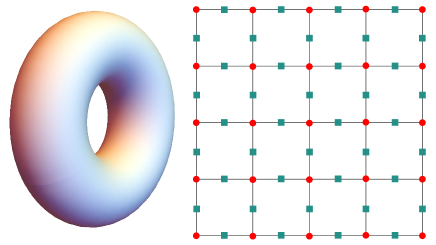
- Ensure commutativity of edge entanglers by constructing a cluster lattice on any triangulable manifold via a consistent edge ordering and vertex assignment scheme.
- Derive the gapped Hamiltonian for the 1D Hopf cluster state by identifying the stabilizer terms as products of generalized Pauli operators acting on neighboring sites.
- Establish equivalence between the 1D Hopf cluster state model and the quasi-1D Hopf quantum double model through Hamiltonian mapping and symmetry analysis.
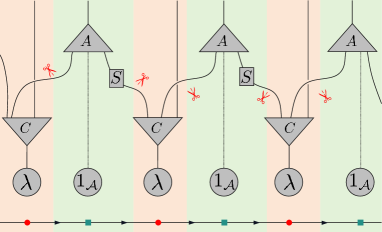
- Introduce the Hopf tensor network representation by encoding structure constants of the Hopf algebra into tensor networks and combining them with string diagram formalism for topological invariance.
Experimental results
Research questions
- RQ1How can cluster states be generalized beyond finite groups by using Hopf algebras as the underlying algebraic structure?
- RQ2What is the role of non-invertible symmetries in Hopf cluster states, and how do they emerge from the algebraic structure of the Hopf algebra?
- RQ3Can a gapped Hamiltonian be constructed for the 1D Hopf cluster state that realizes a symmetry-protected topological phase with non-invertible global symmetry?
- RQ4What is the relationship between the 1D Hopf cluster state and the quasi-1D Hopf quantum double model in terms of Hamiltonian structure and topological order?
- RQ5How can the Hopf tensor network representation be systematically constructed to encode the algebraic and topological features of Hopf cluster states?
Key findings
- The construction of Hopf qudits via regular and representation actions on a Hopf algebra leads to a natural emergence of non-invertible symmetries in the system.
- The edge entanglers in the cluster state construction are made commutative by a lattice construction on triangulable manifolds, enabling consistent state preparation.
- The 1D Hopf cluster state Hamiltonian is shown to be equivalent to the quasi-1D Hopf quantum double model, linking it to known topological quantum field theories.
- The 1D Hopf cluster state realizes a symmetry-protected topological phase with a non-invertible global symmetry described by the fusion category Rep(D₈), consistent with recent results on non-invertible symmetries.
- The Hopf tensor network representation is established by combining the tensor representation of structure constants with string diagrams, providing a diagrammatic and algebraically consistent framework for the state.
- The model generalizes finite group-based cluster states and extends the framework to non-invertible symmetries via Hopf algebras, offering a broader class of SPT phases than previously known.
Better researchstarts right now
From reading papers to final review, dramatically reduce your research time.
No credit card · Free plan available
This review was created by AI and reviewed by human editors.