
[Paper Review] Generative AI for Controllable Protein Sequence Design: A Survey
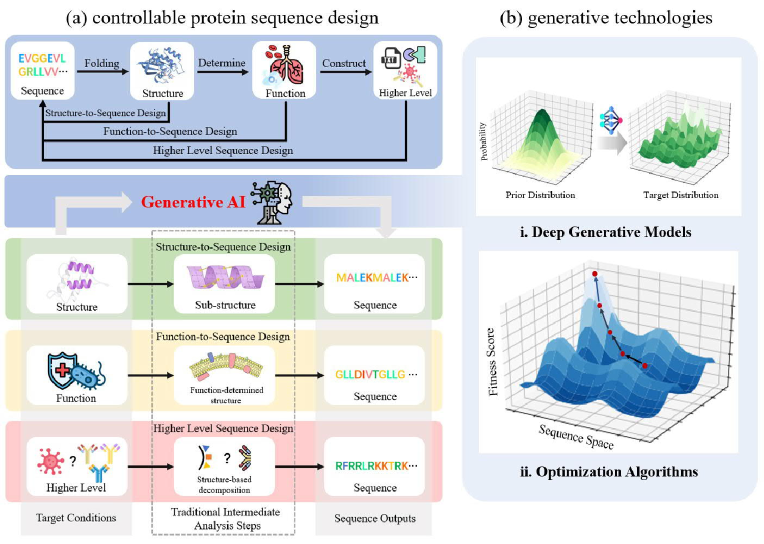
This survey provides a comprehensive overview of generative AI for controllable protein sequence design, systematically categorizing tasks by constraints such as structure, function, and higher-level objectives. It reviews key generative models—including MSA VAE, ProtGPT2, ProGen2, and diffusion-based methods—and optimization techniques, highlighting their role in enabling end-to-end, constraint-aware protein design with applications in drug discovery and enzyme engineering.
The design of novel protein sequences with targeted functionalities underpins a central theme in protein engineering, impacting diverse fields such as drug discovery and enzymatic engineering. However, navigating this vast combinatorial search space remains a severe challenge due to time and financial constraints. This scenario is rapidly evolving as the transformative advancements in AI, particularly in the realm of generative models and optimization algorithms, have been propelling the protein design field towards an unprecedented revolution. In this survey, we systematically review recent advances in generative AI for controllable protein sequence design. To set the stage, we first outline the foundational tasks in protein sequence design in terms of the constraints involved and present key generative models and optimization algorithms. We then offer in-depth reviews of each design task and discuss the pertinent applications. Finally, we identify the unresolved challenges and highlight research opportunities that merit deeper exploration.
Motivation & Objective
- To bridge the gap between machine learning and biochemistry by demystifying controllable protein sequence design for researchers without deep domain expertise.
- To address the limitations of prior surveys that focus narrowly on specific methodologies or tasks, such as de novo design, while overlooking mutation-based optimization.
- To systematize the classification of protein sequence design tasks based on the types of constraints (e.g., structural, functional, or higher-level objectives).
- To identify unresolved challenges in data scarcity, model interpretability, and evaluation robustness, and to highlight underexplored research opportunities.
- To inspire cross-disciplinary collaboration by mapping current advances and outlining a roadmap for future development in controllable protein design.
Proposed method
- Categorizing protein sequence design tasks into three tiers based on the central dogma: structure-to-sequence, function-to-sequence, and higher-level sequence design.
- Surveying foundational generative models, including MSA VAE, ProteinGAN, ProtGPT2, ProGen2, xTrimoPGLM, RITA, and EvoDiff, for learning natural protein sequence distributions.
- Reviewing conditional generative models and optimization algorithms—such as StructTrans, StructG, and reinforcement learning—enabling control over desired structural and functional properties.
- Analyzing non-autoregressive frameworks like GFlowNet and Schrödinger Bridge as promising alternatives to autoregressive and diffusion-based models.
- Integrating pre-trained language models (PLMs) with reinforcement learning to fine-tune sequences for target properties while preserving biological naturalness.
- Proposing the need for task-specific, biologically meaningful evaluation metrics to overcome reliance on distribution-based computational scores.
Experimental results
Research questions
- RQ1How can generative AI models be systematically categorized based on the constraints they enforce in protein sequence design?
- RQ2What are the key generative modeling architectures and optimization strategies enabling controllable design across different protein design tasks?
- RQ3Why do current evaluation protocols in protein sequence design lack biological robustness, and how can they be improved?
- RQ4What are the major challenges in data availability, model interpretability, and benchmarking that hinder progress in the field?
- RQ5How can pre-trained language models and reinforcement learning be leveraged to enhance controllability and naturalness in protein sequence generation?
Key findings
- Generative models such as ProGen2 and EvoDiff have demonstrated strong performance in modeling the distribution of natural protein sequences, enabling the generation of diverse and plausible sequences.
- Conditional generation via models like StructTrans and StructG enables accurate structure-to-sequence mapping, with promising results in inverse folding and structural constraint adherence.
- Reinforcement learning fine-tuning of pre-trained language models (PLMs) shows potential for optimizing sequences toward target functions while preserving sequence naturalness.
- Despite progress, current evaluation metrics remain largely distribution-based and lack biological relevance, underscoring the need for task-specific, biologically grounded benchmarks.
- The field lacks comprehensive, universally accepted benchmarks—though ProteinInvBench has been established for inverse folding, broader, realistic benchmarks are urgently needed.
- Non-autoregressive frameworks such as GFlowNet and Schrödinger Bridge present viable, underexplored alternatives to diffusion models, warranting further investigation in protein sequence generation.
Better researchstarts right now
From reading papers to final review, dramatically reduce your research time.
No credit card · Free plan available
This review was created by AI and reviewed by human editors.