
[Paper Review] Generative Data Assimilation of Sparse Weather Station Observations at Kilometer Scales
This paper proposes a score-based diffusion model for generative data assimilation of sparse weather station observations at 3km resolution, enabling fast, scalable, and physically plausible reconstruction of surface wind and precipitation fields. It achieves 10% lower RMSE than the operational HRRR system on left-out stations, demonstrating a promising proof-of-concept for low-latency km-scale ensemble reanalyses without retraining.
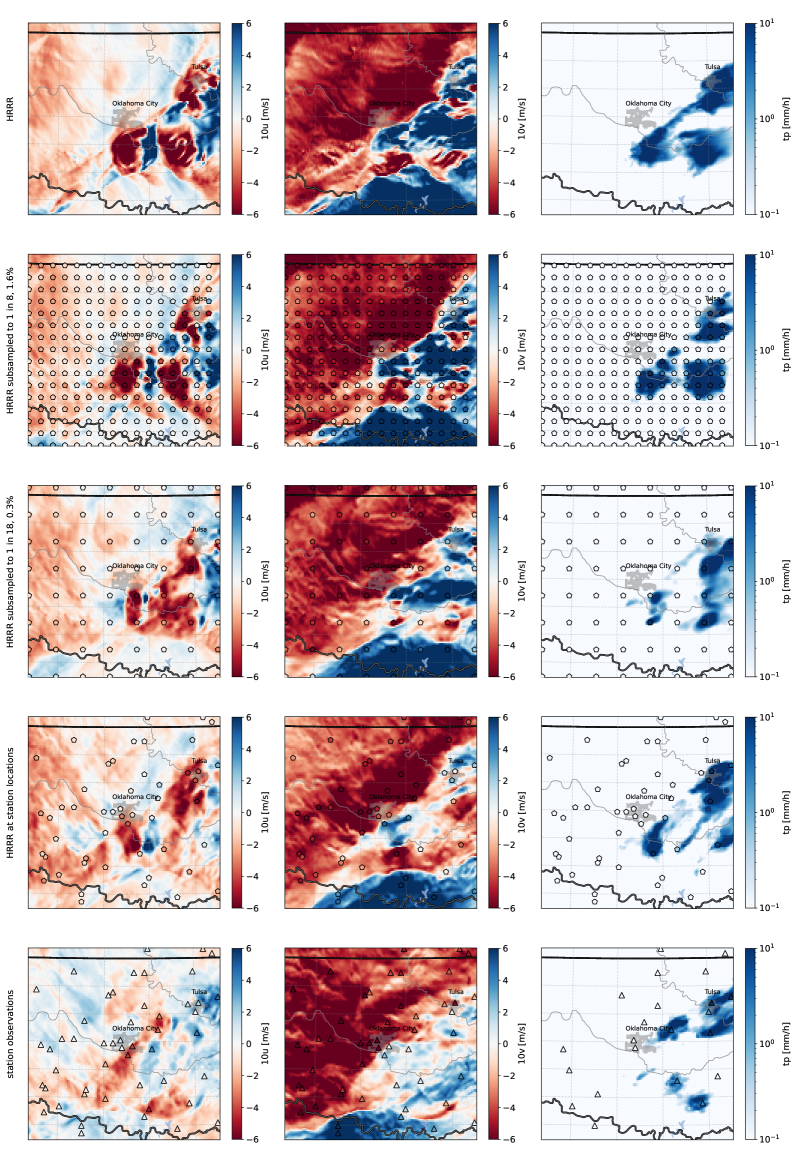
Data assimilation of observational data into full atmospheric states is essential for weather forecast model initialization. Recently, methods for deep generative data assimilation have been proposed which allow for using new input data without retraining the model. They could also dramatically accelerate the costly data assimilation process used in operational regional weather models. Here, in a central US testbed, we demonstrate the viability of score-based data assimilation in the context of realistically complex km-scale weather. We train an unconditional diffusion model to generate snapshots of a state-of-the-art km-scale analysis product, the High Resolution Rapid Refresh. Then, using score-based data assimilation to incorporate sparse weather station data, the model produces maps of precipitation and surface winds. The generated fields display physically plausible structures, such as gust fronts, and sensitivity tests confirm learnt physics through multivariate relationships. Preliminary skill analysis shows the approach already outperforms a naive baseline of the High-Resolution Rapid Refresh system itself. By incorporating observations from 40 weather stations, 10% lower RMSEs on left-out stations are attained. Despite some lingering imperfections such as insufficiently disperse ensemble DA estimates, we find the results overall an encouraging proof of concept, and the first at km-scale. It is a ripe time to explore extensions that combine increasingly ambitious regional state generators with an increasing set of in situ, ground-based, and satellite remote sensing data streams.
Motivation & Objective
- To develop a scalable, low-latency method for initializing high-resolution atmospheric states using sparse weather station data.
- To evaluate whether score-based diffusion models can learn physically plausible atmospheric dynamics from km-scale reanalysis data.
- To demonstrate that the model can be adapted to new observations without retraining, enabling flexible assimilation of diverse data streams.
- To assess the skill of the generated fields against operational benchmarks like HRRR, particularly in precipitation and surface wind estimation.
- To explore the potential of generative models as surrogates for complex, computationally expensive data assimilation pipelines.
Proposed method
- A diffusion model is pre-trained on snapshots from the High Resolution Rapid Refresh (HRRR) reanalysis dataset to generate 3km-resolution surface fields.
- Score-based data assimilation (SDA) is applied to condition the diffusion model on sparse weather station observations using the denoising score function.
- The SDA framework uses a noise schedule and denoiser network to iteratively refine the generated field toward consistency with observed data.
- The model is trained to minimize a loss function that aligns the predicted score with the true score of the noisy data distribution.
- Observation uncertainty is modeled via a diagonal covariance matrix $\sqrt{\Sigma_y}$, with values tuned empirically.
- The method supports inference with varying numbers of denoising steps and correction iterations, enabling trade-offs between accuracy and speed.
![Figure 1: Denoiser training and data assimilation with SDA. a) During the training of the denoiser, noise is added to the training data at different levels, parameterized by time $t\in[0,1]$ . The training objective for the denoiser $D$ is to reconstruct the training data, given the noisy state and](https://ar5iv.labs.arxiv.org/html/2406.16947/assets/figures/methodfig.png)
Experimental results
Research questions
- RQ1Can a diffusion model trained on reanalysis data generate physically plausible 3km-scale surface weather fields when conditioned on sparse observations?
- RQ2Does the model learn multivariate relationships consistent with atmospheric physics, such as those between wind and precipitation?
- RQ3Can the model achieve better accuracy than the operational HRRR system on unseen stations without retraining?
- RQ4How does the model's performance vary with hyperparameters like noise schedule and correction steps?
- RQ5Can the framework be extended to incorporate diverse observational streams, including ground-based and satellite data?
Key findings
- The model successfully generates physically plausible surface wind and precipitation fields at 3km resolution, including features like gust fronts.
- Sensitivity tests confirm that the model captures multivariate relationships consistent with atmospheric dynamics.
- On left-out weather stations, the model achieves 10% lower RMSE than the operational HRRR system, indicating improved skill.
- The method is robust to new observations and does not require retraining, enabling rapid adaptation to new data streams.
- Despite some limitations in ensemble spread, the results represent the first successful proof-of-concept for generative data assimilation at km-scale.
- Hyperparameter tuning shows improved performance with lower $\Gamma$ (0.001) and higher denoising steps, particularly for precipitation.
Better researchstarts right now
From reading papers to final review, dramatically reduce your research time.
No credit card · Free plan available
This review was created by AI and reviewed by human editors.