
[Paper Review] Generative Networks for Precision Enthusiasts
The paper develops a precision INN-based LHC event generator (DiscFlow) that achieves percent-level accuracy for kinematic distributions, and introduces training strategies with a discriminator and Bayesian/conditional uncertainty controls.
Generative networks are opening new avenues in fast event generation for the LHC. We show how generative flow networks can reach percent-level precision for kinematic distributions, how they can be trained jointly with a discriminator, and how this discriminator improves the generation. Our joint training relies on a novel coupling of the two networks which does not require a Nash equilibrium. We then estimate the generation uncertainties through a Bayesian network setup and through conditional data augmentation, while the discriminator ensures that there are no systematic inconsistencies compared to the training data.
Motivation & Objective
- Demonstrate percent-level precision in learned phase-space densities for Z+jets events with variable final-state multiplicity.
- Show how to train an INN generator jointly with a discriminator to improve consistency with training data.
- Introduce uncertainty estimation mechanisms via Bayesian INNs and conditional augmentations to quantify and control residual uncertainties.
- Develop DiscFlow architecture to enable controlled reweighting and joint training without relying on a Nash equilibrium.
Proposed method
- Use normalizing-flow based invertible neural networks (cINN) to map from latent space to phase-space observables for pp -> Z(mu mu)+jets with 1–3 jets.
- Handle variable final-state dimensionality by conditioning the base network on jet multiplicity and adding multiplicity-specific subnetworks.
- Apply cubic spline coupling blocks to efficiently learn complex phase-space patterns and include conditioning on kinematic observables.
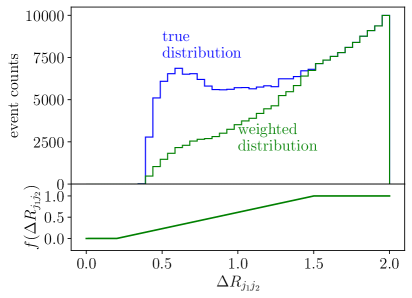
- Introduce a discriminator (DiscFlow) to reweight or jointly train the generator, improving distributions like Delta R and Z mass to percent-level accuracy.
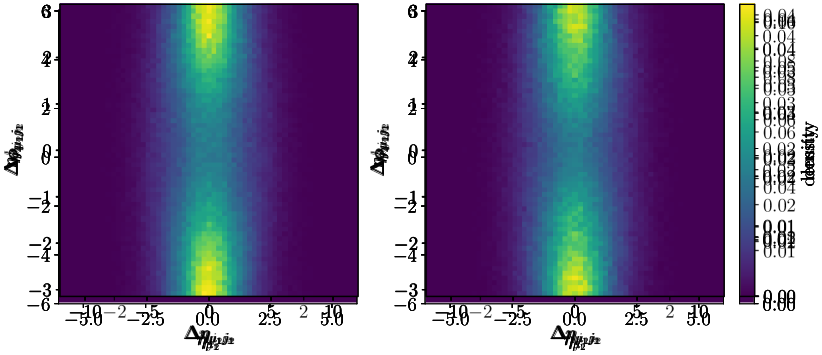
- Implement a Bayesian INN (BINN) to extract uncertainty maps over phase space by sampling over network weight distributions.
- Utilize conditional augmentations and discriminator-based reweighting to control theoretical/systematic uncertainties.
Experimental results
Research questions
- RQ1Can a normalizing-flow INN generator reproduce LHC-like Z+jets phase-space distributions with percent-level precision?
- RQ2Do discriminator-based reweighting and joint DiscFlow training improve challenging kinematic features beyond standard INN performance?
- RQ3How can uncertainties in generated events be quantified and controlled using Bayesian and conditional augmentation techniques?
- RQ4Can the generated events be consistently aligned with training data without requiring a Nash-equilibrium in adversarial training?
Key findings
- INN-based generators reproduce Z+1, Z+2, and Z+3 jet distributions at percent-level accuracy for bulk phase-space regions and within training-statistics expectations.
- Discriminator reweighting improves difficult distributions (e.g., Delta R between jets, Z mass) beyond the baseline INN, but yields weighted events.
- Joint DiscFlow training can achieve unweighted, high-precision distributions comparable to reweighted results, without relying on Nash equilibrium.
- A Bayesian INN provides phase-space uncertainty maps by combining weight-distribution sampling with event counts.
- Conditional augmentations offer a pathway to representing systematic/theory uncertainties within the generative framework.
Better researchstarts right now
From reading papers to final review, dramatically reduce your research time.
No credit card · Free plan available
This review was created by AI and reviewed by human editors.