
[Paper Review] Giant effective magnetic moments of chiral phonons from orbit-lattice coupling
This paper proposes a microscopic theory of giant effective magnetic moments in chiral phonons via orbit-lattice coupling, where circularly polarized lattice vibrations induce transitions between orbital states, leading to magnetic moments on the order of one Bohr magneton—orders of magnitude larger than prior predictions. The mechanism, rooted in hybridization of optical phonons with electronic orbital transitions, quantitatively explains large phonon Zeeman splittings in 4f rare-earth halides and predicts similar effects in 3d transition-metal oxides when orbital and phonon energies are resonant.
Circularly polarized lattice vibrations carry angular momentum and lead to magnetic responses in applied magnetic fields or when resonantly driven with ultrashort laser pulses. Recent measurements have found responses that are orders of magnitude larger than those calculated in prior theoretical studies. Here, we present a microscopic model for the effective magnetic moments of chiral phonons in magnetic materials that is able to reproduce the experimentally measured magnitudes and that allows us to make quantitative predictions for materials with giant magnetic responses using microscopic parameters. Our model is based on orbit-lattice couplings that hybridize optical phonons with orbital electronic transitions. We apply our model to two types of materials: $4f$ rare-earth halide paramagnets and $3d$ transition-metal oxide magnets. In both cases, we find that chiral phonons can carry giant effective magnetic moments of the order of a Bohr magneton, orders of magnitude larger than previous predictions.
Motivation & Objective
- To resolve the long-standing discrepancy between experimentally observed giant phonon magnetic moments (up to Bohr magneton scale) and prior theoretical predictions (typically nuclear magneton scale).
- To develop a microscopic model that quantitatively explains the large effective magnetic moments observed in chiral phonons of paramagnetic and magnetic materials.
- To identify the role of orbit-lattice coupling in generating these giant moments, particularly in systems with strong electron correlation and spin-orbit coupling.
- To predict new materials and conditions—especially in 3d transition-metal oxides—where such giant magnetic responses can be realized.
Proposed method
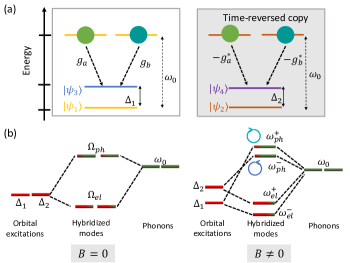
- Develops a microscopic model based on orbit-lattice coupling, where chiral phonons induce transitions between different orbital states, analogous to Raman processes.
- Performs a comprehensive group-theoretical analysis to identify allowed couplings between chiral phonon modes and electronic orbital transitions.
- Applies the model to 4f rare-earth halides, where large spin-orbit coupling and small crystal field splitting enable strong hybridization between phonons and CEF-excited states.
- Extends the model to 3d transition-metal oxides, where hybridization occurs between phonons and orbitally split multiplets from spin-orbit coupling or lattice distortions.
- Uses first-principles calculations to extract microscopic parameters (e.g., effective charge, orbital matrix elements) and inputs them into a spin-orbit-coupled Hamiltonian framework.
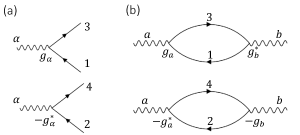
- Derives the effective magnetic moment from the matrix element of the orbital current operator between phonon-coupled states, linking it to measurable phonon Zeeman splittings.
Experimental results
Research questions
- RQ1What microscopic mechanism can explain the experimentally observed giant effective magnetic moments of chiral phonons, which are orders of magnitude larger than predicted by conventional models?
- RQ2How does orbit-lattice coupling mediate the transfer of angular momentum from chiral lattice vibrations to electronic orbital degrees of freedom to generate large effective magnetic moments?
- RQ3Why are phonon Zeeman splittings in 4f rare-earth halides significantly larger than expected from ionic gyromagnetic ratios alone?
- RQ4Can the same mechanism lead to giant magnetic responses in 3d transition-metal oxides, where spin-orbit coupling is weaker but orbital splitting is large?
- RQ5Under what conditions—specifically, energy resonance between phonons and electronic transitions—does the effective magnetic moment reach the Bohr magneton scale?
Key findings
- The model quantitatively reproduces the giant phonon Zeeman splittings observed in 4f rare-earth halides over half a century ago, using only first-principles parameters.
- Chiral phonons in 4f systems acquire effective magnetic moments on the order of one Bohr magneton due to hybridization with crystal field-excited states, enabled by strong spin-orbit coupling.
- In 3d transition-metal oxides, the same orbit-lattice coupling mechanism can generate comparable effective magnetic moments when the energy of the phonon mode resonates with the energy of orbital transitions.
- The effective magnetic moment scales with the matrix element of the orbital current operator between coupled states, which is enhanced by strong spin-orbit coupling and orbital hybridization.
- The theory predicts that materials with near-degenerate orbital multiplets and chiral phonons can exhibit large phonon Zeeman effects and inverse Faraday effects, enabling control of magnetization via ultrafast phonon excitation.
- The model provides a unified explanation for both paramagnetic and magnetic materials with giant phonon responses, resolving inconsistencies in prior theoretical approaches.
Better researchstarts right now
From reading papers to final review, dramatically reduce your research time.
No credit card · Free plan available
This review was created by AI and reviewed by human editors.