
[Paper Review] GNNUERS: Fairness Explanation in GNNs for Recommendation via Counterfactual Reasoning
GNNUERS is a novel counterfactual explanation framework that identifies unfair user-item interactions in GNN-based recommender systems by perturbing the bipartite graph structure to minimize demographic utility disparity. It successfully explains unfairness across three state-of-the-art GNN models on four real-world datasets, revealing interaction patterns linked to gender and age-based fairness disparities.
Nowadays, research into personalization has been focusing on explainability and fairness. Several approaches proposed in recent works are able to explain individual recommendations in a post-hoc manner or by explanation paths. However, explainability techniques applied to unfairness in recommendation have been limited to finding user/item features mostly related to biased recommendations. In this paper, we devised a novel algorithm that leverages counterfactuality methods to discover user unfairness explanations in the form of user-item interactions. In our counterfactual framework, interactions are represented as edges in a bipartite graph, with users and items as nodes. Our bipartite graph explainer perturbs the topological structure to find an altered version that minimizes the disparity in utility between the protected and unprotected demographic groups. Experiments on four real-world graphs coming from various domains showed that our method can systematically explain user unfairness on three state-of-the-art GNN-based recommendation models. Moreover, an empirical evaluation of the perturbed network uncovered relevant patterns that justify the nature of the unfairness discovered by the generated explanations. The source code and the preprocessed data sets are available at https://github.com/jackmedda/RS-BGExplainer.
Motivation & Objective
- Address the lack of explainability for unfairness in GNN-based recommender systems, particularly beyond feature-level explanations.
- Develop a method that explains unfairness not through user or item features, but through specific user-item interactions.
- Enable system designers to understand which interactions contribute to disparities between protected and unprotected demographic groups.
- Provide a counterfactual framework that identifies a minimal set of interactions whose removal leads to fairer recommendations.
- Ensure the explanation is grounded in the graph topology, leveraging the bipartite nature of user-item interaction networks.
Proposed method
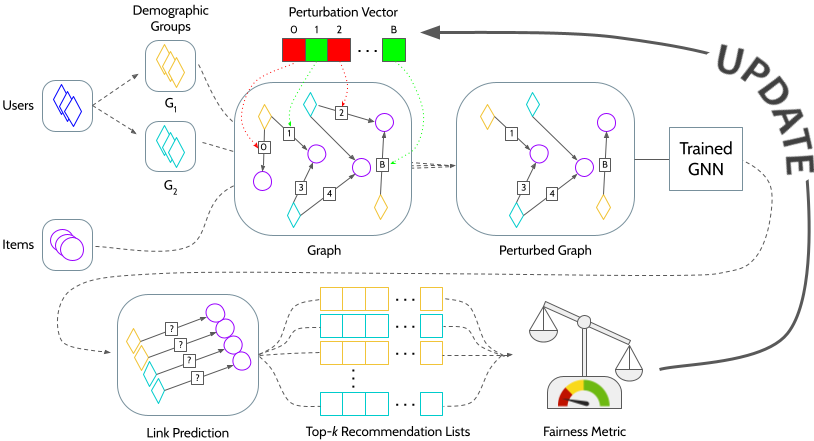
- Formulate user unfairness explanation as a counterfactual problem: find a perturbed version of the original bipartite graph that reduces utility disparity between protected and unprotected groups.
- Represent user-item interactions as edges in a bipartite graph, with users and items as nodes, and use a perturbation vector to model edge removals.
- Optimize the perturbation vector using a differentiable relaxation of edge removals, guided by the demographic parity principle to minimize fairness disparity.
- Leverage the topological structure of GNNs to identify which interactions—when removed—lead to fairer recommendations, focusing on edge-level changes.
- Integrate graph properties (e.g., degree, dyad count, inverse geodesic distance) to interpret the identified edges and synthesize human-readable explanations.
- Apply the framework to three state-of-the-art GNN-based recommendation models across four real-world datasets, validating fairness improvements through utility disparity metrics.
Experimental results
Research questions
- RQ1Which specific user-item interactions are responsible for unfair recommendations in GNN-based recommender systems?
- RQ2Can counterfactual graph perturbations effectively explain unfairness in GNNs without relying on user or item features?
- RQ3How do the identified interactions relate to structural properties of the graph, such as user popularity or network proximity?
- RQ4To what extent can GNNUERS reduce utility disparity between demographic groups (e.g., gender, age) while preserving recommendation quality?
- RQ5Can the framework be generalized to different GNN architectures and multi-group fairness settings?
Key findings
- GNNUERS successfully identifies a set of user-item interactions whose removal leads to fairer recommendations across three state-of-the-art GNN-based models.
- The method uncovers that unfairness in the ML-1M dataset is driven by isolated males with low interaction frequency who prefer niche movies.
- In the LFM-1K dataset, unfairness arises from a combination of low-degree, low-closeness females and high-degree, high-closeness males, indicating structural bias.
- Empirical evaluation shows that the perturbed graphs reveal consistent patterns of unfairness, with explanations grounded in graph topology and user behavior.
- The framework demonstrates robustness across four real-world datasets, including MovieLens, Last.FM, and two others, under varying demographic group distributions.
- GNNUERS provides interpretable, edge-level explanations that go beyond feature-level explanations, offering actionable insights for fairness mitigation.

Better researchstarts right now
From reading papers to final review, dramatically reduce your research time.
No credit card · Free plan available
This review was created by AI and reviewed by human editors.