
[Paper Review] GNNX-BENCH: Unravelling the Utility of Perturbation-based GNN Explainers through In-depth Benchmarking
This paper introduces GNNX-BENCH, a comprehensive benchmark for perturbation-based GNN explainers, evaluating both factual and counterfactual methods across multiple datasets and perturbation types. It identifies RCExplainer as the most stable and effective method, especially under noise, while revealing critical limitations in counterfactual feasibility due to topological constraint violations.
Numerous explainability methods have been proposed to shed light on the inner workings of GNNs. Despite the inclusion of empirical evaluations in all the proposed algorithms, the interrogative aspects of these evaluations lack diversity. As a result, various facets of explainability pertaining to GNNs, such as a comparative analysis of counterfactual reasoners, their stability to variational factors such as different GNN architectures, noise, stochasticity in non-convex loss surfaces, feasibility amidst domain constraints, and so forth, have yet to be formally investigated. Motivated by this need, we present a benchmarking study on perturbation-based explainability methods for GNNs, aiming to systematically evaluate and compare a wide range of explainability techniques. Among the key findings of our study, we identify the Pareto-optimal methods that exhibit superior efficacy and stability in the presence of noise. Nonetheless, our study reveals that all algorithms are affected by stability issues when faced with noisy data. Furthermore, we have established that the current generation of counterfactual explainers often fails to provide feasible recourses due to violations of topological constraints encoded by domain-specific considerations. Overall, this benchmarking study empowers stakeholders in the field of GNNs with a comprehensive understanding of the state-of-the-art explainability methods, potential research problems for further enhancement, and the implications of their application in real-world scenarios.
Motivation & Objective
- To systematically evaluate and compare perturbation-based factual and counterfactual GNN explainers across diverse settings.
- To identify stability and feasibility issues in current explainability methods under noise, architectural variations, and optimization stochasticity.
- To address the lack of benchmarking for counterfactual explainers, which are critical for actionable insights in high-stakes domains.
- To provide actionable recommendations for practitioners based on empirical performance and robustness across tasks and datasets.
Proposed method
- The study benchmarks seven factual and four counterfactual perturbation-based explainers on six standard GNN benchmark datasets, including ogbg-molhiv and IMDB-B.
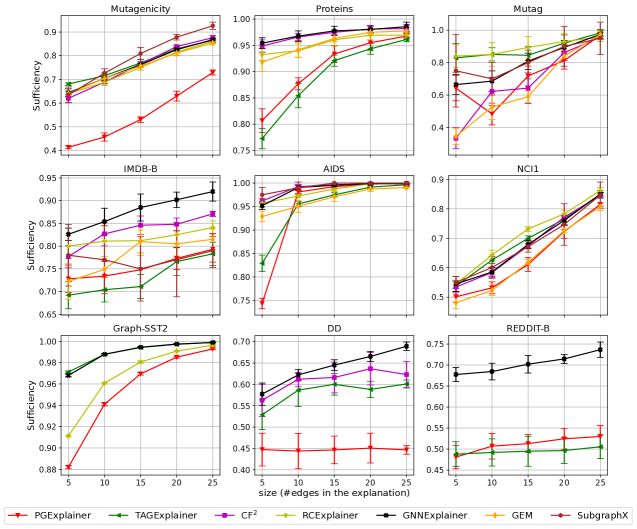
- It evaluates methods using standard metrics such as sufficiency and fidelity, measuring how well explanations reproduce the model’s predictions.
- The authors inject controlled topological noise (edge removals) and vary GNN architectures and training stochasticity to test robustness.
- Explanations are evaluated for feasibility by checking whether they respect domain-specific topological constraints, such as chemical valency in molecular graphs.
- A curated, publicly available codebase is released to ensure reproducibility and facilitate future benchmarking.
- The study includes a decision flowchart to guide practitioners in selecting explainers based on task type, data size, and application context.
![Figure 1: Structuring the space of the existing methods on Gnn explainability as follows. Gradient: SA [ 7 ] , Guided-BP [ 7 ] , Grad-CAM [ 34 ] ; Decomposition: Excitation-BP [ 34 ] , GNN-LRP [ 39 ] , CAM [ 34 ] ; Perturbation: GNNExplainer [ 58 ] , PGExplainer [ 30 ] , SubgraphX [ 62 ] , GEM [ 27](https://ar5iv.labs.arxiv.org/html/2310.01794/assets/x1.png)
Experimental results
Research questions
- RQ1How do perturbation-based factual and counterfactual GNN explainers perform across diverse GNN architectures and datasets under noise?
- RQ2To what extent do counterfactual explainers generate feasible recourses that respect domain-specific structural constraints?
- RQ3Which explainers demonstrate superior stability and consistency under varying optimization stochasticity and hyperparameter settings?
- RQ4How do factual and counterfactual explainers compare in terms of fidelity, sufficiency, and robustness to input perturbations?
- RQ5What are the key trade-offs between inductive and transductive explainers in terms of scalability and performance?
Key findings
- RCExplainer achieved the highest average sufficiency across all datasets, including 0.96 ±0.00 on Mutagenicity and 0.98 ±0.00 on IMDB-B, and demonstrated superior stability under noise.
- All explainers, including RCExplainer, showed reduced performance under topological noise, indicating inherent sensitivity to input perturbations.
- Counterfactual explainers like CF-GNNExplainer and CLEAR frequently generated infeasible recourses due to violations of topological constraints, such as invalid molecular structures.
- CF 2 achieved high performance on AIDS (0.99 ±0.01) but failed on Proteins (NA), highlighting task-specific limitations.
- TAGExplainer (2) did not significantly improve performance over TAGExplainer (1), suggesting limited benefit from its two-stage refinement process.
- The study revealed that no single explainer consistently outperforms others across all metrics, but RCExplainer emerged as the most robust and reliable choice for graph classification tasks.
Better researchstarts right now
From reading papers to final review, dramatically reduce your research time.
No credit card · Free plan available
This review was created by AI and reviewed by human editors.