
[Paper Review] Graph Positional and Structural Encoder
This paper introduces the Graph Positional and Structural Encoder (GPSE), a learnable graph encoder that jointly captures positional and structural information from graph topology, replacing hand-crafted positional and structural encodings (PSEs) in GNNs. GPSE is pre-trained on diverse graph datasets using random node features to ensure expressivity, achieving state-of-the-art performance on ZINC and Peptides-struct while generalizing effectively across datasets with different sizes, connectivities, and modalities.
Positional and structural encodings (PSE) enable better identifiability of nodes within a graph, rendering them essential tools for empowering modern GNNs, and in particular graph Transformers. However, designing PSEs that work optimally for all graph prediction tasks is a challenging and unsolved problem. Here, we present the Graph Positional and Structural Encoder (GPSE), the first-ever graph encoder designed to capture rich PSE representations for augmenting any GNN. GPSE learns an efficient common latent representation for multiple PSEs, and is highly transferable: The encoder trained on a particular graph dataset can be used effectively on datasets drawn from markedly different distributions and modalities. We show that across a wide range of benchmarks, GPSE-enhanced models can significantly outperform those that employ explicitly computed PSEs, and at least match their performance in others. Our results pave the way for the development of foundational pre-trained graph encoders for extracting positional and structural information, and highlight their potential as a more powerful and efficient alternative to explicitly computed PSEs and existing self-supervised pre-training approaches. Our framework and pre-trained models are publicly available at https://github.com/G-Taxonomy-Workgroup/GPSE. For convenience, GPSE has also been integrated into the PyG library to facilitate downstream applications.
Motivation & Objective
- To address the lack of a unified, transferable method for learning positional and structural encodings (PSEs) in graph neural networks (GNNs), especially for graph Transformers.
- To overcome the limitations of hand-crafted PSEs, which vary in effectiveness across tasks and lack generalization.
- To develop a pre-trained graph encoder that learns rich, shared representations of positional and structural information across diverse graph distributions.
- To enable transfer learning of PSE representations across datasets with different sizes, connectivity patterns, and modalities.
- To provide a viable alternative to both explicitly computed PSEs and self-supervised pre-training methods in graph representation learning.
Proposed method
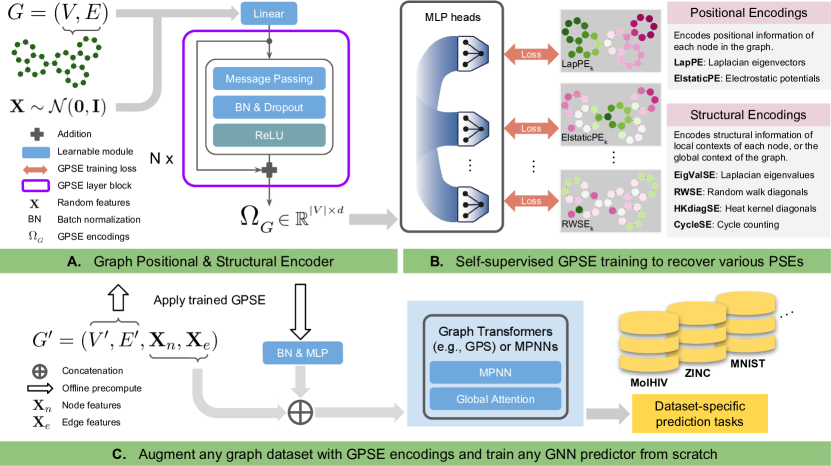
- GPSE is a learnable graph encoder trained to predict multiple types of PSEs—such as Laplacian eigenvectors, random walk encodings, and heat kernel features—simultaneously from graph structure.
- The model uses random node features (standard normal distribution) during pre-training to break symmetry and ensure that non-isomorphic graphs are distinguishable, even under 1-WL limitations.
- The encoder is trained via a multi-task objective combining mean absolute error (MAE) and cosine loss across multiple PSE types to learn a unified latent representation.
- The pre-trained GPSE encoder is fine-tuned or directly applied as node features in downstream GNNs, replacing traditional PSEs or raw node features.
- The architecture is compatible with both message-passing GNNs (e.g., GIN, GatedGCN) and graph Transformers, enabling broad applicability.
- Transferability is evaluated by applying the same pre-trained GPSE encoder to datasets with different graph statistics and modalities, including molecular, social, and synthetic graphs.
Experimental results
Research questions
- RQ1Can a single learnable encoder effectively capture diverse positional and structural encoding patterns from graph topology?
- RQ2Does GPSE generalize across datasets with different sizes, connectivity patterns, and data modalities?
- RQ3Can GPSE improve downstream GNN performance compared to hand-crafted PSEs and self-supervised pre-training?
- RQ4How critical is the use of random node features in enabling GPSE to distinguish non-isomorphic graphs?
- RQ5To what extent can GPSE replace explicitly computed PSEs without performance degradation?
Key findings
- GPSE achieves state-of-the-art performance on the ZINC and Peptides-struct benchmarks, outperforming models using traditional PSEs.
- On the PCQM4Mv2 dataset, GPSE achieves a test MAE of 0.1196 ± 0.0004 when pre-trained on MolPCBA and fine-tuned, demonstrating strong transferability.
- The inclusion of random node features is essential: GPSE fails to distinguish non-isomorphic graphs (e.g., HEXAGON vs. PENTAGON) when node features are constant, but succeeds with random features.
- Fine-tuning GPSE on downstream datasets consistently improves performance, with MAE decreasing from 0.0707 to 0.0685 on GEOM and from 0.0667 to 0.0643 on ChEMBL.
- GPSE pre-training on large datasets like MolPCBA (323,555 graphs) leads to strong generalization, with test loss decreasing from 0.06939 (5%) to 0.01219 (80%) as training size increases.
- Ablation studies show that excluding any single PSE task during pre-training has minimal negative impact, indicating robustness and complementary learning across PSE types.
Better researchstarts right now
From reading papers to final review, dramatically reduce your research time.
No credit card · Free plan available
This review was created by AI and reviewed by human editors.