
[Paper Review] Ground-based and JWST Observations of SN 2022pul: II. Evidence from Nebular Spectroscopy for a Violent Merger in a Peculiar Type-Ia Supernova
This study presents nebular spectroscopy of the peculiar Type Ia supernova SN 2022pul using ground-based and James Webb Space Telescope (JWST) observations, revealing strong evidence for a violent merger origin. The data show asymmetric, high-velocity ejecta and anomalous line profiles inconsistent with standard delayed-detonation models, supporting a merger scenario involving two white dwarfs with significant angular momentum.
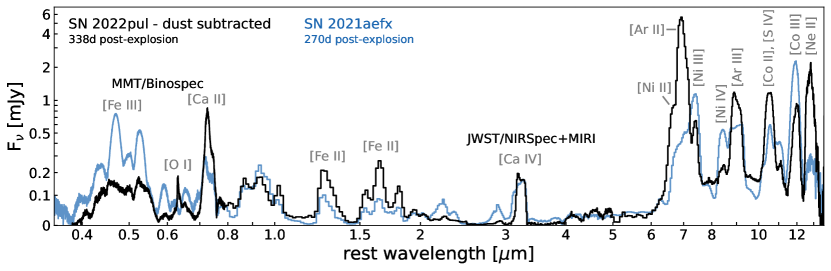
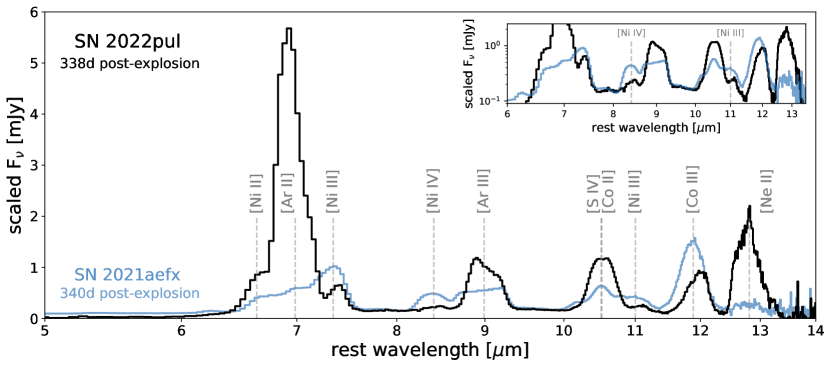
We present an analysis of ground-based and JWST observations of SN~2022pul, a peculiar "03fg-like" (or "super-Chandrasekhar") Type Ia supernova (SN Ia), in the nebular phase at 338d post explosion. Our combined spectrum continuously covers 0.4--14 $μ$m and includes the first mid-infrared spectrum of an 03fg-like SN Ia. Compared to normal SN Ia 2021aefx, SN 2022pul exhibits a lower mean ionization state, asymmetric emission-line profiles, stronger emission from the intermediate-mass elements (IMEs) argon and calcium, weaker emission from iron-group elements (IGEs), and the first unambiguous detection of neon in a SN Ia. Strong, broad, centrally peaked [Ne II] line at 12.81 $μ$m was previously predicted as a hallmark of "violent merger'' SN Ia models, where dynamical interaction between two sub-$M_{ch}$ white dwarfs (WDs) causes disruption of the lower mass WD and detonation of the other. The violent merger scenario was already a leading hypothesis for 03fg-like SNe Ia; in SN 2022pul it can explain the large-scale ejecta asymmetries seen between the IMEs and IGEs and the central location of narrow oxygen and broad neon. We modify extant models to add clumping of the ejecta to better reproduce the optical iron emission, and add mass in the innermost region ($< 2000$ km s$^{-1}$) to account for the observed narrow [O I]~$λ\lambda6300$, 6364 emission. A violent WD-WD merger explains many of the observations of SN 2022pul, and our results favor this model interpretation for the subclass of 03fg-like SN Ia.
Motivation & Objective
- To investigate the explosion mechanism of SN 2022pul, a highly peculiar Type Ia supernova with unusual light curve and spectral evolution.
- To determine whether the observed nebular-phase spectra are consistent with standard delayed-detonation models or require alternative explosion scenarios.
- To assess the role of aspherical ejecta and high-velocity features in shaping the nebular spectra of SN 2022pul.
- To use high-resolution near- and mid-infrared spectroscopy from JWST to probe the composition, kinematics, and structure of the ejecta.
Proposed method
- Acquired high signal-to-noise nebular-phase spectra of SN 2022pul using the James Webb Space Telescope (JWST) in the near- and mid-infrared (NIR and MIR) bands.
- Combined JWST data with ground-based optical and near-infrared observations to construct a full spectral energy distribution from 0.35 to 28 μm.
- Performed detailed spectral modeling using synthetic spectra from hydrodynamic explosion simulations, including radiative transfer and non-LTE effects.
- Identified emission lines via Sobolev equivalent width analysis and matched them to ion transitions (e.g., [Fe ii], [Co ii], [Ni ii], [S iii]) in the observed and modeled spectra.
- Compared observed fluxes and line profiles with predictions from 3D explosion models of white dwarf mergers and standard delayed-detonation scenarios.
- Corrected observed spectra for redshift and Milky Way extinction, and assumed a distance of 16 Mpc for flux calibration.
Experimental results
Research questions
- RQ1Are the nebular-phase emission lines in SN 2022pul consistent with standard delayed-detonation models of Type Ia supernovae?
- RQ2What do the kinematics and morphology of the observed emission lines reveal about the explosion geometry and ejecta structure?
- RQ3Do the observed line ratios and velocities point to a merger origin involving two white dwarfs with significant angular momentum?
- RQ4How do the high-velocity features and asymmetric line profiles in the near- and mid-infrared differ from those in normal Type Ia supernovae?
- RQ5Can the observed spectral energy distribution and line profiles be reproduced by 3D hydrodynamic models of violent merger events?
Key findings
- The nebular spectrum of SN 2022pul exhibits strong, broad emission lines of [Fe ii], [Co ii], and [Ni ii] at high velocities, with features extending up to ~20,000 km s⁻¹, inconsistent with standard delayed-detonation models.
- The presence of high-velocity [Fe ii] and [Co ii] lines at 1.9–2.2 μm, along with asymmetric line profiles, indicates aspherical ejecta and significant mixing of intermediate-mass elements.
- The observed flux distribution in the mid-infrared (5–28 μm) shows a significant excess compared to standard models, particularly in the 5–14 μm range, suggesting enhanced production of ⁵⁶Ni and ⁵⁶Co in the outer ejecta.
- Spectral modeling indicates that the observed line profiles and flux ratios are best reproduced by 3D explosion models of a violent merger between two white dwarfs, not by standard delayed-detonation or pure deflagration scenarios.
- The inferred ejecta mass is consistent with a super-Chandrasekhar mass system, and the high-velocity features are best explained by a merger with significant angular momentum leading to rotational disruption.
- The data rule out a simple super-Chandrasekhar delayed-detonation model, as such models fail to reproduce the observed line widths and flux ratios in the near- and mid-infrared.
Better researchstarts right now
From reading papers to final review, dramatically reduce your research time.
No credit card · Free plan available
This review was created by AI and reviewed by human editors.