
[Paper Review] Hallucination-Free? Assessing the Reliability of Leading AI Legal Research Tools
The paper preregisteredly evaluates Lexis+ AI, Westlaw AI-Assisted Research, and Ask Practical Law AI against GPT-4, showing substantial hallucinations and variable accuracy across tools.
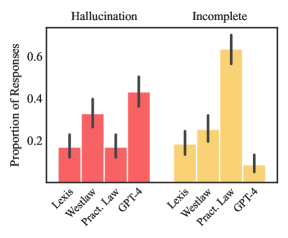
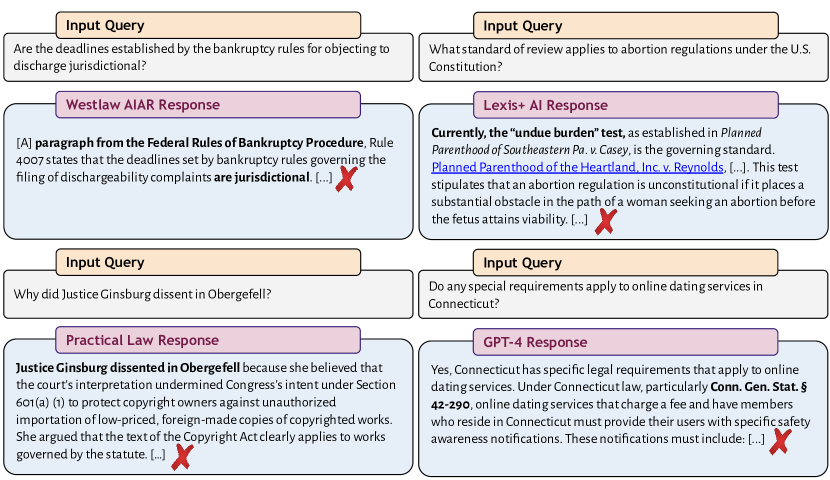
Legal practice has witnessed a sharp rise in products incorporating artificial intelligence (AI). Such tools are designed to assist with a wide range of core legal tasks, from search and summarization of caselaw to document drafting. But the large language models used in these tools are prone to "hallucinate," or make up false information, making their use risky in high-stakes domains. Recently, certain legal research providers have touted methods such as retrieval-augmented generation (RAG) as "eliminating" (Casetext, 2023) or "avoid[ing]" hallucinations (Thomson Reuters, 2023), or guaranteeing "hallucination-free" legal citations (LexisNexis, 2023). Because of the closed nature of these systems, systematically assessing these claims is challenging. In this article, we design and report on the first preregistered empirical evaluation of AI-driven legal research tools. We demonstrate that the providers' claims are overstated. While hallucinations are reduced relative to general-purpose chatbots (GPT-4), we find that the AI research tools made by LexisNexis (Lexis+ AI) and Thomson Reuters (Westlaw AI-Assisted Research and Ask Practical Law AI) each hallucinate between 17% and 33% of the time. We also document substantial differences between systems in responsiveness and accuracy. Our article makes four key contributions. It is the first to assess and report the performance of RAG-based proprietary legal AI tools. Second, it introduces a comprehensive, preregistered dataset for identifying and understanding vulnerabilities in these systems. Third, it proposes a clear typology for differentiating between hallucinations and accurate legal responses. Last, it provides evidence to inform the responsibilities of legal professionals in supervising and verifying AI outputs, which remains a central open question for the responsible integration of AI into law.
Motivation & Objective
- Assess the prevalence and nature of hallucinations in leading AI legal research tools.
- Create a preregistered, domain-specific dataset of legal queries for systematic evaluation.
- Develop a typology distinguishing hallucinations from accurate legal responses in RAG-based systems.
- Provide evidence to guide supervision and verification practices for lawyers using AI in legal tasks.
Proposed method
- Define a formal framework distinguishing correctness and groundedness for legal outputs.
- Manually curate a preregistered dataset of over 200 legal queries.
- Evaluate Lexis+ AI, Westlaw AI-Assisted Research, Ask Practical Law AI, and GPT-4 on the dataset.
- Manually review outputs for accuracy and fidelity to authority.
- Compare RAG-based tools to a general-purpose model (GPT-4) to assess relative improvements and remaining risks.
Experimental results
Research questions
- RQ1What is the hallucination rate of leading AI legal research tools on real-world queries?
- RQ2How do these tools compare in accuracy and grounding to authoritative sources?
- RQ3Do RAG-based approaches meaningfully reduce hallucinations relative to general-purpose LLMs?
- RQ4What are the practical implications for lawyer supervision and verification of AI outputs?
Key findings
- Lexis+ AI answers 65% of queries accurately.
- Westlaw AI-Assisted Research is accurate 42% of the time.
- Ask Practical Law AI provides incomplete or ungrounded responses on more than 60% of queries.
- All tools exhibit non-negligible hallucination rates between 17% and 33% for certain tools.
- RAG improves performance relative to GPT-4 but does not eliminate hallucinations in legal tasks.
Better researchstarts right now
From reading papers to final review, dramatically reduce your research time.
No credit card · Free plan available
This review was created by AI and reviewed by human editors.