
[Paper Review] Healthcare Data Governance, Privacy, and Security -- A Conceptual Framework
This paper proposes a privacy- and security-first conceptual framework for healthcare data governance, integrating data privacy and security by design (PSbD) with Privacy-Enhancing Technologies (PETs) and policy-based compliance checking. The framework addresses systemic vulnerabilities in electronic health records by embedding privacy throughout the data lifecycle, offering a proactive, compliance-ready model to mitigate breaches and insider threats.
The abundance of data has transformed the world in every aspect. It has become the core element in decision making, problem solving, and innovation in almost all areas of life, including business, science, healthcare, education, and many others. Despite all these advances, privacy and security remain critical concerns of the healthcare industry. It is important to note that healthcare data can also be a liability if it is not managed correctly. This data mismanagement can have severe consequences for patients and healthcare organisations, including patient safety, legal liability, damage to reputation, financial loss, and operational inefficiency. Healthcare organisations must comply with a range of regulations to protect patient data. We perform a classification of data governance elements or components in a manner that thoroughly assesses the healthcare data chain from a privacy and security standpoint. After deeply analysing the existing literature, we propose a conceptual privacy and security driven healthcare data governance framework.
Motivation & Objective
- Address the persistent gap in healthcare data governance where privacy is treated as an afterthought rather than a core design principle.
- Mitigate risks from data breaches, insider threats, and regulatory non-compliance in electronic health records (EHRs).
- Develop a comprehensive, privacy- and security-driven conceptual framework applicable across the full healthcare data lifecycle.
- Ensure compliance with evolving regulations by embedding policy-based automated compliance checking into data governance processes.
- Enhance data quality and trust by aligning privacy, security, and data integrity across healthcare systems.
Proposed method
- Conduct a systematic literature review to classify data governance components with a focus on privacy and security across the healthcare data chain.
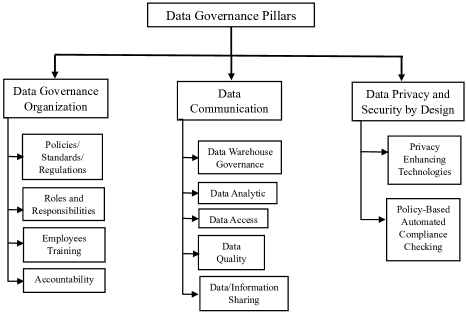
- Propose a three-pillar conceptual framework: (1) data governance, (2) data privacy and security by design (PSbD), and (3) data fortification through PETs and policy-based compliance.
- Integrate Privacy-Enhancing Technologies (PETs) such as differential privacy, homomorphic encryption, and secure multi-party computation to protect sensitive data during processing.
- Implement policy-based automated compliance checking systems that monitor logs, transactions, and access patterns to detect deviations from privacy and security policies.
- Structure the framework around six data quality dimensions—accuracy, completeness, consistency, uniqueness, timelessness, and validity—to ensure reliable and secure data handling.
- Embed PSbD principles into system design, development, and deployment phases to proactively prevent privacy violations.
Experimental results
Research questions
- RQ1How can healthcare data governance be restructured to prioritize privacy and security as foundational elements rather than secondary concerns?
- RQ2What components are essential for a comprehensive, privacy- and security-driven healthcare data governance framework?
- RQ3How can Privacy-Enhancing Technologies (PETs) be effectively integrated into the healthcare data lifecycle to protect sensitive information?
- RQ4In what ways can automated compliance checking improve regulatory adherence and reduce the risk of data breaches in healthcare systems?
- RQ5How does integrating data quality dimensions with privacy and security enhance the overall integrity and trustworthiness of healthcare data systems?
Key findings
- Existing healthcare data governance frameworks often treat privacy as a peripheral concern rather than a core design requirement, increasing vulnerability to breaches.
- The proposed conceptual framework embeds privacy and security by design (PSbD) throughout the data lifecycle, significantly reducing the risk of unauthorized access and data leakage.
- Privacy-Enhancing Technologies (PETs) such as differential privacy and secure computation can be effectively applied to protect sensitive data during analytics and sharing without compromising utility.
- Policy-based automated compliance checking enables real-time monitoring and detection of policy violations, improving responsiveness to emerging threats and regulatory changes.
- Data quality dimensions—accuracy, completeness, consistency, uniqueness, timelessness, and validity—are essential for ensuring that privacy and security controls operate on reliable data.
- The framework addresses insider threats by enforcing strict access controls and monitoring, even for authorized users with legitimate system access, thereby reducing the risk of malicious internal actions.
Better researchstarts right now
From reading papers to final review, dramatically reduce your research time.
No credit card · Free plan available
This review was created by AI and reviewed by human editors.