
[Paper Review] Higher representations for extended operators
The paper generalizes how symmetries act on extended operators in quantum field theory by introducing higher representations: n-1 dimensional operators transform in n-representations of finite higher-group symmetries, with detailed analysis for n=1,2,3 (local, line, and surface defects).
It is known that local operators in quantum field theory transform in representations of ordinary global symmetry groups. The purpose of this paper is to generalise this statement to extended operators such as line and surface defects. We explain that $(n-1)$-dimensional operators transform in $n$-representations of a finite invertible or group-like symmetry and thoroughly explore this statement for $n = 1,2,3$. We therefore propose higher representation theory as the natural framework to describe the action of symmetries on the extended operator content in quantum field theory.
Motivation & Objective
- Generalize the action of finite symmetries from local operators to extended operators (line and surface defects).
- Propose higher representation theory as the natural framework for describing symmetry actions on extended operator content.
- Classify irreducible higher representations for lines and surfaces (2- and 3-representations) and relate them to physical data such as subgroups, cohomology classes, and fusion categories.
- Provide elementary and categorical perspectives, connecting to TQFTs and gapped boundary conditions, to illuminate the structure of higher representations.
Proposed method
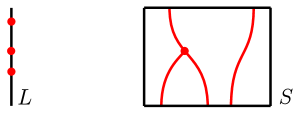
- Describe how G acts on extended operators via topological symmetry defects and their junctions.
- Characterize irreducible 2-representations of a finite group by data (σ,c) with a transitive G-action σ and a twisted 2-cocycle c in H^2_σ(G,U(1)^n).
- Generalize to separated line defects and tensor products, yielding tensor product rules for 2-representations.
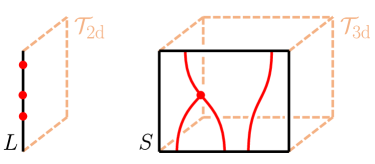
- Introduce a categorical perspective using attached n-dimensional TQFTs to realize n-representations as G-equivariant structures.
- Explain orientation reversal and junction operator behavior leading to graded projective representations of type (σ,c).
- Provide elementary examples from gauge theory to illustrate the framework.
Experimental results
Research questions
- RQ1How do extended operators transform under finite (higher) group symmetries beyond local operators?
- RQ2What is the precise data needed to specify an n-representation for line and surface defects under finite groups?
- RQ3How do line and surface defects transform under orientation changes and under fusion (tensor product) operations?
- RQ4Can extended operators be described via attached TQFTs and G-equivariant structures to recover higher representation theory?
- RQ5What are concrete physical interpretations (e.g., anomalies, fusion categories) of higher representations for defects?
Key findings
- Local operators transform in irreducible representations of G (reviewed in Section 2).
- Line defects transform in irreducible 2-representations of G, classified by a transitive permutation representation σ and a twisted 2-cocycle c in Z^2_σ(G,U(1)^n).
- Separated line defects transform under tensor product of 2-representations, yielding (σ,c)⊗(σ′,c′)=(σ⊗σ′,c⊗c′).
- Junction operators on line defects furnish graded projective representations of G of type (σ,c) for non-genuine local operators ending the lines.
- Orientation reversal maps to the conjugate 2-representation (σ,ĉ) with ĉ determined by c via complex conjugation.
- The framework supports a categorical interpretation via n-dimensional TQFTs and background Wilson lines, providing a unified description of higher representations and their anomalies.
Better researchstarts right now
From reading papers to final review, dramatically reduce your research time.
No credit card · Free plan available
This review was created by AI and reviewed by human editors.