
[Paper Review] How baryons appear in low-energy QCD: Domain-wall Skyrmion phase in strong magnetic fields
This paper proposes a model-independent, analytic transition in low-energy QCD under strong magnetic fields: at baryon chemical potential μ_B ≥ μ_c ≈ 1.03 GeV, the chiral soliton lattice (CSL) phase transforms into a domain-wall Skyrmion phase. Two-dimensional Skyrmions emerge on soliton surfaces, behaving as three-dimensional baryons with quantized interiors and persistent superconducting currents due to charged pion condensation, offering a new baryonic phase accessible in heavy-ion collisions.
Low-energy dynamics of QCD can be described by pion degrees of freedom in terms of the chiral perturbation theory(ChPT). A chiral soliton lattice(CSL), an array of solitons, is the ground state due to the chiral anomaly in the presence of a magnetic field larger than a certain critical value at finite density. Here, we show in a model-independent and fully analytic manner (at the leading order of ChPT) that the CSL phase transits to a {\it domain-wall Skyrmion phase} when the chemical potential is larger than the critical value $μ_{ m c} = 16πf_π^2/3m_π \sim 1.03 \;\; { m GeV}$ with the pion's decay constant $f_π$ and mass $m_π$, which can be regarded as the nuclear saturation density. There spontaneously appear stable two-dimensional Skyrmions or lumps on a soliton surface, which can be viewed as three-dimensional Skyrmions carrying even baryon numbers from the bulk despite no Skyrme term. They behave as superconducting rings with persistent currents due to a charged pion condensation, and areas of the rings' interiors are quantized. This phase is in scope of future heavy-ion collider experiments.
Motivation & Objective
- To understand how baryons arise in low-energy QCD without relying on the Skyrme term.
- To identify a new baryonic phase in the presence of strong magnetic fields and finite baryon density.
- To establish a model-independent, analytic transition from the chiral soliton lattice (CSL) to a domain-wall Skyrmion phase at high chemical potential.
- To clarify the role of the chiral anomaly and charged pion condensation in stabilizing two-dimensional Skyrmions on soliton surfaces.
Proposed method
- Analytic derivation within chiral perturbation theory (ChPT) at leading order, using the effective Lagrangian for pions coupled to electromagnetic and chiral anomalies.
- Mapping the system to a sine-Gordon model via the neutral pion's anomalous coupling to magnetic fields, enabling domain wall solutions.
- Decomposing the three-dimensional baryon number density into contributions from the sine-Gordon soliton number and two-dimensional lump topological charge density.
- Using meromorphic functions to describe k-lump configurations and computing the Wess-Zumino-Witten (WZW) term to evaluate energy contributions from magnetic flux and spinor structure.
- Applying the Goldstone-Wilczek current to relate the chiral anomaly to the magnetic field coupling in the effective action.
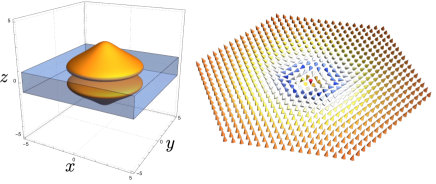
- Evaluating the energy functional to show that baryon number density peaks at two distinct locations, indicating the formation of stable Skyrmion-like structures.
Experimental results
Research questions
- RQ1How do baryons emerge in low-energy QCD without the Skyrme term, in the presence of strong magnetic fields and finite baryon density?
- RQ2What is the nature of the phase transition from the chiral soliton lattice (CSL) to a new baryonic phase at high chemical potential?
- RQ3How do two-dimensional Skyrmions form on the surface of solitons, and what is their topological and physical characterization?
- RQ4What role does charged pion condensation play in stabilizing these structures and enabling persistent currents?
- RQ5How is the baryon number density distributed in this new phase, and what determines the quantization of the Skyrmion core?
Key findings
- The CSL phase transitions to a domain-wall Skyrmion phase when the baryon chemical potential exceeds μ_c = 16πf_π²/(3m_π) ≈ 1.03 GeV, corresponding to nuclear saturation density.
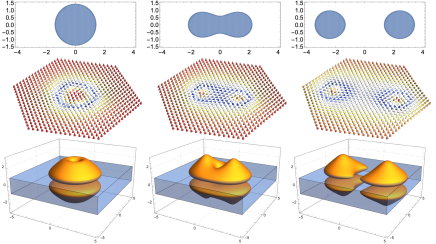
- Stable two-dimensional Skyrmions (lumps) spontaneously form on the surface of solitons, which are topologically stable and carry quantized baryon number.
- These domain-wall Skyrmions behave as three-dimensional Skyrmions from the bulk perspective, despite the absence of the Skyrme term.
- The Skyrmions host persistent supercurrents due to charged pion condensation, leading to quantized magnetic flux in their interiors.
- The baryon number density exhibits a double-peak structure in the z-direction (perpendicular to the soliton plane), with total integral 2q(x,y), confirming the two-dimensional nature of the Skyrmion charge.
- The energy functional favors configurations with b_{k-1} = 0, indicating that the lowest-energy Skyrmion states are those with minimal non-uniformity in the meromorphic function describing the lump.
Better researchstarts right now
From reading papers to final review, dramatically reduce your research time.
No credit card · Free plan available
This review was created by AI and reviewed by human editors.