
[Paper Review] Idiosyncratic Risk, Government Debt and Inflation
The paper shows that public debt can raise the inflation-neutral rate when households insure idiosyncratic risk, causing inflation under active Taylor-rule monetary policy; results depend on asset-market structure and are quantified with a 2-asset HANK model.
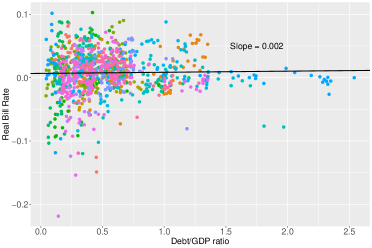
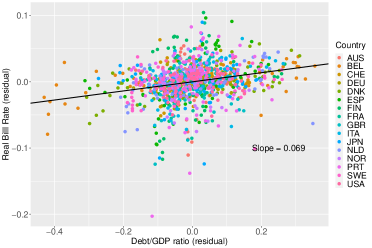
How does public debt matter for price stability? If it is useful for the private sector to insure idiosyncratic risk, even transitory government debt expansions can exert upward pressure on interest rates and create inflation. As I demonstrate using an analytically tractable model, this holds in the presence of an active Taylor rule and does not require the absence of future fiscal consolidation. Further analysis using a quantitative 2-asset HANK model reveals the magnitude of the mechanism to crucially depend on the structure of the asset market: under common assumptions, the interest rate effects of public debt are either overly strong or overly weak. After disciplining this aspect based on evidence regarding its long-term relationship with treasury returns, my framework indicates relevant short-run effects of public debt on inflation under active monetary policy: In particular, in the HANK model the mechanism can account for US inflation remaining elevated in 2023 and afterwards.
Motivation & Objective
- Explain how government debt affects price stability when private sectors use debt as insurance against idiosyncratic risk.
- Show that debt can raise the neutral rate and induce inflation under a Taylor-rule, even with funded debt.
- Analyze how asset market structure (liquid vs illiquid, two-asset framework) influences this mechanism.
- Assess whether monetary policy can compensate for neutral-rate effects of debt, including disinflation dynamics.
- Provide calibration and robustness checks to gauge quantitative relevance in a HANK setting.
Proposed method
- Derives analytical results in a tractable New Keynesian model with idiosyncratic income risk and a Taylor-rule monetary policy.
- Introduces a two-asset HANK model with liquid and illiquid assets and a liquid asset fund to study how asset-market structure shapes policy transmission.
- Calibrates the model to match micro moments (income/wealth distribution, plausible MPCs) and investigates inflation dynamics under debt expansions.
- Analyzes alternative fiscal rules and different monetary-policy rules to isolate the debt-inflation channel.
- Discusses empirical considerations and relates findings to debt-inflation evidence and spreads between assets of differing liquidity.
Experimental results
Research questions
- RQ1Does government debt expansion affect the inflation path when private agents insure idiosyncratic risk under active monetary policy?
- RQ2How does the structure of the asset market (liquid vs illiquid assets) influence the transmission of debt to real rates and inflation?
- RQ3Can the central bank counteract inflationary pressures from debt by adjusting the Taylor rule or by accounting for neutral-rate effects?
- RQ4What is the quantitative magnitude of the debt-inflation mechanism in a calibrated HANK framework the presence of idiosyncratic risk?
- RQ5Do different fiscal rules (funded vs non-funded debt) qualitatively alter the inflation dynamics in these models?
Key findings
- In the analytical NK model with idiosyncratic risk, higher public debt raises the natural rate of interest, implying inflation under a Taylor rule unless the policy response adjusts.
- In the 2-asset HANK model, the magnitude of the debt-inflation mechanism crucially depends on asset-market structure; standard setups may over- or under-estimate the effect.
- A parsimonious asset-market framework that allows capital to imperfectly serve liquidity needs helps align the model with observed inflation dynamics linked to debt expansions.
- Persistently elevated debt can impede the final leg of disinflation unless the central bank explicitly accounts for its effect on the neutral rate.
- The framework suggests that monetary policy can achieve faster disinflation at lower costs if it internalizes the neutral-rate pressure generated by debt.
Better researchstarts right now
From reading papers to final review, dramatically reduce your research time.
No credit card · Free plan available
This review was created by AI and reviewed by human editors.