
[Paper Review] Imaging the breaking of electrostatic dams in graphene for ballistic and viscous fluids
This study uses scanning tunneling potentiometry (STP) to image quasiparticle flow in graphene with nanoscale resolution, revealing non-Ohmic flow profiles and super-ballistic conductance in narrow channels. It demonstrates that at 77 K, viscous electron flow exceeds the ballistic limit, with measured electron-electron scattering length ~100 nm and kinematic viscosity ≈2.5×10³ cm²/s, confirming hydrodynamic behavior in graphene's Fermi fluid.
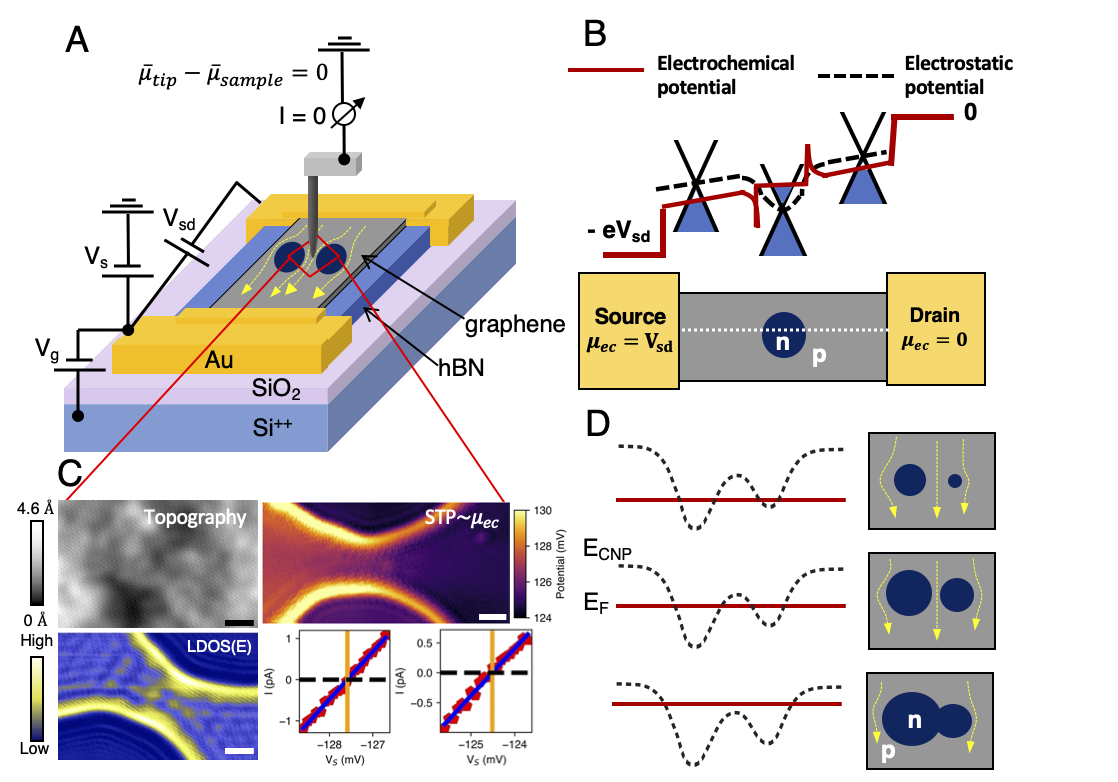
The flow of charge carriers in materials can, under some circumstances, mimic the flow of viscous fluids. In order to visualize the consequences of such effects, new methodologies must be developed that can probe the quasiparticle flow profile with nm-scale resolution as the geometric parameters of the system are continuously evolved. In this work, scanning tunneling potentiometry (STP) is used to image quasiparticle flow around engineered electrostatic barriers in graphene/hBN heterostructures. Measurements are performed as electrostatic dams - defined by lateral pn-junction barriers - are broken within the graphene sheet, and carriers move through conduction channels with physical widths that vary continuously from pinch-off to um-scale. Local, STP measurements of the electrochemical potential allow for direct characterization of the evolving flow profile, which we compare to finite-element simulations of a Stokesian fluid with varying parameters. Our results reveal distinctly non-Ohmic flow profiles, with charge dipoles forming across barriers due to carrier scattering and accumulation on the upstream side, and depletion downstream. Conductance measurements of individual channels, meanwhile, reveal that at low temperatures the quasiparticle flow is ballistic, but as the temperature is raised there is a Knudsen-to-Gurzhi regime crossover where the fluid becomes viscous and the channel conductance exceeds the ballistic limit set by Sharvin conductance. These results provide a clear illustration of how carrier flow in a Fermi fluid evolves as a function of carrier density, channel width, and temperature. They also demonstrate how STP can be used to extract key parameters of quasiparticle transport, with a spatial resolution that exceeds that of other methods by orders of magnitude.
Motivation & Objective
- To visualize quasiparticle flow in graphene with nanoscale spatial resolution as geometric parameters like channel width are continuously tuned.
- To probe the transition from ballistic to viscous electron flow in graphene by varying temperature and carrier density.
- To demonstrate that scanning tunneling potentiometry (STP) enables direct measurement of electrochemical potential profiles with superior resolution compared to other methods.
- To extract key hydrodynamic parameters such as electron-electron scattering length and kinematic viscosity from experimental STP data.
- To validate observed flow profiles against finite-element simulations of a Stokesian fluid model.
Proposed method
- Scanning tunneling potentiometry (STP) is used to map local electrochemical potential across graphene with sub-100 nm spatial resolution.
- Electrostatic barriers (p-n junctions) are created in situ using voltage pulses from an STM tip, forming tunable constrictions and 'electrostatic dams'.
- The method allows continuous variation of channel width from micrometer-scale to pinch-off, enabling real-time observation of flow evolution.
- Finite-element simulations of a Stokesian fluid are used to model and compare with experimental flow profiles under varying parameters.
- Theoretical modeling of charge density and potential in circular pn-junctions uses self-consistent solutions of coupled equations under the Thomas-Fermi approximation.
- Nonlinear screening effects in graphene pn-junctions are analyzed to assess validity of hydrodynamic modeling at different length scales.
Experimental results
Research questions
- RQ1How does the quasiparticle flow profile in graphene evolve as electrostatic dams are broken and channel width is continuously varied?
- RQ2What signatures of viscous versus ballistic transport emerge in local electrochemical potential measurements at different temperatures?
- RQ3To what extent can STP resolve hydrodynamic features such as charge dipoles and super-ballistic conductance in graphene?
- RQ4How do electron-electron scattering length and kinematic viscosity in graphene compare to theoretical predictions and experimental observations?
- RQ5Can finite-element simulations of a Stokesian fluid quantitatively reproduce the observed STP-measured potential profiles?
Key findings
- At 4.5 K, quasiparticle flow is ballistic, with channel conductance matching the Sharvin conductance limit, indicating minimal scattering.
- At 77 K, channel conductance exceeds the ballistic limit, demonstrating super-ballistic behavior consistent with viscous flow.
- The electron-electron scattering length is measured to be approximately 100 nm at 77 K, indicating strong many-body interactions.
- The kinematic viscosity of the electron fluid is estimated at approximately 2.5×10³ cm²/s, confirming viscous hydrodynamic transport.
- Charge dipoles form across barriers due to upstream carrier accumulation and downstream depletion, a hallmark of non-Ohmic flow.
- STP measurements resolve potential gradients with nanoscale spatial resolution, exceeding the resolution of other scanned-probe techniques by orders of magnitude.
Better researchstarts right now
From reading papers to final review, dramatically reduce your research time.
No credit card · Free plan available
This review was created by AI and reviewed by human editors.