
[Paper Review] Implications for the non-Gaussianity of curvature perturbation from pulsar timing arrays
The paper uses combined PTA data to constrain the local-type non-Gaussianity of curvature perturbations via scalar-induced gravitational waves, finding |F_NL| ≲ 13.9 and -13.9 ≲ F_NL ≲ -0.1 to avoid PBH overproduction.
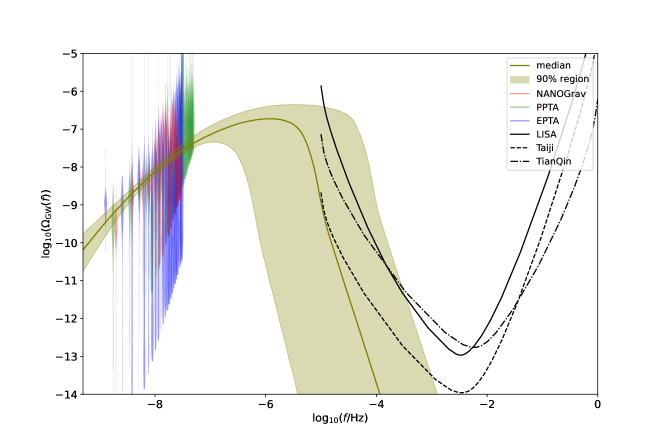
The recently released data by pulsar timing array (PTA) collaborations present strong evidence for a stochastic signal consistent with a gravitational-wave background. Assuming this signal originates from scalar-induced gravitational waves, we jointly use the PTA data from the NANOGrav 15-yr data set, PPTA DR3, and EPTA DR2 to probe the small-scale non-Gaussianity. We put the first-ever constraint on the non-Gaussianity parameter, finding $|F_\mathrm{NL}|\lesssim 13.9$ for a lognormal power spectrum of the curvature perturbations. Furthermore, we obtain $-13.9 \lesssim F_\mathrm{NL}\lesssim -0.1$ to prevent excessive production of primordial black holes. Moreover, the multi-band observations with the space-borne gravitational-wave detectors, such as LISA/Taiji/TianQin, will provide a complementary investigation of primordial non-Gaussianity. Our findings pave the way to constrain inflation models with PTA data.
Motivation & Objective
- Motivate probing small-scale non-Gaussianity of primordial curvature perturbations using PTAs that have detected a stochastic gravitational-wave background.
- Quantify how local-type non-Gaussianity (F_NL) affects scalar-induced gravitational waves and primordial black hole production.
- Demonstrate a Bayesian framework combining NANOGrav 15-yr, PPTA DR3, and EPTA DR2 data to constrain F_NL and related parameters.
Proposed method
- Adopt a local-type expansion R(x) = R_G(x) + F_NL( R_G^2(x) - <R_G^2> ) linking F_NL to non-Gaussian curvature perturbations.
- Use an effective curvature perturbation power spectrum P_R^{NG} = P_R + F_NL^2 ∫∫ P_R(uk)P_R(vk)/(u^2 v^2) du dv to capture non-Gaussian contributions.
- Compute the SIGW energy density Omega_GW(k) via a second-order source term from scalar perturbations with a radiation-era transfer function T(u,v).
- Model P_R(k) with a lognormal spectrum and relate k to frequency f through k = 2πf to obtain Omega_GW,0(f) after cosmic evolution.
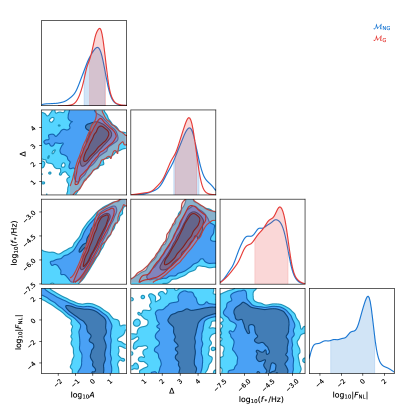
- Perform Bayesian inference with a 66-point multi-band PTA spectrum, using dynesty/BILBY to constrain parameters including A, Δ, f_*, and |F_NL|.
Experimental results
Research questions
- RQ1What are the allowed ranges of the local non-Gaussianity parameter F_NL given PTA measurements assuming SIGWs originate from small-scale curvature perturbations?
- RQ2How does F_NL influence the SIGW spectrum and the resulting PBH abundance within the PTA frequency window?
- RQ3Can joint PTA data (NANOGrav, PPTA, EPTA) tighten constraints on F_NL beyond single-PTA analyses?
- RQ4What implications do the constraints on F_NL have for inflationary scenarios that generate non-Gaussian curvature perturbations (e.g., curvaton models)?
Key findings
- The joint PTA analysis yields |F_NL| ≲ 13.9 for a lognormal P_R(k).
- Allowing PBH constraints reduces the range to -13.9 ≲ F_NL ≲ -0.1, avoiding excessive PBH production.
- Amplitude parameter constrained to A = 1.06^{+5.20}_{-1.02} with Δ and f_* values provided in the results, improving precision over NANOGrav-alone analyses.
- Positive and negative F_NL are degenerate in their impact on SIGWs, motivating PBH-based degeneracy-breaking constraints.
- The results imply a non-negligible curvaton decay fraction r_D (r_D ≳ 0.05 at 95% C.L.; stronger when F_NL ≲ -0.1), impacting inflation-model viability.
Better researchstarts right now
From reading papers to final review, dramatically reduce your research time.
No credit card · Free plan available
This review was created by AI and reviewed by human editors.