
[Paper Review] Implications of the NANOGrav results for primordial black holes and Hubble tension
The paper links NANOGrav’s stochastic gravitational-wave signal to primordial black holes (PBHs) formed during inflation, derives PBH thermodynamics from GW frequency, and connects PBH evaporation and an effective Hubble rate to the Hubble tension.
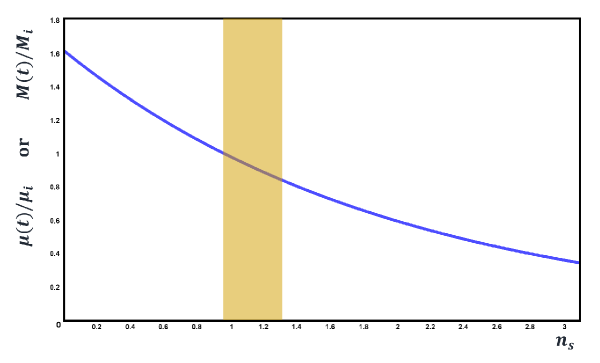
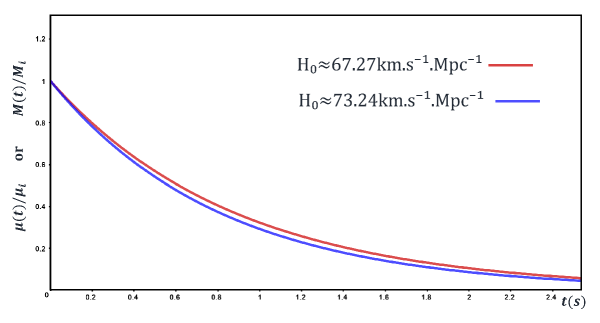
The purpose of this work is to investigate the formation and evaporation of the primordial black holes in the inflationary scenarios. Thermodynamic parameters such as mass, temperature and entropy are expressed in terms of NANOGrav frequency. By numerical calculations we show that the constraint on the mass range $10^{-5}kg-10^{50}kg$ is well confirmed. We discuss the relation between the redshift and the probability for gravitational wave source populations. A new parameter associated with the frequency and Hubble rate is presented, by which for the spectral index $n_{s}\approx 0.996$ and the Hubble constant $H_{0}\approx 67.27km.s^{-1}.Mpc^{-1}$, the effective Hubble constant is calculated to be $H_{eff,0}\approx 73.24km.s^{-1}.Mpc^{-1} $ which is compatible with the observational data. We make a comparison between the Hubble tension and the primordial perturbations and the expression of the mass loss rate, chemical potential and central charge needed to describe the Hawking evaporation will be established.
Motivation & Objective
- Motivate the connection between NANOGrav stochastic GW signals and PBHs formed during inflation.
- Express PBH thermodynamic quantities (mass, temperature, entropy) as functions of GW frequency.
- Investigate how PBH formation and evaporation relate to inflationary dynamics and the Hubble tension.
- Introduce a new parameter tied to GW frequency and the Hubble rate to reconcile H0 measurements.
- Discuss gauge/gravity duality aspects via chemical potential and central charge in PBH thermodynamics.
Proposed method
- Relate PBH mass to GW frequency using M ~ c^3/G · N/(16π^2 f) and f = emission frequency of PBHs (Eq. 2.9).
- Compute PBH temperature with T ∝ 1/M and link to inflationary e-folds N through T = (2πħ f)/s and s = kB N (Eq. 2.6, 2.8).
- Derive a slow-roll/inflationary framework to obtain the spectral index n_s from ε_H and η (Eq. 3.5).
- Define an effective Hubble rate H_eff = H + N H_f and relate it to n_s and cosmological data (Eq. 3.6, 3.7).
- Model PBH mass loss via Hawking evaporation and connect it to an evolving H_eff (Eq. 4.10–4.13).
- Introduce a chemical potential μ conjugate to the central charge C in a holographic/duality-inspired framework (Eq. 5.2–5.4).
Experimental results
Research questions
- RQ1Can PBHs formed during inflation account for the NANOGrav stochastic GW background?
- RQ2How can PBH thermodynamics be expressed as functions of GW frequency, and what does this imply for PBH mass and temperature?
- RQ3Does an inflationary and holographic framework yield an effective Hubble constant compatible with local and CMB measurements?
- RQ4What is the role of the spectral index n_s in linking PBH physics to the Hubble tension?
Key findings
- PBH mass scales inversely with GW frequency, with f ≈ 5.5 nHz yielding PBH masses suggested by the analysis (Table 1 discussion).
- PBHs have extremely low temperatures, consistent with a cold dark matter interpretation.
- An effective Hubble constant H_eff,0 ≈ 73.24 km/s/Mpc is obtained for n_s ≈ 0.996, in line with some local measurements.
- A relation between n_s, H_eff,0, and N is derived, providing a possible link between inflationary perturbations and the Hubble tension.
- Mass loss due to Hawking evaporation is quantified via a frequency-dependent rate, influencing the evolution of PBHs and H_eff.
- A holographic perspective introduces a chemical potential μ and central charge C, connecting PBH thermodynamics to boundary/bulk duality.
Better researchstarts right now
From reading papers to final review, dramatically reduce your research time.
No credit card · Free plan available
This review was created by AI and reviewed by human editors.