
[Paper Review] In Defense of RAG in the Era of Long-Context Language Models
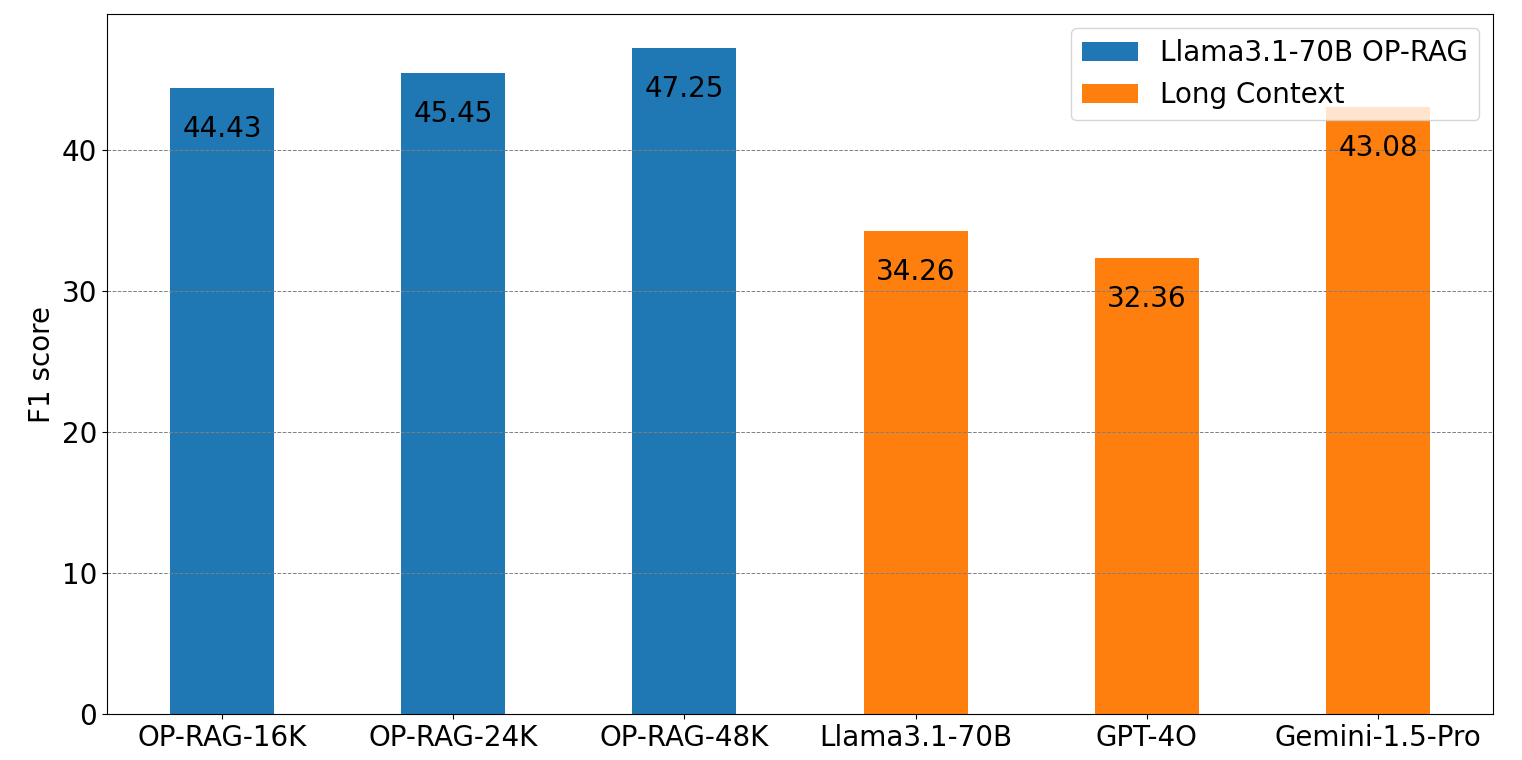
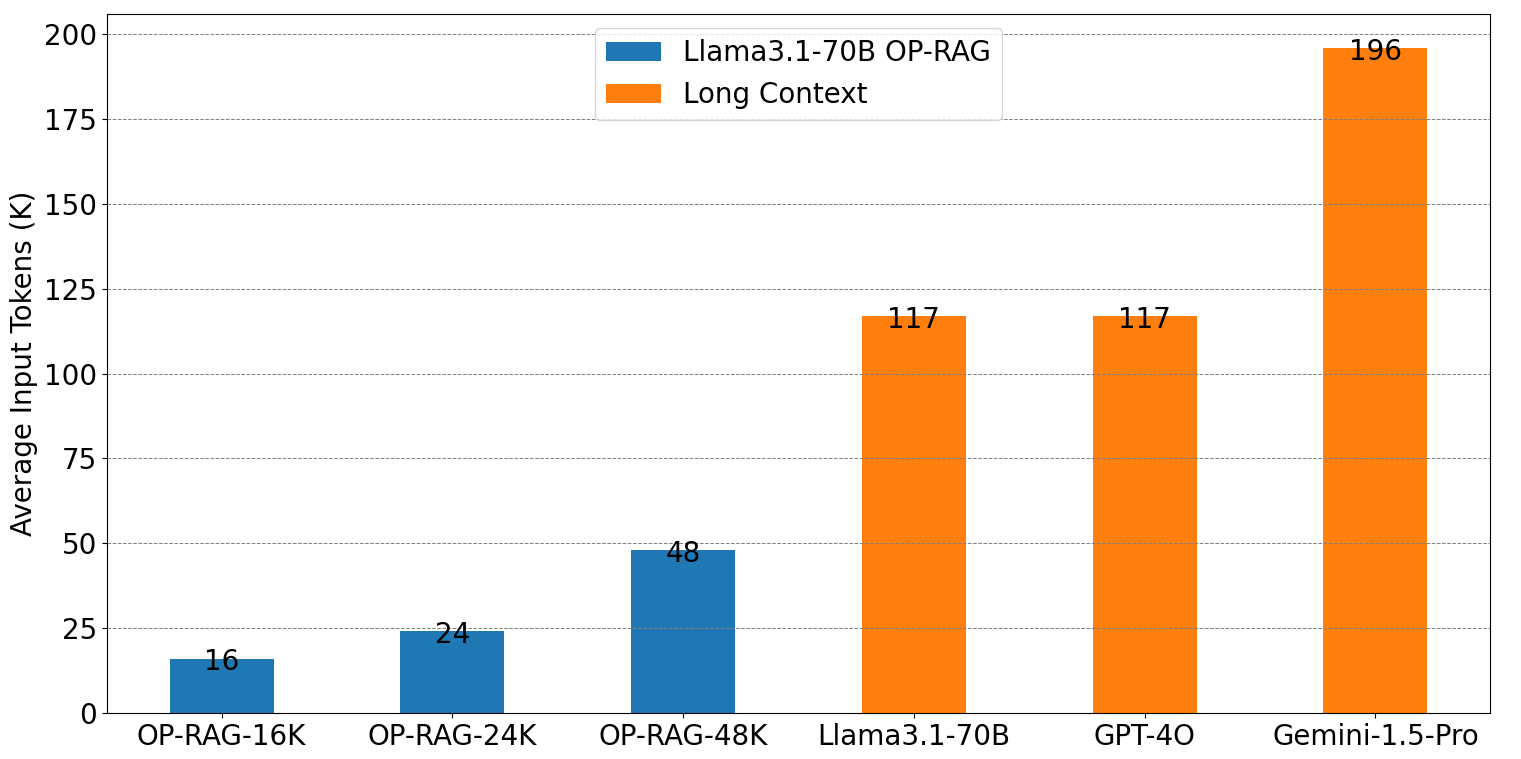
This paper proposes Order-Preserve Retrieval-Augmented Generation (OP-RAG), a method that maintains the original order of retrieved document chunks to improve answer quality in long-context question-answering. Unlike vanilla RAG or long-context LLMs, OP-RAG achieves higher F1 scores (up to 47.25) with significantly fewer input tokens (48K) than long-context models processing 117K–196K tokens, demonstrating that focused retrieval outperforms brute-force context length extension.
Overcoming the limited context limitations in early-generation LLMs, retrieval-augmented generation (RAG) has been a reliable solution for context-based answer generation in the past. Recently, the emergence of long-context LLMs allows the models to incorporate much longer text sequences, making RAG less attractive. Recent studies show that long-context LLMs significantly outperform RAG in long-context applications. Unlike the existing works favoring the long-context LLM over RAG, we argue that the extremely long context in LLMs suffers from a diminished focus on relevant information and leads to potential degradation in answer quality. This paper revisits the RAG in long-context answer generation. We propose an order-preserve retrieval-augmented generation (OP-RAG) mechanism, which significantly improves the performance of RAG for long-context question-answer applications. With OP-RAG, as the number of retrieved chunks increases, the answer quality initially rises, and then declines, forming an inverted U-shaped curve. There exist sweet points where OP-RAG could achieve higher answer quality with much less tokens than long-context LLM taking the whole context as input. Extensive experiments on public benchmark demonstrate the superiority of our OP-RAG.
Motivation & Objective
- To re-evaluate the role of RAG in the era of long-context LLMs, challenging the assumption that long-context models alone outperform retrieval-augmented methods.
- To investigate whether the order of retrieved chunks affects answer quality in long-context question-answering.
- To identify optimal retrieval scope where RAG performance peaks before degrading due to irrelevant information.
- To demonstrate that efficient, focused retrieval can surpass the performance of long-context LLMs processing entire documents.
Proposed method
- Propose Order-Preserve RAG (OP-RAG), which preserves the original sequence of retrieved document chunks instead of reordering them by relevance.
- Use dense vector retrieval (BGE-large-en-v1.5) to embed queries and document chunks, retrieving top-k chunks based on similarity.
- Structure the input context for the LLM by concatenating retrieved chunks in their original document order, maintaining temporal and structural coherence.
- Systematically vary the number of retrieved chunks to study the trade-off between recall (more relevant info) and precision (less distraction).
- Use Llama3.1-70B and other long-context LLMs as generators to evaluate performance across different input lengths.
- Apply ablation studies to isolate the impact of retrieval order and context length on answer quality.
Experimental results
Research questions
- RQ1Does preserving the original order of retrieved chunks improve answer quality in long-context question-answering compared to relevance-sorted retrieval?
- RQ2How does answer quality in RAG vary with increasing numbers of retrieved chunks, and does it follow an inverted U-shaped curve?
- RQ3Can RAG with optimized chunk count outperform long-context LLMs that process entire documents as input, despite using fewer tokens?
- RQ4What is the optimal balance between retrieval recall and distraction in long-context RAG systems?
- RQ5How does the model scale (e.g., Llama3.1-8B vs. 70B) affect the peak performance point in OP-RAG?
Key findings
- OP-RAG achieves a 47.25 F1 score on the En.QA benchmark using only 48K input tokens, outperforming Llama3.1-70B without RAG, which achieves 34.26 F1 with 117K tokens.
- With 128 retrieved chunks, OP-RAG achieves 44.43 F1 on En.QA, while vanilla RAG with the same number of chunks reaches only 38.40 F1.
- On the EN.MC dataset, OP-RAG with 192 chunks achieves 88.65% accuracy, compared to 81.22% for vanilla RAG, demonstrating a significant gain at scale.
- The performance of OP-RAG follows an inverted U-shaped curve: quality improves with more chunks up to a peak, then declines due to increased distraction from irrelevant content.
- OP-RAG with 24K tokens achieves 88.65% accuracy on EN.MC, surpassing GPT-4O (78.42%) and Gemini-1.5-Pro (85.57%) despite using far fewer tokens.
- The peak performance for Llama3.1-70B occurs at 48K tokens on En.QA and 32K on EN.MC, indicating that larger models can tolerate more context before degradation.
Better researchstarts right now
From reading papers to final review, dramatically reduce your research time.
No credit card · Free plan available
This review was created by AI and reviewed by human editors.