
[Paper Review] Inferior Myocardial Infarction Detection from lead II of ECG: A Gramian Angular Field-based 2D-CNN Approach
This paper proposes a 2D-CNN approach using Gramian Angular Summation Field (GASF) and Difference Field (GADF) to convert lead II ECG signals into 2D grayscale images for automated myocardial infarction (MI) detection. The method achieves up to 99.84% accuracy on noisy and baseline-wander-contaminated ECG data, enabling robust, single-lead MI detection suitable for real-time wearable devices without handcrafted features.
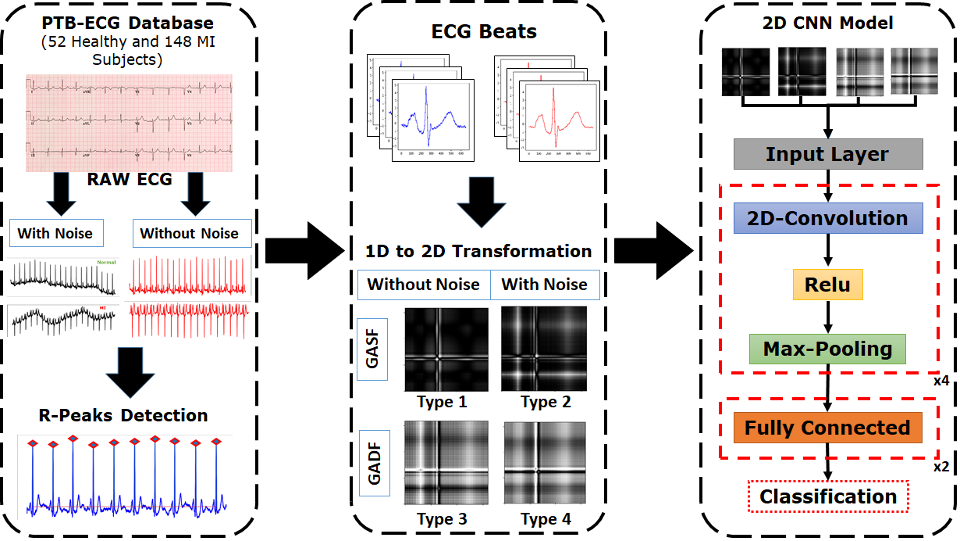
This paper presents a novel method for inferior myocardial infarction (MI) detection using lead II of electrocardiogram (ECG). We evaluate our proposed method on a public dataset, namely, Physikalisch Technische Bundesanstalt (PTB) ECG dataset from Physionet. Under our proposed method, we first clean the noisy ECG signals using db4 wavelet, followed by an R-peak detection algorithm to segment the ECG signals into beats. We then translate the ECG timeseries dataset to an equivalent dataset of gray-scale images using Gramian Angular Summation Field (GASF) and Gramian Angular Difference Field (GADF) operations. Subsequently, the gray-scale images are fed into a custom two-dimensional convolutional neural network (2D-CNN) which efficiently differentiates between a healthy subject and a subject with MI. Our proposed approach achieves an average classification accuracy of 99.68%, 99.80%, 99.82%, and 99.84% under GASF dataset with noise and baseline wander, GADF dataset with noise and baseline wander, GASF dataset with noise and baseline wander removed, and GADF dataset with noise and baseline wander removed, respectively. Most importantly, this work opens the floor for innovation in wearable devices to measure lead II ECG (e.g., by a smart watch worn on right wrist, along with a smart patch on left leg), in order to do accurate, real-time and early detection of inferior wall MI.
Motivation & Objective
- To develop an automated, deep learning-based method for detecting myocardial infarction (MI) using only lead II of the ECG, avoiding reliance on multi-lead or expert-designed features.
- To address the challenge of noise and baseline wander in real-world ECG signals by integrating wavelet denoising and robust signal preprocessing.
- To explore the feasibility of converting 1D ECG time series into 2D image representations using Gramian Angular Fields (GASF and GADF) for improved CNN-based classification.
- To demonstrate high-performance MI classification using a lightweight, single-lead ECG framework suitable for deployment in wearable health devices.
- To achieve state-of-the-art accuracy in MI detection while minimizing computational complexity and dependence on domain-specific feature engineering.
Proposed method
- ECG signals from lead II were preprocessed using the db4 wavelet transform to remove noise and baseline wander.
- R-peak detection was applied to segment the ECG signals into individual cardiac beats.
- Each ECG beat was transformed into a 2D grayscale image using the Gramian Angular Summation Field (GASF) and Gramian Angular Difference Field (GADF) methods, which encode temporal dynamics into spatial patterns.
- The resulting 2D images were fed into a custom 2D-convolutional neural network (CNN) with six hidden layers for end-to-end feature learning and classification.
- The model was trained using the Adam optimizer with a learning rate of 0.001 and categorical cross-entropy loss, with a batch size of 8 and 80-20 train-test split.
- K-fold cross-validation (K=10) was employed to ensure generalization and prevent overfitting, with performance averaged across all folds.
Experimental results
Research questions
- RQ1Can a 2D-CNN model trained on GASF- and GADF-converted 1D ECG beats from lead II achieve high accuracy in distinguishing MI from healthy cases?
- RQ2How does the presence of additive noise and baseline wander affect the classification performance of the proposed method?
- RQ3To what extent can the proposed method generalize without requiring handcrafted ECG features or multi-lead input?
- RQ4Is the GASF/GADF transformation effective in preserving discriminative temporal patterns for MI detection in a single-lead ECG setting?
- RQ5Can this framework be practically deployed in wearable devices for real-time, continuous, and early MI detection?
Key findings
- The proposed method achieved an average classification accuracy of 99.68% on ECG data with noise and baseline wander using the GASF transformation.
- The GADF-based approach achieved 99.80% accuracy under the same noisy conditions, demonstrating robustness to signal degradation.
- After removing noise and baseline wander, the GASF method reached 99.82% accuracy, while the GADF method achieved 99.84% accuracy, indicating high performance on clean data.
- Sensitivity and specificity values exceeded 99.7% and 99.2%, respectively, across all datasets, confirming strong diagnostic performance.
- The accuracy curves stabilized within 50 epochs, and loss curves showed convergence, indicating effective training and minimal overfitting.
- The method outperforms existing state-of-the-art approaches in MI detection, particularly when using only a single ECG lead, and maintains high accuracy even under adverse signal conditions.
Better researchstarts right now
From reading papers to final review, dramatically reduce your research time.
No credit card · Free plan available
This review was created by AI and reviewed by human editors.