
[Paper Review] Inferring fundamental spacetime symmetries with gravitational-wave memory: from LISA to the Einstein Telescope
This paper proposes using gravitational-wave memory effects—specifically displacement and spin memory—as probes to infer fundamental spacetime symmetries, such as those in the extended Bondi-Metzner-Sachs (BMS) group. Using simulated binary black hole mergers, it demonstrates that the Einstein Telescope (ET) can constrain the displacement memory amplitude to 2% and spin memory to 22% in one year, significantly improving parameter estimation and offering a new observational test of gravity’s infrared structure.
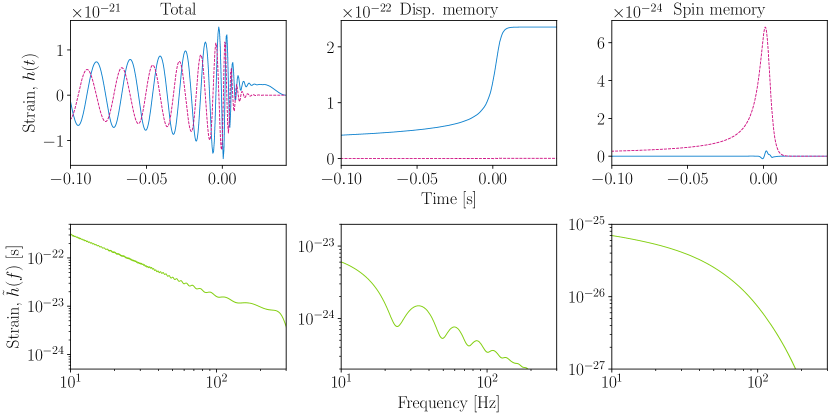
We revisit gravitational wave (GW) memory as the key to measuring spacetime symmetries, extending beyond its traditional role in GW searches. In particular, we show how these symmetries may be probed via displacement and spin memory observations, respectively. We further find that the Einstein Telescope's (ET) sensitivity enables constraining the strain amplitude of a displacement memory to 2% and that of spin memory to 22%. Finally, we point out that neglecting memory could lead to an overestimation of measurement uncertainties for parameters of binary black hole (BBH) mergers by about 10% in ET.
Motivation & Objective
- To shift the paradigm of gravitational-wave memory from a detection target to a tool for measuring fundamental spacetime symmetries.
- To assess the capability of current and future detectors—LISA and the Einstein Telescope (ET)—to constrain memory amplitudes and infer BMS symmetries.
- To quantify how neglecting memory effects may bias parameter estimation in loudest binary black hole signals.
- To evaluate the feasibility of using memory effects for testing General Relativity and probing low-energy quantum gravity structures.
Proposed method
- Simulating binary black hole (BBH) mergers under extended BMS symmetry scenarios to generate gravitational-wave strain signals with memory effects.
- Using the numerical relativity surrogate model nrhybsur3dq8 to compute waveforms including displacement and spin memory contributions.
- Applying Fisher information matrix analysis to estimate parameter uncertainties for memory amplitudes in ET and LISA-like sensitivity curves.
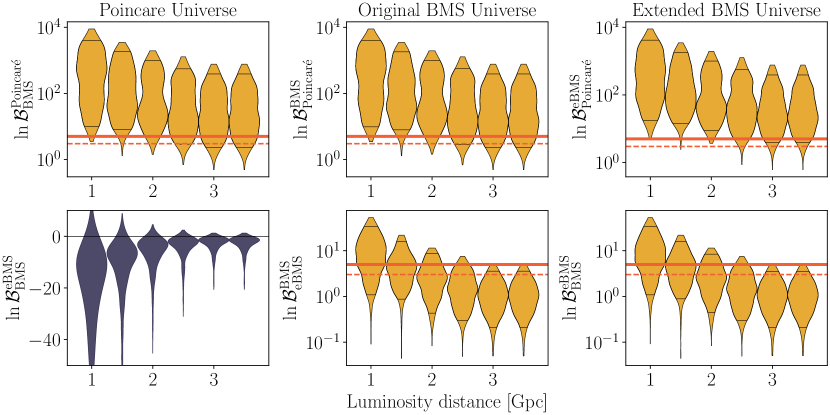
- Performing Bayesian inference simulations on a subset of the loudest 5% of BBH events to assess memory amplitude constraints.
- Evaluating the impact of memory on parameter estimation by comparing results with and without memory in waveform models.
- Assessing robustness under conservative and optimistic assumptions, including spin effects, noise, and detector sensitivity.
Experimental results
Research questions
- RQ1Can gravitational-wave memory effects be used to infer fundamental spacetime symmetries such as supertranslations and superrotations?
- RQ2To what extent can future detectors like the Einstein Telescope constrain the amplitudes of displacement and spin memory effects?
- RQ3How does neglecting memory in waveform models affect the accuracy of parameter estimation for the loudest binary black hole signals?
- RQ4What is the expected sensitivity of LISA and ET to memory amplitudes, and how does it compare to current limits?
- RQ5Can memory effects serve as a probe of the infrared structure of gravity and its connection to quantum field theory?
Key findings
- The Einstein Telescope can constrain the displacement memory amplitude to 2% at 1σ confidence level within one year of observation.
- The spin memory amplitude can be constrained to 22% at 1σ confidence level under the same conditions.
- Including memory effects reduces parameter estimation uncertainties for the loudest BBH signals by approximately 10%, indicating that neglecting memory may lead to systematic errors at the 1–2σ level.
- The study demonstrates that ET with ~10^4 optimally selected BBH events—representing ~5% of annual detections—can achieve these constraints.
- The results suggest that memory effects are not negligible in data analysis and should be incorporated into future waveform models for ET, CE, and LISA.
- Conservative assumptions (e.g., non-spinning black holes, loudest events) and optimistic ones (e.g., design sensitivity) were tested, showing robustness of the main findings.
Better researchstarts right now
From reading papers to final review, dramatically reduce your research time.
No credit card · Free plan available
This review was created by AI and reviewed by human editors.