
[Paper Review] Inflation -- who cares? Monetary Policy in Times of Low Attention
This paper proposes a model of limited attention to quantify public attention to inflation, showing that declining attention since the 1980s has made managing inflation expectations more difficult under the effective lower bound (ELB). It identifies 'inflation-attention traps'—prolonged periods of low inflation and rate cuts due to sluggish expectations—and finds that lower attention reduces welfare when the ELB binds, necessitating higher inflation targets for optimal policy.
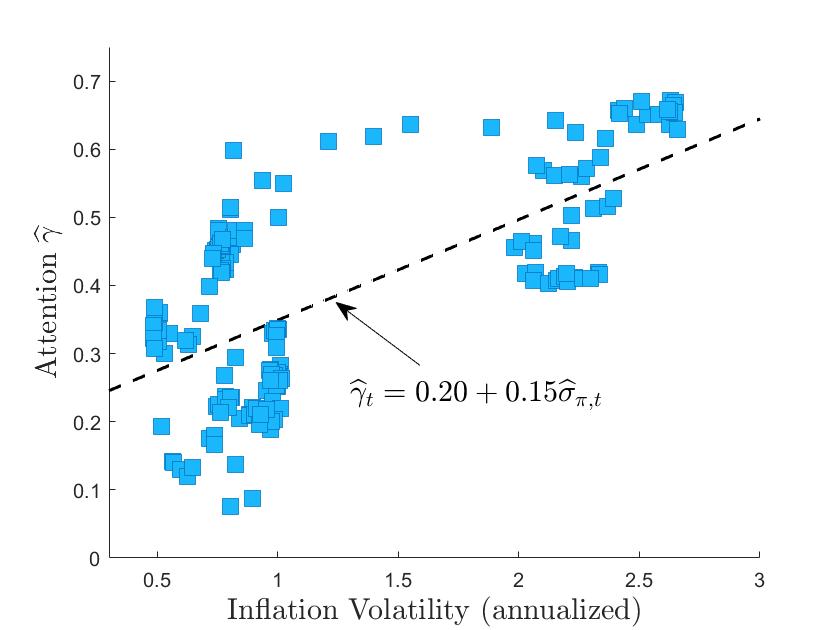
I propose an approach to quantify attention to inflation in the data and show that the decrease in the volatility and persistence of U.S. inflation after the Great Inflation period was accompanied by a decline in the public's attention to inflation. This decline in attention has important implications (positive and normative) for monetary policy as it renders managing inflation expectations more difficult and can lead to inflation-attention traps: prolonged periods of a binding lower bound and low inflation due to slowly-adjusting inflation expectations. As attention declines the optimal policy response is to increase the inflation target. Accounting for the lower bound fundamentally changes the normative implications of declining attention. While lower attention raises welfare absent the lower-bound constraint, it decreases welfare when accounting for the lower bound.
Motivation & Objective
- To develop a model that quantifies public attention to inflation using a framework of optimal attention choice under information costs.
- To analyze how declining attention affects the effectiveness of monetary policy, particularly under the binding effective lower bound (ELB) on nominal interest rates.
- To investigate the normative implications of low attention for welfare and optimal inflation targeting in New Keynesian models with limited attention and ELB constraints.
- To explain persistent low inflation during post-Great Recession recoveries as a consequence of low attention and sluggish inflation expectations.
- To assess how mean beliefs about inflation and the persistence of expectations interact with attention levels to shape optimal policy responses.
Proposed method
- Formulates a model of optimal attention choice where agents face information acquisition costs and update inflation expectations based on surprise inflation, with attention level γ governing the speed of adjustment.
- Derives a law of motion for inflation expectations: π^e_{t|t-1} + ρ_π γ(π_t - π^e_{t|t-1}), where γ captures attention and ρ_π measures persistence.
- Estimates attention levels (γ) using U.S. micro-survey data on professional and consumer inflation forecasts, linking observed expectation dynamics to attention.
- Solves for Ramsey optimal monetary policy in a New Keynesian model with an effective lower bound (ELB) and limited attention, allowing for time-varying γ.
- Compares welfare and policy outcomes under rational expectations vs. limited attention, especially under binding ELB conditions.
- Uses numerical simulations to analyze the impact of different mean beliefs (π̄) and attention levels on optimal inflation targets and welfare.
Experimental results
Research questions
- RQ1How can public attention to inflation be quantified using a model of optimal attention choice under information costs?
- RQ2How has public attention to inflation changed over time in the U.S., particularly comparing the high-inflation 1970s–80s to the low-inflation post-Great Recession period?
- RQ3What are the normative implications of declining attention for optimal monetary policy, especially when the nominal interest rate is constrained by the effective lower bound (ELB)?
- RQ4Under what conditions does low attention lead to 'inflation-attention traps'—prolonged periods of low inflation and rate cuts due to sluggish expectations?
- RQ5How does the optimal inflation target vary with attention levels and mean beliefs about inflation, and how does this affect welfare?
Key findings
- Attention to inflation has declined significantly since the 1980s, with particularly low levels observed just before the Covid-19 crisis, consistent with higher inflation volatility and persistence in earlier decades.
- Lower attention stabilizes inflation expectations in the short run, resembling more anchored expectations, which improves welfare in the absence of the ELB.
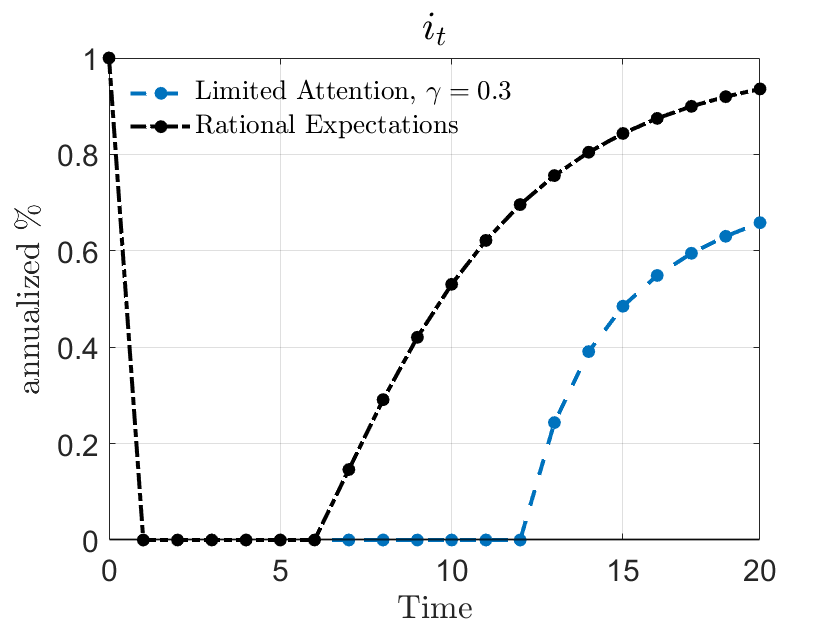
- However, under the binding ELB, lower attention reduces welfare because it makes managing inflation expectations more difficult, leading to longer spells at the effective lower bound.
- The model identifies 'inflation-attention traps'—persistent low inflation and rate cuts—where low attention causes expectations to adjust slowly, prolonging the ELB constraint.
- When attention is low, the optimal inflation target increases more strongly with mean beliefs (π̄), as the transmission of target changes to expectations weakens, requiring larger target hikes to achieve desired expectation shifts.
- The relationship between the optimal inflation target and mean beliefs is non-monotonic: at low attention, a higher π̄ leads to a higher optimal target, but the effect diminishes as attention increases.
Better researchstarts right now
From reading papers to final review, dramatically reduce your research time.
No credit card · Free plan available
This review was created by AI and reviewed by human editors.